Division I vs. Division II vs. Division III Wrestling: Choosing the Right Level
An honest breakdown of what wrestling looks like at each NCAA division — scholarship availability, competition intensity, academic priorities, and how to find your fit.
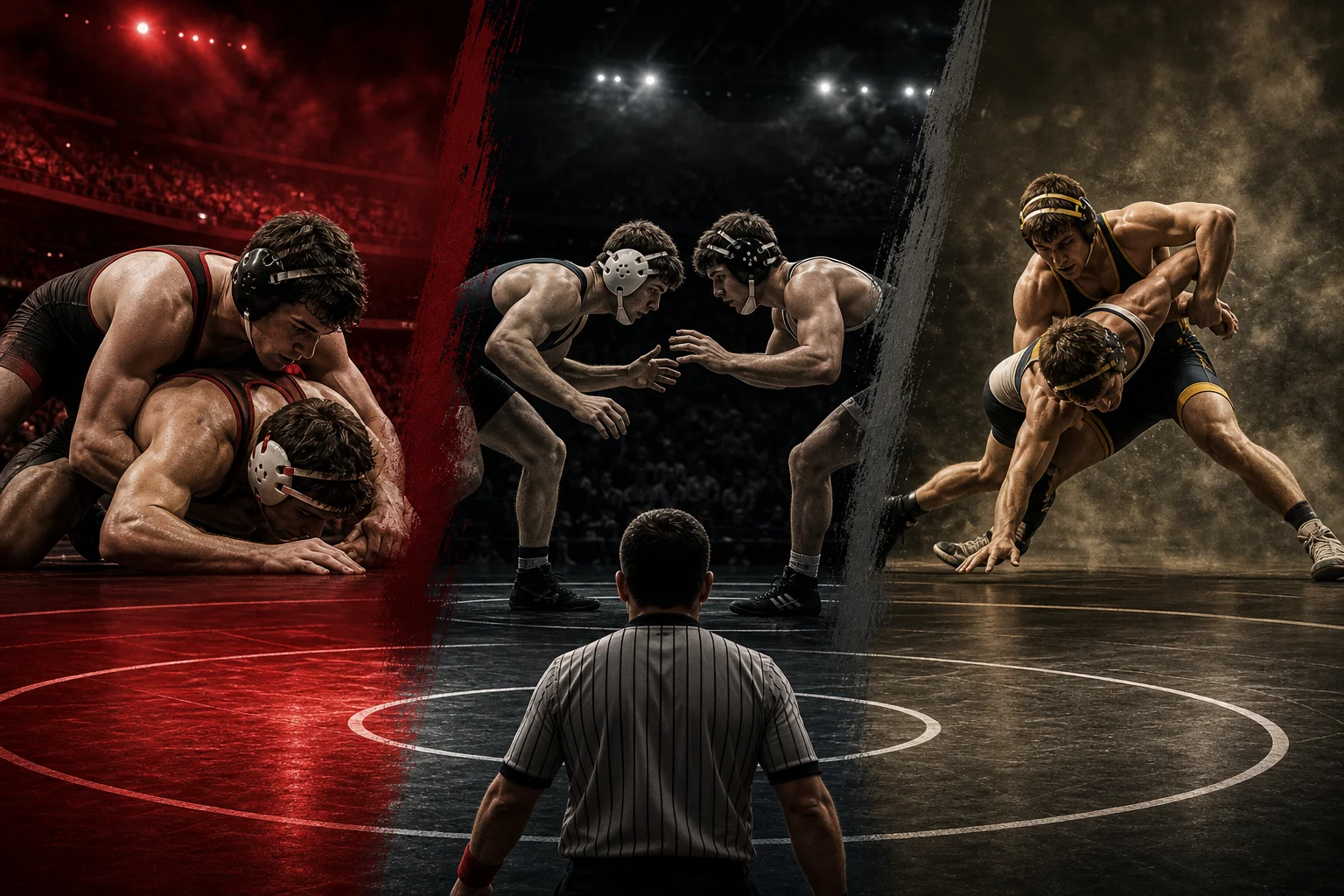
2025 NCAA Wrestling Fit: 3 Divisions, Not 1 Ladder, and What Actually Changes
Choosing between NCAA Division I, Division II, and Division III wrestling is not just a question of “how good are you?” It is a question of fit: athletic level, academic goals, finances, coaching style, campus size, travel demands, long-term health, and the kind of daily environment that helps you improve.
A high school state placer may be a developing prospect at one Division I program, a priority recruit at a strong Division II program, or a future conference champion at the right Division III school. A wrestler with national credentials may still choose Division III for academics. A late bloomer may use junior college, prep, club, or a smaller NCAA room as the best bridge to college success.
This guide breaks down what wrestling looks like across NCAA divisions, including scholarship availability, training intensity, recruiting expectations, academic priorities, and practical ways for athletes, parents, coaches, and officials to evaluate the right level.
Quick Comparison: Division I vs. Division II vs. Division III Wrestling
| Category | NCAA Division I | NCAA Division II | NCAA Division III |
|---|---|---|---|
| Athletic profile | Highest overall concentration of elite recruits, age-group national placers, state champions, and international-level prospects | High-level college wrestling with strong starters, transfers, late bloomers, and many state/national credentialed wrestlers | Serious college wrestling with a wide range of academic-first athletes, strong regional talent, and high-end competitors capable of beating wrestlers from any division |
| Scholarships | Division I scholarship rules changed significantly for 2025-26; funding varies by institution, and roster limits now matter more than old equivalency numbers | Athletic scholarships are permitted, but programs are often partially funded | No athletic scholarships, but academic, need-based, leadership, and institutional aid may be available |
| Recruiting pace | Often starts earlier for nationally known prospects; heavy evaluation at major tournaments, camps, and high school state events | Active recruiting of state placers, national qualifiers, transfers, and athletes with growth potential | Fit-driven recruiting; academics, campus match, coach relationship, and roster opportunity are major factors |
| Training demand | Year-round, high-volume, high-accountability environment with major travel and performance pressure | Serious training and competition with strong balance at many schools, though demands remain high | Competitive college workload, often with a greater academic-centered culture and less national travel than many DI programs |
| Academics | Varies widely; support services can be strong, but time demands are significant | Often flexible for athletes balancing athletics and career-focused majors | Often strong academic identity; admissions fit can be central to recruiting |
| Best fit for | Wrestlers seeking the highest visibility and toughest national schedule | Wrestlers who want serious college wrestling with scholarship possibility and strong development opportunity | Wrestlers who want competitive wrestling with no athletic-scholarship model and a major emphasis on school fit |
Start With the Right Question: “Where Will I Develop?”
Many athletes ask, “Can I wrestle Division I?” A better question is, “Where will I actually get better, compete, graduate, and stay healthy?”
The college level is full of wrestlers who were dominant in high school. Once you enter a college room, everyone has won big matches. Everyone has trained hard. Everyone has been the best athlete in a lineup before. The difference between surviving and improving often comes down to daily fit.
Ask these questions early:
- Will I be in a room where I am challenged but not buried?
- Can I see a path to making the lineup?
- Does the coaching staff develop athletes like me?
- Does the school offer my academic program?
- Can my family afford the school after real financial aid numbers are known?
- Will the weight plan be safe and sustainable?
- Do I like the campus without wrestling?
- Would I still want to attend if I got injured?
That last question matters. College wrestling is demanding. Injuries, lineup battles, coaching changes, and academic pressure happen. The right school should make sense even when wrestling is hard.
Division I Wrestling: The Highest-Visibility Environment
Division I wrestling is the most visible NCAA level. It receives the most media coverage, draws many of the sport’s most highly recruited athletes, and produces the largest share of NCAA household names. Many DI rooms include former Fargo placers, Super 32 placers, multiple-time state champions, prep national placers, international age-group athletes, and transfers with college starting experience.
That does not mean every Division I starter was a national superstar in high school. Late bloomers still exist. Under-recruited wrestlers still break through. Walk-ons still earn spots. But the margin for error is thinner.
What the Daily Life Looks Like
A Division I schedule can feel like a job layered on top of school. Athletes may have:
- Early-morning lifts or conditioning
- Skill sessions and team practice
- Film review
- Recovery work
- Academic meetings
- Travel for duals and tournaments
- Weight-management check-ins
- Offseason training expectations
Time management is not optional. A DI wrestler may miss class for travel and must communicate with professors, academic advisors, and coaches. Strong programs often provide academic support, but the athlete still has to do the work.
The room itself is usually intense. There may be multiple athletes at the same weight who were all state champions. Some programs bring in transfers, international athletes, and graduate students. If you are used to being the best wrestler in your high school room, DI can be a major adjustment.
Competition Intensity
Division I competition is physically and technically demanding. Scrambles are cleaner. Finishes are harder. Opponents punish small mistakes. Riding, mat returns, short offense, edge wrestling, and match management become major separators.
High school wrestlers should also understand that college folkstyle is not simply “harder high school.” NCAA rules differ from NFHS rules in several areas, including riding time, certain scoring procedures, out-of-bounds interpretations, video review at many college events, and match structure. Most high school wrestlers compete under NFHS rules, where scoring includes a 3-point takedown, 2-point reversal, 1-point escape, and near-fall points awarded under NFHS criteria. College wrestlers must learn the NCAA rule set quickly.
For officials and coaches, this difference matters when advising recruits. A wrestler who wins mostly on athletic takedowns may need time to adjust to college mat wrestling. A wrestler who controls ties, finishes cleanly, rides hard, and scores late in periods may translate well.
Scholarships in Division I
For many years, men’s Division I wrestling was known as an equivalency sport with a limited scholarship pool. For the 2025-26 academic year, Division I scholarship rules changed as part of broader NCAA changes following the House settlement. Instead of relying only on the old scholarship-cap model, Division I programs now operate in an environment where roster limits and institutional funding decisions are central.
The practical takeaway: do not assume every Division I wrestling program has the same scholarship money available. Some institutions may fund wrestling aggressively. Others may not. Some offers may be athletic aid, some may combine athletic and academic aid, and some roster spots may have little or no athletic money.
Families should ask direct questions:
- What type of aid is being discussed: athletic, academic, need-based, or other institutional aid?
- Is the offer guaranteed for one year or structured differently?
- What academic requirements must be maintained?
- How does the school handle injury, redshirt seasons, or roster changes?
- What is the total cost after all aid, not just the scholarship headline?
- Are roster limits affecting how many athletes the program can carry?
A “Division I offer” sounds exciting, but the real number is the net cost and the real opportunity.
Who Fits Division I Best?
Division I may be the right fit if you:
- Want the most demanding college wrestling environment available
- Have a strong history of success against national-level competition
- Are prepared to compete for a lineup spot every year
- Can handle heavy travel and training demands
- Have academic habits that can survive a compressed schedule
- Want exposure to high-level events, media, and national competition
Division I may not be the right fit if you mainly want the label but are not interested in the daily workload. The brand name does not make the experience better if you are unhappy, academically overwhelmed, or stuck in a room where you rarely compete.
Division II Wrestling: Serious College Wrestling With Development Opportunity
Division II wrestling is often misunderstood. It is not “easy college wrestling.” Many Division II starters are excellent wrestlers with impressive high school and college credentials. The best DII programs have tough rooms, experienced coaching staffs, high-level transfers, strong international athletes in some cases, and competitors who can challenge wrestlers from any division.
Division II can be an excellent home for athletes who want serious wrestling, scholarship opportunity, and a college environment that may offer a different balance than many Division I programs.
What the Daily Life Looks Like
A Division II wrestler still trains hard. Practices are structured. Weight management is monitored. Duals and tournaments matter. Athletes lift, condition, drill, study opponents, and travel.
The difference is often in institutional scale and program culture. Many DII schools are smaller than major DI universities. Athletes may have more direct contact with professors, smaller class sizes, and a tighter campus community. Some programs place a strong emphasis on career preparation, teaching, business, health sciences, criminal justice, education, or other applied majors.
That does not make DII less serious. It means the overall campus and athletic department may feel different.
Competition Intensity
The top end of Division II is extremely competitive. A DII All-American is a serious wrestler by any standard. DII national qualifiers are skilled, strong, and disciplined. The gap between divisions is not as simple as “DI beats DII, DII beats DIII.” Matchups depend on the athlete, program, weight class, style, age, and development path.
DII often includes:
- Former DI athletes who transferred for opportunity
- State champions who were under-recruited
- Late bloomers who developed physically after high school
- Wrestlers who wanted athletic aid but did not find the right DI fit
- Athletes who wanted a specific major or campus environment
A high school wrestler who is not a major national recruit can still become an excellent college wrestler at this level.
Scholarships in Division II
Division II wrestling allows athletic scholarships. Historically, DII wrestling has operated under an equivalency model with a maximum scholarship limit for fully funded programs. In practice, many DII programs are not fully funded. Coaches may split available aid among multiple athletes.
That means a DII scholarship may be a partial award combined with academic merit aid, need-based aid, grants, and other institutional support. The total package can be very competitive, but families must compare actual costs.
A coach may say, “We can give you athletic money,” but the better question is, “What will our annual out-of-pocket cost be?”
Also ask:
- Is the program fully funded?
- How many athletes usually receive athletic aid?
- Can academic scholarships stack with athletic aid?
- Does aid change if the athlete redshirts?
- What GPA is required to keep academic money?
- How does housing, meal plan cost, and travel distance affect the real budget?
DII can be a strong financial fit, especially for athletes with good grades.
Who Fits Division II Best?
Division II may be the right fit if you:
- Want high-level college wrestling without assuming DI is the only serious path
- Are looking for possible athletic scholarship aid
- Want a realistic path to early competition
- Fit well with a smaller or mid-sized campus
- Have strong development potential
- Want a balance of athletics, academics, and career preparation
DII is especially attractive for athletes who are still improving. A wrestler who did not peak in high school may find the right room, coaching attention, and competitive schedule to make a major jump.
Division III Wrestling: No Athletic Scholarships, Real Competition
Division III wrestling has one of the clearest identities in college sports: no athletic scholarships, strong academic focus, and real competition. The absence of athletic scholarships does not mean the wrestling is casual. Many DIII wrestlers train year-round, compete intensely, and pursue All-American honors with the same seriousness as athletes in other divisions.
Division III can be the right choice for wrestlers who want a strong academic institution, a good campus match, and a competitive wrestling experience without the athletic-scholarship structure.
What the Daily Life Looks Like
DIII programs vary widely. Some are nationally competitive with deep rooms and high expectations. Others are developing programs where a motivated recruit may compete early. Many DIII schools are smaller private colleges, though there is variety across the division.
The academic culture can be demanding. Labs, internships, student teaching, clinical requirements, senior projects, and study-abroad goals may be more central to the college experience. Coaches still expect commitment, but the school’s model is designed around athletics as part of the student experience rather than the driver of it.
For the right athlete, that is a major advantage.
Competition Intensity
Do not confuse “no athletic scholarships” with “low-level wrestling.” DIII national placers are excellent. Many DIII starters were state champions, state placers, prep standouts, or strong multi-sport athletes. The best DIII teams wrestle a disciplined, physical style and can challenge opponents from other divisions.
Depth varies more widely than in DI. One DIII program may have multiple high-end athletes at a weight, while another may need immediate lineup help. This creates opportunity for recruits who do their homework.
Financial Aid in Division III
DIII schools cannot award athletic scholarships. They can provide:
- Academic merit scholarships
- Need-based aid
- Grants
- Leadership awards
- Departmental scholarships
- Work-study opportunities
- Other institutional aid
For strong students, a DIII financial package can be better than a partial athletic scholarship elsewhere. Families should avoid assuming “no athletic scholarship” means “more expensive.” Sometimes it is. Sometimes it is not.
The key is to compare financial aid award letters after applications are complete. Coaches can often support the admissions process, but they cannot offer athletic money.
Ask:
- What academic scholarships might I qualify for?
- Is test-optional admission available, and how does it affect merit aid?
- What GPA is required to renew aid?
- Does the school meet a certain level of demonstrated financial need?
- Are there additional scholarships for my major?
- What is the four-year cost projection?
DIII recruiting is often a partnership among the athlete, family, coach, admissions office, and financial aid office.
Who Fits Division III Best?
Division III may be the right fit if you:
- Want competitive wrestling and a strong academic environment
- Are not focused on athletic scholarship money
- Want a campus where academics strongly drive the experience
- Prefer a smaller school or close professor relationships
- Want a realistic path to compete while pursuing a demanding major
- Value long-term career placement, graduate school, or academic identity
A wrestler choosing DIII is not “settling” if the school matches the athlete’s goals. For many athletes, it is the best decision.
Recruiting Reality: How Coaches Evaluate Level
College coaches do not recruit only by medals. They evaluate projection.
A coach may ask:
- Does this athlete score against good opponents?
- Can they get off bottom?
- Do they finish shots cleanly?
- Do they wrestle through positions or wait for stalemates?
- Are they coachable?
- Do they compete hard after giving up points?
- Is their weight plan realistic?
- Are their grades strong enough for admission and retention?
- Does the family understand cost and travel?
- Will this athlete improve in a college room?
For high school coaches, the best service you can provide is honest placement. Do not send every wrestler to the same level because it sounds good. Help athletes identify where they can contribute and grow.
Video Matters
A highlight clip can help, but college coaches need real match video. They want to see full periods, hard opponents, bottom wrestling, mat returns, and how an athlete responds when tired.
A good recruiting video package includes:
- A short highlight clip
- Full match video against strong opponents
- Current weight and projected college weight
- GPA, test scores if used, and intended major
- Tournament results with context
- Contact information for athlete and coach
Do not over-edit. Coaches know what they are looking at.
Results That Travel Well
Not all records mean the same thing. A 42-2 record in a weaker schedule may not carry as much recruiting value as a 30-12 record against national competition. Coaches look at quality wins, competitive losses, tournament placement, state classification, offseason events, and style.
Important signals include:
- State tournament placement
- Wins over other college-bound wrestlers
- National tournament performance
- Freestyle and Greco-Roman results
- Consistency over multiple seasons
- Upward development trend
- Strong academics
A wrestler does not need every box checked. Different divisions and programs recruit different profiles.
Academic Fit: The Most Underrated Recruiting Factor
Wrestling ends. The degree stays.
This is not a slogan; it is a practical recruiting standard. An athlete should never choose a school solely because of wrestling if the academic fit is poor. The major, department quality, academic support, class schedule, internship access, and graduation path matter.
Questions for Academic Fit
Ask each school:
- Do you offer my intended major?
- How often do athletes in that major have class conflicts with practice?
- Are labs, clinicals, or student teaching compatible with wrestling?
- What academic support is available for athletes?
- What is the team’s academic culture?
- How many wrestlers in my major have graduated recently?
- Are summer classes needed to stay on track?
Some majors are harder to pair with travel-heavy sports. That does not mean they are impossible. It means the athlete needs a plan.
Admissions Standards
Recruiting interest does not guarantee admission. This is especially important at academically selective DIII schools and some DI or DII institutions. A coach may support an application, but the admissions office makes the decision.
Athletes should keep grades strong from freshman year onward. Waiting until junior year to care about academics can limit options.
Good grades can also increase financial aid options, especially at DII and DIII schools.
Health, Weight, and the College Transition
Weight management is one of the most important athlete-health topics in wrestling. The right college fit includes a safe, sustainable plan for training weight, competition weight, nutrition, hydration, and recovery.
No athlete should choose a school because a coach promises success through extreme weight loss. Crash-cutting is dangerous, harms performance, and can damage long-term health. Responsible programs use certified athletic trainers, medical guidance, body composition rules, hydration standards, and gradual plans.
High School to College Weight Changes
Many high school wrestlers grow after graduation. A senior who competed at 132 may not be a healthy 133-pound college athlete. Strength training, natural maturation, meal access, and training volume can change body composition.
Ask college coaches:
- What weight do you see me at as a freshman?
- Do you expect me to redshirt and grow?
- How do you monitor hydration and body composition?
- Who supervises nutrition and medical concerns?
- What happens if the projected weight is not healthy?
- Do you have access to a dietitian?
The correct answer should center on health, performance, and long-term development.
NFHS Weight Management Reminder
Most high school wrestlers compete under NFHS rules as adopted by their state association. NFHS wrestling rules work alongside state weight-management programs, which commonly include hydration testing, body composition assessment, minimum weight certification, and limits on descent plans. State associations administer these systems, so exact procedures can vary.
For the 2025-26 season, coaches and athletes should follow their state association’s weight-management rules, weigh-in procedures, grooming requirements, and competition limits. Officials enforce the contest rules on site, but safe weight control starts long before weigh-ins.
College recruiting should never pressure a high school athlete to violate NFHS rules or state association policies.
Rules Transition: NFHS Wrestlers Entering NCAA Competition
High school wrestlers must understand that college wrestling is not officiated under NFHS rules. Most high school competition uses NFHS rules, while NCAA competition uses NCAA rules. The differences can affect strategy, conditioning, and skill development.
Key Areas That Change
| Area | NFHS High School Wrestling | NCAA College Wrestling |
|---|---|---|
| Rule authority | NFHS rules, with state association adoption and administration | NCAA rules |
| Match structure | High school period format and overtime procedures under NFHS rules | NCAA period format, overtime, and riding-time rules |
| Takedown value | NFHS uses a 3-point takedown for 2025-26 | NCAA also uses a 3-point takedown in the current college scoring system |
| Riding time | Not part of standard NFHS scoring | Major tactical factor in college wrestling |
| Video review | Generally not part of regular high school duals and tournaments, though state events may vary by policy | Used at many college events depending on competition rules and setup |
| Weight management | State-administered programs tied to NFHS participation | NCAA certification and descent rules |
| Medical oversight | High school athletic trainer/medical protocols and NFHS injury rules | NCAA medical protocols and institutional athletic medicine staff |
For coaches, the most transferable skills are position, mat awareness, hand fighting, bottom discipline, and the ability to wrestle hard through the end of periods. For officials, it is helpful to remind athletes that similar scoring words may have different applications across rule codes.
Redshirting, Transfers, and Roster Spots
College wrestling careers rarely follow a straight line. Redshirting, injuries, transfers, coaching changes, and lineup depth all affect the path.
Redshirting
A redshirt year can be valuable. It may allow a wrestler to:
- Adjust academically
- Build strength
- Improve technically
- Grow into a college weight
- Compete unattached where permitted
- Learn the team culture
But redshirting should be explained clearly. Families should ask what the plan looks like and whether the athlete is expected to compete attached, unattached, or not at all.
Transfers
Transfers are now a major part of college wrestling. A program may recruit high school athletes while also bringing in college transfers. This can change lineup projections quickly.
Ask coaches:
- How many athletes are currently at my projected weight?
- Are you recruiting transfers at this weight?
- What is your history of developing high school recruits?
- How often do athletes at this weight compete in open tournaments?
- What is the realistic timeline to challenge for the lineup?
Do not demand guarantees. Coaches cannot honestly promise future lineup spots. But they can describe the current room and development plan.
Roster Limits
Roster management has become more important, especially in Division I after 2025-26 changes. Athletes should ask whether roster limits affect walk-ons, developmental athletes, and incoming class size.
A walk-on opportunity can be excellent if the path is real. It can also be risky if the roster is tight and the athlete has no clear place in the program’s plan.
How to Build a Target School List
A good recruiting list has range. Do not build it only around dream schools.
Create three groups:
1. Reach Schools
These are programs where admission, wrestling level, cost, or lineup opportunity may be difficult but possible. Include them if there is a real reason: academic match, coach interest, tournament performance, or family connection.
2. Fit Schools
These are schools where your academics, wrestling level, finances, location, and campus preferences line up well. Most recruiting energy should go here.
3. Safety Schools
These are schools where admission and wrestling opportunity appear realistic, and the school still meets your academic and personal standards. A safety school should be a place you would attend happily.
For each school, track:
- Division
- Head coach and assistant coach contacts
- Weight class needs
- Academic major
- Admission standards
- Estimated cost
- Scholarship or aid possibility
- Distance from home
- Team culture
- Application deadlines
- Visit status
A spreadsheet is simple, but it keeps the process honest.
Campus Visits: What to Watch
A visit is not just a tour. It is a chance to observe the program.
Pay attention to:
- How coaches speak to athletes
- Whether wrestlers seem engaged or drained
- How the team warms up and drills
- Whether injured athletes are still supported
- How athletes talk about academics
- How clean and organized the facility is
- Whether the coach gives direct answers about cost and roster spots
- Whether the school feels right outside the wrestling room
Parents should listen carefully but let the athlete lead parts of the conversation. College coaches are recruiting the wrestler, not the parent.
Questions for the Coaching Staff
Ask:
- What do you like about my wrestling style?
- What areas would I need to improve first?
- Where do you project my college weight?
- What is your development plan for freshmen?
- How many athletes are at my projected weight?
- What does your competition schedule look like?
- How do you handle academic conflicts?
- What is your team culture around weight management?
- What aid may be available, and who can explain final cost?
- What are the next steps in recruiting?
The best coaches will be clear, realistic, and professional.
Advice for High School Coaches
High school coaches play a major role in helping wrestlers choose the right level. Your honesty carries weight.
Help athletes by:
- Creating accurate profiles
- Sharing full match video
- Calling college coaches when appropriate
- Being honest about work habits and coachability
- Teaching athletes how to email coaches
- Encouraging safe weight practices
- Supporting academic accountability
- Explaining differences between NFHS and NCAA wrestling
- Helping families compare fit, not just division label
Avoid telling every successful wrestler that DI is the only goal. Some athletes need that challenge. Others will thrive in DII or DIII. The right level is the one where the athlete can grow.
Advice for Officials
Officials see wrestlers in stressful moments. While officials should not act as recruiters during events, they can support the sport by understanding how rule sets and college expectations differ.
Helpful areas include:
- Enforcing NFHS rules consistently during the high school season
- Supporting safe competition and proper injury procedures
- Communicating professionally with coaches and athletes
- Understanding that college-bound wrestlers still need to wrestle within the current high school rule code
- Encouraging rules education when asked in appropriate settings
For 2025-26, high school athletes should compete under NFHS rules as adopted by their state association, not under college assumptions. A wrestler preparing for NCAA competition still must follow high school scoring, weigh-in, uniform, grooming, sportsmanship, and medical rules during the scholastic season.
Common Mistakes in Choosing a Division
Mistake 1: Chasing the Highest Division Name
A DI roster spot with no clear development plan may be less valuable than a DII or DIII program where the athlete competes, improves, and graduates.
Mistake 2: Ignoring Cost
Families should compare net cost, not sticker price or scholarship percentage. A partial athletic scholarship at one school may still cost more than an academic package at another.
Mistake 3: Choosing a Weight Instead of a School
If a projected college weight requires unsafe habits, it is the wrong plan. Performance depends on fuel, recovery, and health.
Mistake 4: Waiting Too Long
Recruiting timelines vary by division and program, but athletes should start building profiles, video, and academic plans early in high school. Serious communication often increases during junior year, but preparation starts before that.
Mistake 5: Forgetting the Major
If the school does not offer the academic path you want, think carefully. Changing majors is common, but choosing a school with limited academic options can close doors.
Mistake 6: Overvaluing Walk-On Promises
Walking on can work. Many athletes have done it successfully. But families should understand roster limits, cost, competition access, and the coach’s real level of interest.
A Practical Fit Checklist
Before committing, an athlete should be able to answer “yes” to most of these:
- I would attend this school even if wrestling became difficult.
- The school offers academic programs that interest me.
- My family understands the real cost.
- The coaching staff has explained my likely role honestly.
- I know the athletes at my weight.
- I understand the training expectations.
- I have asked about weight management and health support.
- I know how academic support works.
- I have visited campus or taken a serious virtual visit.
- I understand the division’s scholarship model.
- I can see a path to development, not just survival.
If too many answers are unclear, slow down.
Final Word: Pick the Level That Matches the Life You Want
Division I, Division II, and Division III wrestling all offer serious opportunities. The best choice depends on the athlete’s goals, ability, academic direction, finances, health, and preferred environment.
Division I provides the highest-visibility stage and the deepest concentration of elite competition. Division II offers strong college wrestling with athletic scholarship possibilities and major development potential. Division III provides competitive wrestling in an academic-centered model without athletic scholarships.
The right level is not always the highest one that shows interest. It is the place where the wrestler can train hard, compete with purpose, stay healthy, earn a degree, and become the kind of person the sport is supposed to build.
For more recruiting guidance, rules education, coaching resources, and wrestling tools built for athletes, coaches, and officials, visit the WrestleFlow hub and explore the platform that fits your role.