How NFHS Wrestling Officials Are Trained and Certified
What it takes to become an NFHS-certified wrestling official — training clinics, state certification exams, and ongoing education requirements.
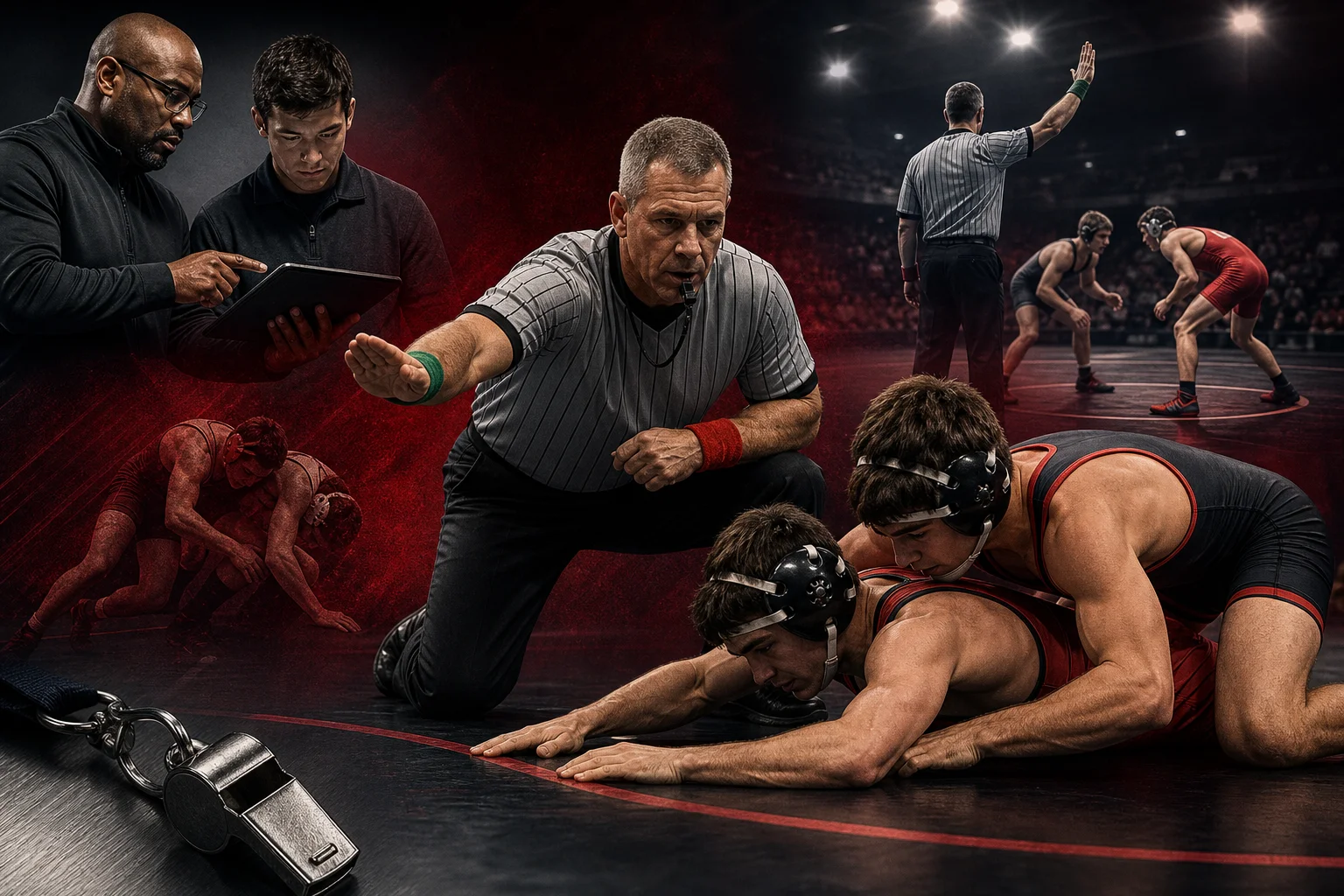
2025-26 NFHS Wrestling Officials: 7 Steps That Actually Lead to Certification — Not Just a Striped Shirt
High school wrestling depends on trained officials as much as it depends on prepared athletes and organized coaches. A referee is not simply the person who blows the whistle, raises a hand, and awards points. In NFHS wrestling, officials are responsible for applying the rules, managing safety, controlling the match environment, communicating with coaches and table workers, and protecting competitive fairness from weigh-ins through the final handshake.
Becoming an NFHS wrestling official is not a single national license handed out from one office. The National Federation of State High School Associations publishes the NFHS Wrestling Rules Book, Case Book, Officials Manual, education materials, and national guidance. Certification, registration, assignment, and renewal are handled through state high school associations and, in many areas, local officials associations or chapters.
That structure matters. A wrestling official in Iowa, New Jersey, California, Texas, or Pennsylvania may study the same NFHS rules, but the path to work a varsity dual, postseason qualifier, or state championship can differ by state. Most officials follow a common track: register with the state association, complete required training, pass a rules exam, attend clinics or rules meetings, satisfy safety education requirements, gain supervised mat experience, and renew annually.
This guide explains what coaches, athletes, athletic directors, and prospective officials should know about how NFHS wrestling officials are trained and certified for the 2025-26 season.
What “NFHS-Certified” Usually Means
The phrase “NFHS-certified wrestling official” is commonly used, but it needs a practical explanation.
NFHS does not assign every high school wrestling official in the country. Instead, NFHS provides the national rules framework and educational resources. Each state high school association determines how officials become registered, certified, licensed, classified, or approved to work interscholastic contests in that state.
Depending on the state, the credential may be called:
- Registered official
- Certified official
- Licensed official
- Approved official
- Probationary official
- Level 1, Level 2, or master official
- Tournament-qualified official
The key point is this: a high school wrestling official normally must be approved by the state association that governs that school’s competition. The official may also be required to join a local officials association, attend local interpretation meetings, and meet assignment criteria set by assigners or conference commissioners.
NFHS materials sit at the center of that training. Most state exams, clinics, and rules meetings are built around the current NFHS Wrestling Rules Book, Case Book, and Officials Manual. State associations may also publish modifications, points of emphasis, tournament procedures, and sportsmanship policies that officials must know.
The 7-Step Certification Path for New Wrestling Officials
A new official’s path varies by state, but the process usually follows these seven steps.
| Step | Requirement | What It Usually Includes | Why It Matters |
|---|---|---|---|
| 1 | State registration | Application, fees, personal information, sport selection | Places the official under state association authority |
| 2 | Eligibility screening | Background check, age requirement, conduct policies | Protects athletes and schools |
| 3 | Rules study | NFHS Rules Book, Case Book, Officials Manual, state materials | Builds the foundation for accurate calls |
| 4 | Training clinic | State or local clinic, mechanics instruction, rule interpretations | Turns rule knowledge into match management |
| 5 | Rules exam | Online or proctored test, often open-book or timed depending on state | Confirms minimum rules competency |
| 6 | Mentored experience | Scrimmages, youth events, JV matches, evaluations | Develops judgment, positioning, and communication |
| 7 | Annual renewal | Rules meetings, education courses, exam renewal, dues | Keeps officials current every season |
Some states allow a new official to work sub-varsity matches before passing every higher-level requirement. Others require full registration and testing before any high school assignment. Postseason work usually requires more experience, higher test scores, evaluations, and attendance at advanced clinics.
Step 1: Registering With the State Association
The first formal step is registration with the state high school association. A prospective official usually creates an online account, selects wrestling as a sport, pays a registration fee, and agrees to follow state association rules and codes of conduct.
Registration normally covers one school year or one sports season. Some states bundle registration with NFHS membership or NFHS exam access. Others use separate systems.
A new official should expect to provide:
- Legal name and contact information
- Date of birth
- Emergency contact information
- Prior officiating experience
- School affiliation or conflict-of-interest disclosures
- Consent for background screening, if required
- Agreement to follow state association bylaws and sportsmanship policies
Many states have minimum age rules. Some allow high school students or recent graduates to officiate middle school or youth matches under restrictions. Varsity officials are usually adults, and postseason officials typically need several years of experience.
Conflict-of-interest rules are important. An official may be restricted from working matches involving a school where they work, coach, have immediate family participating, recently attended, or have another close connection. Coaches and athletic directors should understand that officials are expected to avoid both actual conflicts and situations that could reasonably appear unfair.
Step 2: Background Checks, Conduct Standards, and Professional Expectations
Because high school officials work directly with minors, many state associations require a background check before approval. The details vary, but the purpose is consistent: athlete safety and school trust.
Officials may also be required to complete conduct training or agree to policies covering:
- Abuse prevention
- Harassment and discrimination
- Hazing prevention
- Social media conduct
- Sports wagering restrictions
- Professional boundaries with students
- Ejection and incident reporting
- Use of tobacco, alcohol, or drugs around contests
A wrestling official’s professional standard begins before the first whistle. Officials are expected to arrive on time, dress appropriately, communicate calmly, avoid favoritism, and maintain control without becoming the center of attention.
That standard matters in wrestling because the official is close to the athletes and coaches throughout the contest. The referee may be inches from a scramble, listening to breathing, watching potentially dangerous pressure, and deciding when action has crossed from legal wrestling into a safety issue.
Step 3: Studying the NFHS Wrestling Rules
The NFHS Wrestling Rules Book is the core text. A new official should not treat it as a quick exam guide. The rules govern weight classes, weigh-ins, uniforms, equipment, match structure, scoring, penalties, injury time, blood time, skin conditions, conduct, and dual meet or tournament administration.
For the 2025-26 season, officials should study the current NFHS publications for that year, not old summaries or college rule references. NCAA, freestyle, Greco-Roman, and youth club rules can differ from NFHS rules in scoring, out-of-bounds action, video review, passivity/stalling concepts, and match administration.
Core NFHS Rule Areas Every Official Must Know
A new official’s study plan should cover at least these areas:
-
Match structure and timing
Officials must know period lengths, overtime procedures, choice of position, rest periods, and when the clock should start or stop. -
Scoring
NFHS scoring includes takedowns, escapes, reversals, near-fall, penalties, and match-ending situations such as falls, technical falls, disqualifications, forfeits, defaults, and injury defaults. Officials must apply current NFHS values and criteria, including the modern high school scoring structure. -
Control and reaction time
Wrestling judgment often turns on whether control has been established. Officials must understand when a takedown, reversal, or escape has truly occurred rather than guessing based on motion alone. -
Near-fall criteria
Officials must be trained to recognize when the defensive wrestler’s back is exposed within NFHS criteria and how long near-fall criteria are held. -
Illegal holds and potentially dangerous situations
Safety judgment is central. Officials must identify illegal holds, unnecessary roughness, pressure against joints, dangerous head and neck positions, and situations where action should be stopped before injury occurs. -
Stalling, fleeing, and action requirements
Officials must distinguish aggressive wrestling, counter-wrestling, legal defense, stalling, and fleeing the mat. -
Technical violations
These include locked hands in certain positions, grasping clothing, incorrect starting position, false starts, interlocking or overlapping hands in referee’s position, and other rule-specific violations. -
Conduct rules
Unsportsmanlike conduct, flagrant misconduct, coach misconduct, team personnel behavior, and bench control require clear rule knowledge and calm enforcement. -
Injury, blood, and recovery time
Officials must know how to administer injury time, blood time, recovery time after illegal holds or unnecessary roughness, and default procedures. -
Weight management and weigh-ins
Officials may be involved in verifying legal weigh-in procedures, weight classes, grooming, uniform compliance, and medical documentation.
The Rules Book Is Not Enough by Itself
The NFHS Case Book is just as important for developing judgment. It applies rules to realistic situations: scrambles, boundary calls, penalty sequences, injury timing, coach conferences, and scoring corrections.
The Officials Manual teaches mechanics: position, signals, communication, match control, table procedure, and tournament responsibilities. A rules expert who stands in the wrong place will miss calls. A physically fit official with good mechanics but weak rules knowledge will also struggle.
Good officials study all three: rules, cases, and mechanics.
Step 4: Training Clinics and Rules Meetings
Most state associations require wrestling officials to attend a state rules meeting, local association clinic, or online interpretation session. These meetings are not optional reminders. They are often part of the official’s eligibility for assignments.
A typical wrestling officials clinic covers:
- New NFHS rule changes for the current season
- State association adaptations or administrative procedures
- Points of emphasis
- Weigh-in procedures
- Dual meet administration
- Tournament advancement and bracket procedures
- Uniform and equipment requirements
- Injury, blood, and skin condition protocols
- Stalling and fleeing interpretations
- Referee positioning and mat mechanics
- Assistant referee mechanics, where used
- Table communication and score correction
- Coach conference procedure
- Ejection or disqualification reporting
Clinics may be in person, online, or hybrid. New officials benefit most from live training that includes mat demonstrations. Wrestling is a movement sport, and many calls cannot be learned from text alone. Seeing a near-fall count, boundary situation, locked-hands violation, or potentially dangerous hold at full speed helps officials connect written rules to real matches.
Local Associations Play a Major Role
In many states, local wrestling officials associations provide weekly meetings during the season. These groups are where new officials learn from veterans, review video, ask questions, and receive assignments.
Local associations may also run:
- New-official classes
- Mechanics nights
- Scrimmage officiating opportunities
- Mentorship programs
- Rules quizzes
- Tournament preparation sessions
- Evaluations for promotion
A strong local association helps prevent the “learn alone” problem. New officials need feedback. Without it, they may repeat the same positioning errors, signaling mistakes, or penalty sequence problems all season.
Step 5: Passing the State Certification Exam
Most states require a wrestling rules exam before an official is fully certified or eligible for varsity assignments. The exam is often based on NFHS rules and may be administered through the state association, NFHS platform, or another testing provider.
Exam formats differ. Some are open-book. Some are closed-book. Some have time limits. Some allow multiple attempts. Some states require a minimum score for registration and a higher score for postseason eligibility.
Common exam topics include:
- Scoring values and criteria
- Starting positions and restarts
- Out-of-bounds and boundary rules
- Near-fall situations
- Illegal holds
- Technical violations
- Stalling and fleeing
- Injury, blood, and recovery time
- Weigh-ins and weight classes
- Uniform and equipment rules
- Misconduct and penalty progression
- Dual meet scoring
- Tournament advancement and defaults
- Correctable errors and coach conferences
How Officials Should Prepare for the Exam
The best exam preparation is active study, not memorization alone.
Prospective officials should:
- Read the current NFHS Wrestling Rules Book from front to back.
- Study the Case Book after each rule section.
- Make flashcards for scoring, timing, and penalty sequences.
- Attend a clinic before taking the exam if possible.
- Work through practice questions with a mentor.
- Review state-specific modifications.
- Learn definitions exactly as written.
- Practice applying rules to video clips or live scrimmages.
Definitions matter. Words such as control, neutral, supporting points, near-fall criteria, unnecessary roughness, flagrant misconduct, default, and disqualification have specific rule meanings. A casual understanding can lead to incorrect calls.
The exam is a checkpoint, not the finish line. Passing proves a minimum level of rules knowledge. It does not mean the official is ready for a heated rivalry dual, a packed gym, or the final round of a qualifying tournament without continued development.
Step 6: Learning Mechanics, Positioning, and Match Control
A wrestling official must see the right angle at the right time. Mechanics training teaches where to stand, how to move, when to drop to the mat, when to circle, how to signal, and how to communicate with the table.
Referee Positioning
Good positioning helps the official see:
- Control
- Locked hands
- Near-fall exposure
- Illegal pressure
- Hands to the face or eyes
- Boundary action
- Potentially dangerous holds
- Stalling patterns
- Reactions after the whistle
New officials often stand too high, too far away, or directly behind the action. Veteran officials learn to move with purpose. They stay close enough to see details but far enough to avoid interfering with the wrestlers.
Positioning changes by situation. Neutral wrestling requires an angle that sees both athletes’ feet, hips, and hands. Referee’s position requires attention to the offensive wrestler’s hands, the defensive wrestler’s first move, and legal starting position. Near-fall situations require the official to get low, see the scapulae or back exposure criteria, count visibly, and stay aware of safety.
Signals and Communication
NFHS officials use approved signals to communicate scoring, warnings, penalties, starting and stopping action, near-fall counts, and match results. Signals must be clear to the table, coaches, athletes, and spectators.
Poor signaling creates confusion. If a referee awards points quietly or late, the table may record the wrong score. If the official does not clearly identify the offending wrestler on a penalty, coaches may challenge the administration rather than the judgment.
Communication must be firm but professional. Officials should answer proper questions during appropriate times, but they should not debate every judgment call. Coaches are entitled to a rules-based conference when they believe a rule has been misapplied, not an unlimited argument over judgment.
Whistle Discipline
The whistle controls wrestling. An early whistle can erase a scoring action. A late whistle can expose an athlete to unnecessary risk. Training teaches officials to blow the whistle with confidence when action stops, a violation occurs, a dangerous situation develops, time expires, or a fall is earned.
Whistle discipline is especially important in scrambles. Officials must avoid guessing. They should let legal wrestling continue long enough to see control, while stopping action immediately when safety requires it.
Step 7: Mentoring, Evaluation, and Advancement
No official becomes skilled through classroom instruction alone. Wrestling officials improve through live matches, feedback, and repetition.
New officials commonly begin with:
- Preseason scrimmages
- Middle school matches
- Freshman or junior varsity duals
- Youth tournaments
- Assistant referee roles, where used
- Table-side support at larger events
Mentors help new officials with match flow, body language, difficult coaches, and uncommon situations. They can explain why a call was technically right but mechanically weak, or why a no-call was better than a rushed penalty.
Evaluation Criteria
Officials are often evaluated formally or informally before advancing to higher-level assignments. Evaluators may consider:
- Rules knowledge
- Positioning
- Signals
- Confidence and composure
- Hustle and conditioning
- Consistency
- Safety awareness
- Stalling recognition
- Boundary judgment
- Communication with coaches
- Table administration
- Professional appearance
- Report filing
- Ability to handle pressure
Postseason selection is usually based on experience, availability, ratings, test scores, clinic attendance, evaluations, and recommendations. Coaches’ ratings may also be part of the process in some states, although state associations typically control final selection procedures.
Annual Renewal and Ongoing Education
Certification is not permanent. Wrestling rules, interpretations, and points of emphasis can change from year to year. Officials must renew registration and education requirements annually.
A returning official may need to:
- Pay annual state registration dues
- Renew local association membership
- Pass the current season rules exam
- Attend a mandatory rules meeting
- Complete NFHS Learn courses required by the state
- Review new rules and interpretations
- Complete a background check renewal
- Submit availability to assigners
- Maintain good standing with reporting and conduct rules
Common Required Education Courses
State requirements vary, but officials may be required to complete education related to athlete safety and school sport conduct. These courses may include:
- Concussion recognition and response
- Sudden cardiac arrest awareness
- Heat illness prevention
- Sportsmanship
- Hazing prevention
- Abuse prevention
- Implicit bias or respectful conduct training
- Emergency action plan awareness
Wrestling officials should take health and safety education seriously. They are not physicians, athletic trainers, or emergency medical providers unless separately qualified, but they are often the first adult to stop action when something looks wrong.
Athlete Health Responsibilities in Wrestling Officiating
Wrestling carries health concerns that officials must respect: skin infections, concussions, joint injuries, dehydration, bleeding, and unsafe weight management practices. Officials do not coach athletes on nutrition or medical treatment, but they enforce rules that support safety.
Skin Conditions
NFHS wrestling has procedures for communicable skin conditions. Officials must understand when documentation is required and how to handle questionable skin issues at weigh-ins or before competition.
Coaches should not expect officials to “look the other way” on skin concerns. Skin rules protect both wrestlers. If a condition may be contagious and proper medical clearance is not available as required, participation may be restricted under applicable rules and state procedures.
Blood Time and Injury Time
Officials administer blood time and injury time according to NFHS rules. They must track time accurately, communicate with the table, and apply default rules when time limits are exceeded.
Blood must be addressed properly before wrestling continues. Uniforms, mats, and athletes may need cleaning or replacement procedures under school and state protocols. The goal is safe continuation, not rushing the match.
Concussion Awareness
If an athlete shows signs consistent with a concussion, officials must follow state association procedures and applicable law. Typical signs may include confusion, balance problems, slow response, loss of consciousness, headache complaints, or unusual behavior after contact.
An official should not clear an athlete medically. Return-to-play decisions belong to qualified medical personnel under state law and association policy.
Weight Management Without Unsafe Shortcuts
High school wrestling uses weight management rules to reduce unsafe weight-cutting practices. Officials should support legal weigh-in procedures and state weight certification systems. Coaches and athletes should avoid dehydration, crash dieting, sauna suits, excessive exercise for rapid weight loss, or any method that risks health for a number on the scale.
A responsible wrestling culture treats weight management as a long-term plan involving hydration, nutrition, training, family communication, and medical guidance when needed.
The Certification Path Is Different for Coaches Who Become Officials
Former wrestlers and coaches often make excellent officials because they understand mat situations, technique, and match pressure. But they also face a transition.
A coach thinks in terms of strategy: ride, escape, attack, defend, protect a lead. An official must think in terms of rules, criteria, safety, and neutrality. Knowing wrestling technique helps, but it does not replace rules study.
Former coaches must also adjust communication habits. An official cannot coach from the mat, react emotionally to tactics, or favor a preferred style. The best former coaches become strong officials when they combine wrestling experience with disciplined neutrality.
What Coaches Should Know About Certified Officials
Coaches do not need to know every step of the certification process, but understanding it improves communication.
A certified official has likely:
- Registered with the state association
- Passed a wrestling rules exam
- Attended rules training
- Studied current NFHS materials
- Completed required safety education
- Been assigned through approved channels
- Agreed to conduct standards
- Participated in ongoing education
That does not mean every call will be perfect. Wrestling is fast. Judgment calls are difficult. Officials can miss angles, and coaches can see action differently from the corner. But coaches should understand that certified officials are trained to apply written criteria, not personal preference.
Productive Coach-Official Communication
Coaches should:
- Ask rules questions at appropriate times.
- Use the proper coach conference process.
- Know the difference between a rule misapplication and a judgment disagreement.
- Keep athletes away from arguments.
- Speak professionally.
- Avoid public accusations about bias or competence.
- Teach wrestlers to continue wrestling until the whistle.
Officials should:
- Listen to legitimate rules questions.
- Explain rule administration when appropriate.
- Avoid sarcasm or personal comments.
- Stay calm during tense moments.
- Correct correctable errors under the rules.
- Report misconduct when required.
A professional match environment protects athletes and improves competition.
What Athletes Should Know About Officials
Athletes should understand that officials are trained to reward legal wrestling and stop unsafe action. A wrestler can help themselves by competing through positions, responding to the whistle, staying in legal holds, and avoiding emotional reactions after calls.
Athletes should know:
- The referee may stop action even if neither wrestler wants a stoppage when safety is at risk.
- Wrestling after the whistle can create penalties or misconduct.
- Talking back, gestures, or taunting can cost team points.
- Legal technique matters as much as effort.
- The official’s angle may differ from the athlete’s feel in a scramble.
- The safest response to confusion is to keep wrestling until stopped.
Wrestlers who learn the rules gain a competitive advantage. They understand boundary wrestling, near-fall danger, stalling pressure, injury time, and penalty consequences. Rules knowledge does not replace technique, but it helps athletes avoid giving away points.
What Athletic Directors and Assigners Look For
Athletic directors and assigners want officials who are reliable, prepared, and professional. A new official who wants more assignments should focus on more than passing the exam.
Assigners value officials who:
- Accept appropriate matches and honor commitments
- Arrive early
- Communicate availability clearly
- Wear the proper uniform
- Handle paperwork and reports promptly
- Work well with partners and table crews
- Improve after feedback
- Maintain conditioning
- Avoid unnecessary conflict
- Know state procedures
- Can manage both duals and tournaments
Reliability is a major part of advancement. A brilliant rules mind who cancels late or arrives unprepared creates problems for schools. A steady official who studies, shows up, communicates, and improves will earn trust over time.
Uniform, Equipment, and Professional Presentation
Officials are usually required to wear the state-approved wrestling officials uniform. Requirements vary, but may include:
- Official shirt
- Black pants
- Black belt, if applicable
- Black shoes
- Black socks
- Whistle and lanyard
- Red and green wristbands or scoring indicators
- Flip disc or choice indicator
- Penalty recording tools
- Timing awareness tools
- State association patch or insignia, where required
Officials should carry backup equipment. A broken whistle or missing wristband should not delay a dual meet. Professional appearance also includes grooming, posture, and confidence. Coaches and athletes notice whether an official looks prepared.
Assistant Referees and Multi-Official Systems
Some tournaments and high-level matches use an assistant referee or second official system under approved mechanics. The lead referee remains responsible for the match, but the assistant can help with out-of-position views, locked hands, boundary action, timing issues, and consultation on scoring or penalties.
Training for assistant referee work is specific. The assistant should not mirror the lead official or create confusion with conflicting signals. Good crews communicate before the match about responsibilities, eye contact, table procedures, and conference mechanics.
Officials selected for major tournaments often need experience working with partners. A strong tournament official must be able to lead, assist, and accept correction when another official has a better view.
Common Challenges for New Wrestling Officials
New officials often struggle with the same areas.
Calling Control Too Quickly
Scrambles are exciting, but control requires criteria. Awarding a takedown or reversal before control is established can change a match unfairly. New officials should learn patience without becoming passive.
Missing Locked Hands
Locked hands can happen quickly in referee’s position and mat wrestling. Good positioning and focus on the offensive wrestler’s hands are essential.
Inconsistent Stalling Calls
Stalling is one of the hardest areas for new officials. It requires recognizing action, inaction, blocking, backing away, parallel riding, failure to improve, edge behavior, and match context under NFHS criteria. Consistency matters more than popularity.
Poor Table Communication
Many problems come from unclear communication with the scorer and timer. Officials must ensure the correct wrestler, points, warnings, penalties, choice, and time are recorded.
Letting Coaches Control the Match
Coaches may be passionate, but the official controls the contest. New officials need calm confidence. They should answer proper questions, enforce conduct rules, and avoid being drawn into running debate.
Not Stopping Dangerous Action Soon Enough
Officials must protect athletes. Letting a dangerous hold continue because “they might wrestle through it” is not good officiating. When pressure becomes potentially dangerous or illegal, stop it.
How to Build a Strong First Season as an Official
A new official should treat the first season as an apprenticeship. The goal is not to work the biggest match immediately. The goal is to become dependable, accurate, and safe.
A strong first-season plan includes:
- Register early before deadlines.
- Buy the current NFHS rules materials.
- Attend every available clinic.
- Ask for a mentor.
- Work scrimmages before live events.
- Review video when possible.
- Keep a notebook of unusual situations.
- Study penalty sequences weekly.
- Watch experienced officials in person.
- Accept feedback without defensiveness.
- Stay physically ready for long tournaments.
- Learn the state reporting system.
- Communicate professionally with assigners.
- Keep athlete safety at the center of every call.
A new official who does these things will improve quickly.
2025-26 Season Readiness Checklist
Before working the 2025-26 season, an official should confirm each item with the state association or local chapter.
| Readiness Item | Completed? | Notes |
|---|---|---|
| State registration approved | ☐ | Confirm sport and classification |
| Background check complete | ☐ | If required by state |
| Current NFHS Wrestling Rules Book reviewed | ☐ | Use 2025-26 materials |
| Case Book reviewed | ☐ | Focus on match situations |
| Officials Manual reviewed | ☐ | Mechanics and signals |
| State rules meeting attended | ☐ | Mandatory in many states |
| Local clinic attended | ☐ | Strongly recommended |
| Rules exam passed | ☐ | Check minimum score |
| Safety courses completed | ☐ | Concussion and other required topics |
| Uniform and equipment ready | ☐ | Include backups |
| Assigning profile updated | ☐ | Availability, travel limits |
| Mentor identified | ☐ | Especially for first- and second-year officials |
| Reporting procedures understood | ☐ | Ejections, injuries, misconduct |
| Weight management and weigh-in procedures reviewed | ☐ | Follow state policy |
Why Certification Matters to the Sport
Wrestling is intense, emotional, and physically demanding. A trained official helps keep that intensity within fair and safe boundaries.
Certification matters because it creates standards. It tells schools that the official has studied the current rules, passed required exams, completed required training, and agreed to state association oversight. It gives coaches a process for rules questions and reports. It gives athletes a better chance to compete in matches decided by legal wrestling rather than confusion.
The best officials keep learning. They study new rules, review difficult calls, ask for feedback, and stay connected to the wrestling community. They understand that every whistle affects athletes who have trained for months, coaches who have prepared teams, and families who care deeply about the outcome.
Becoming a high school wrestling official is a serious commitment, but it is also one of the most meaningful ways to serve the sport. For former wrestlers, coaches, parents, and fans who want to stay involved, officiating offers a direct role in protecting competition and teaching respect for the rules.
If you are preparing for the 2025-26 season, make rules study part of your weekly routine. Coaches and athletes can also benefit from learning how officials are trained and what calls are based on. For rule references, officiating situations, scoring questions, and match-management help, use WrestleFlow’s WrestleRef tool to sharpen your understanding of NFHS wrestling rules and officiating.