Live Wrestling in Practice: Designing Controlled Scrimmage Segments
How to structure live wrestling segments in practice for maximum development — situational wrestling, go from position, and restricted-rules live.
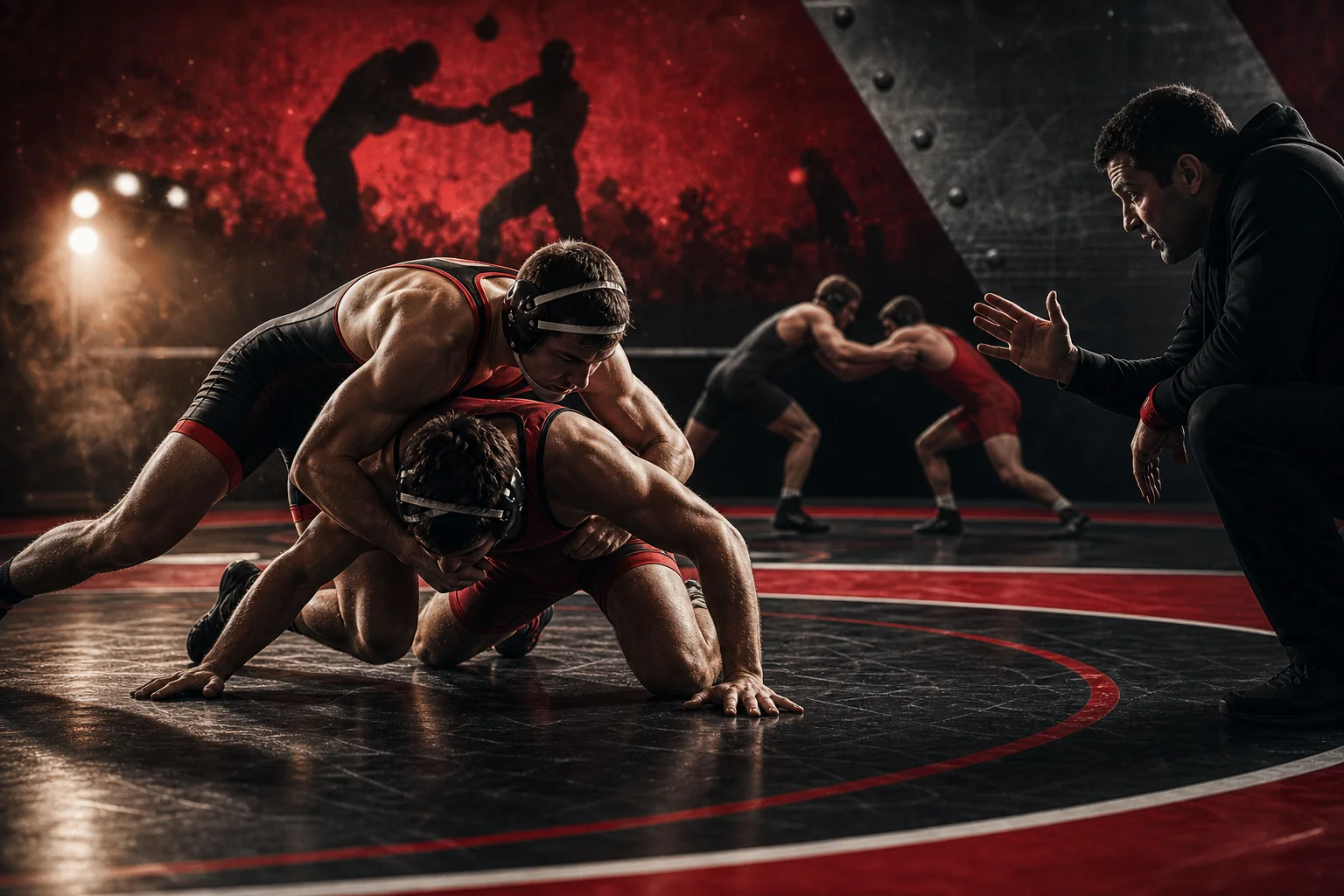
9 Tested Live Wrestling Segments for 2025-26 That Actually Fit NFHS Scoring Without Chaos
Live wrestling is where practice pressure becomes match readiness. It is also where sloppy practice design can waste minutes, reward bad habits, and create avoidable safety issues. The best live work is not always “go hard for six minutes.” Wrestlers need full live wrestling, but they also need controlled scrimmage segments that start from meaningful positions, use clear scoring goals, and stop before fatigue turns skill into survival.
For coaches, athletes, and officials, the key question is simple: What is the purpose of this live segment? If the answer is “get tough,” the design is too vague. If the answer is “finish single legs on the edge,” “escape within 20 seconds,” “ride without locking hands,” or “score first from neutral under current NFHS rules,” the segment can be coached, measured, and improved.
This article lays out a practical system for designing live wrestling in practice: situational wrestling, go-from-position work, and restricted-rules live. It also keeps the 2025-26 NFHS framework in view, including current scoring values and safety expectations.
What “Controlled Live” Means
Controlled live wrestling is competitive wrestling with limits. The athletes are trying to score, defend, and win the exchange, but the coach controls one or more of the following:
- Starting position
- Time
- Score
- Rules emphasis
- Allowed attacks or finishes
- Boundary location
- Partner matchups
- Intensity
- Restart criteria
- Coaching feedback windows
This is different from drilling, where the outcome is mostly known. It is also different from open live wrestling, where wrestlers start neutral and wrestle full periods with normal rules. Controlled live sits between those two: enough resistance to expose real habits, enough structure to target a specific skill.
A good controlled segment should answer five questions before the whistle:
- Where do we start?
- How long do we wrestle?
- What counts as success?
- What rules are in effect?
- When do we restart?
If athletes cannot answer those questions, the segment is not controlled enough.
NFHS 2025-26 Scoring Context for Live Practice
Practice segments do not need to be formal matches, but they should teach habits that transfer to NFHS competition. For the 2025-26 high school season, coaches should build live work around the current NFHS scoring structure:
| Action | NFHS Points |
|---|---|
| Takedown | 3 |
| Escape | 1 |
| Reversal | 2 |
| Near fall | 2, 3, or 4 based on criteria met and time held |
| Penalty points | Awarded under NFHS penalty rules |
| Technical fall | 15-point advantage |
The move to a 3-point takedown changes the way coaches should frame live situations. A takedown is now a larger scoring event relative to an escape or reversal. That does not mean top and bottom wrestling matter less; it means neutral exchanges, finishes, and defense deserve careful live practice because one clean takedown can swing a period.
Near-fall work also needs clear coaching. Under current NFHS scoring, near fall may be worth 2, 3, or 4 points depending on how long the near-fall criteria are met. When athletes practice turns, officials and coaches should use consistent counts and consistent language. If a coach calls “four-count” in practice but does not mirror NFHS timing expectations, athletes can develop a false sense of scoring.
Practice Rules Cannot Override Safety Rules
Restricted-rules live can limit what athletes are allowed to do, but it cannot permit unsafe or illegal wrestling. A coach may say “single legs only,” “no throws,” or “escape only from bottom.” A coach should not allow illegal holds, dangerous pressure, slams, uncontrolled returns, or continued wrestling when an athlete may be injured.
NFHS rules require officials to stop potentially dangerous situations before they become injuries. Coaches should use the same standard in the room. Examples include:
- Uncontrolled twisting of the knee, shoulder, neck, or spine
- Head, neck, or throat pressure that creates danger
- Lifts or returns that cannot be brought safely to the mat
- Holds that become illegal or potentially dangerous as body position changes
- Any action where the defensive wrestler cannot protect themselves
A practice room should also treat blood, skin concerns, concussion signs, and injury complaints seriously. Live wrestling is not a place to “test” whether an athlete is hurt. Stop, assess, and follow school, state association, medical, and NFHS procedures.
Why Full Live Alone Is Not Enough
Full live wrestling has value. Athletes need to manage nerves, fatigue, pace, mat awareness, scoring decisions, and late-period pressure. But if every hard practice ends with repeated full-go matches, several problems appear.
First, athletes spend too much time in positions they already prefer. A strong neutral wrestler may keep scoring takedowns and never improve bottom escapes. A good rider may avoid neutral danger. A young wrestler may spend every live period defending without ever getting enough meaningful offensive reps.
Second, full live makes it harder to isolate habits. If a wrestler gives up a takedown, fails to clear hands on bottom, gets turned, and loses the period, which skill needs attention first? Controlled live narrows the lens.
Third, full live can reward athletic scrambling over technical decision-making. Scrambling is part of wrestling, but practice should also teach when to build height, when to cut across, when to circle in, when to concede an escape, and when to stay patient.
Fourth, fatigue can reduce learning. Hard conditioning matters, but live wrestling should not become a punishment block where technique disappears. If the goal is development, the coach must balance intensity with usable feedback.
The 3 Main Types of Controlled Scrimmage Segments
Controlled live usually falls into three families: situational wrestling, go-from-position wrestling, and restricted-rules live. The categories overlap, but separating them helps coaches plan better practices.
| Segment Type | Main Purpose | Example | Best Use |
|---|---|---|---|
| Situational wrestling | Train match decisions in a defined scenario | Down by 1 with 30 seconds left, bottom position | Late-match awareness, scoring choices |
| Go from position | Build skill under resistance from a specific position | Start in single-leg finish with head inside | Finishing, defending, chain wrestling |
| Restricted-rules live | Force a technical theme by limiting options | Neutral live, only re-attacks score | Habit correction, tactical emphasis |
A complete weekly plan should include all three, plus some full live. The mix depends on the season phase, athlete level, and upcoming competition.
Segment 1: First Score Wins Neutral
Setup
Wrestlers start neutral. The first athlete to score a takedown wins the rep. If neither wrestler scores within the time limit, the coach can call it a draw, assign a conditioning consequence, or restart with a different partner.
Recommended time:
- Beginners: 20-30 seconds
- Intermediate wrestlers: 30-45 seconds
- Advanced wrestlers: 45-60 seconds
Why It Works
This segment sharpens hand fighting, motion, setups, and shot selection. Because takedowns are worth 3 points under NFHS scoring, the first takedown is a major event. Athletes learn that passive circling and low-quality attacks are costly.
Coaching Cues
- “Hands before attacks.”
- “Win inside position.”
- “Create an angle before you shoot.”
- “Score on the second effort, not the fifth bad effort.”
- “If you shoot, finish or improve immediately.”
Official’s Lens
An official working this segment can focus on neutral control, takedown criteria, boundary calls, and reaction time. Coaches should encourage athletes to wrestle through the edge legally rather than stopping early because they think they are out.
Segment 2: Takedown Plus 5
Setup
Wrestlers start neutral. Once a takedown is scored, the action continues for five seconds. The top wrestler tries to hold control or transition to a turn. The bottom wrestler tries to escape, build a base, or create a reversal threat.
Scoring options:
- Takedown only: 3 points
- Takedown plus ride-out: bonus practice point
- Takedown plus immediate escape allowed: score both actions
- Takedown plus near-fall attempt: continue if criteria are close
Why It Works
Many wrestlers treat the takedown as the end of the exchange. In real matches, the five seconds after a takedown often decide whether the athlete builds a lead or gives back an escape. This segment teaches transition wrestling: finish, cover, settle hips, control wrists, and prevent the quick one-point escape.
Coaching Cues
For the top wrestler:
- “Cover hips before chasing turns.”
- “Mat return safely if they stand.”
- “Don’t reach over both arms and lose position.”
- “Stay behind the arms.”
For the bottom wrestler:
- “Move on the whistle.”
- “Hands, hips, head position.”
- “Do not accept the takedown and flatten out.”
- “Build to a base before you panic.”
NFHS Reminder
If an athlete earns an escape after the takedown, it is 1 point. If the bottom wrestler gains control from underneath, it is a 2-point reversal. Practice scoring should reflect those differences.
Segment 3: Bottom 20-Second Escape
Setup
Start in referee’s position. Bottom wrestler has 20 seconds to escape or reverse. Top wrestler has 20 seconds to ride, return, or turn. Use normal NFHS top and bottom rules.
Common scoring:
- Escape: bottom wins
- Reversal: bottom wins with bonus
- Ride-out: top wins
- Near fall: top wins with bonus
- Penalty: score it under NFHS expectations
Why It Works
This is one of the highest-value live segments in high school wrestling. Bottom wrestling is often undertrained because athletes dislike it. A short time limit forces urgency without creating a long, sloppy ride.
Coaching Cues
For bottom:
- “First move must be real.”
- “Clear the near-side hand.”
- “Get weight back to your feet.”
- “Do not tripod with your head down.”
- “Face the opponent after separation.”
For top:
- “Chop, spiral, claw, tight waist — but keep it legal.”
- “Return with control.”
- “Hands inside, hips heavy.”
- “If they stand, mat return safely or cut and re-attack if that is the plan.”
Safety Point
Mat returns must be controlled. A return that lifts and drives an opponent dangerously is not acceptable practice wrestling. Coaches should stop the action before athletes normalize unsafe returns.
Segment 4: Short-Time Ride or Escape
Setup
Start with 15 seconds left in the period. Bottom is down by 1. Top is protecting a lead. Wrestlers begin in referee’s position.
Run several reps with different scores:
- Bottom down 1
- Bottom down 2
- Top up 1 with riding time not relevant in NFHS
- Tied match, end of second period
- End of third period
Why It Works
Short-time wrestling teaches score awareness. A bottom wrestler who needs one point should not attempt a low-percentage roll that gives up near fall. A top wrestler who is up by one should not chase a risky turn and give up a reversal.
Coaching Cues
For bottom:
- “Know what point you need.”
- “Escape first; reversal only if it is there.”
- “Hand control beats panic.”
- “Move immediately.”
For top:
- “No cheap lock hands.”
- “Stay behind.”
- “Return safely, then cover.”
- “Do not reach yourself out of position.”
Official’s Lens
Short-time segments are excellent for officials practicing whistle timing, stalling awareness, locked-hands recognition, potentially dangerous stoppages, and end-of-period judgment.
Segment 5: Edge Wrestling From Neutral
Setup
Start both wrestlers near the boundary, with one athlete’s back close to the edge. The coach defines the situation:
- Attacker has underhook near edge
- Defender is circling off
- Wrestler has a single leg near edge
- Both athletes are hand fighting with 20 seconds left
Use normal NFHS rules for in-bounds and out-of-bounds. Do not tell athletes to ignore the boundary unless the drill is clearly non-scoring and safety-controlled.
Why It Works
Matches are won and lost at the edge. Athletes must learn when to circle, when to finish, when to stay in bounds, and when the opponent is trying to use the boundary to avoid wrestling.
Coaching Cues
- “Circle in before you shoot.”
- “Finish with feet in position.”
- “Don’t assume the whistle is coming.”
- “Keep wrestling until the official stops you.”
- “Use the edge legally; don’t flee.”
NFHS Reminder
Coaches should not reward habits that could become stalling or fleeing the mat. If an athlete repeatedly backs out or avoids wrestling at the edge, address it in practice before it becomes a penalty in competition.
Segment 6: Single-Leg Finish Versus Real Defense
Setup
Start with one wrestler already in on a single leg. Change the starting position across rounds:
- Head inside, opponent hopping
- Head outside, opponent whizzer
- Low single at the ankle
- Single leg with opponent’s hand on the mat
- Single leg near boundary
The offensive wrestler has 10-20 seconds to finish. The defensive wrestler tries to sprawl, whizzer, square hips, funk legally, force stalemate, or score.
Why It Works
Most takedown improvement comes from finishing positions, not just shooting more. Starting in the finish position lets athletes feel real defense many times in a short block.
Coaching Cues
For the attacker:
- “Head up, hips in.”
- “Climb the leg.”
- “Cut the corner.”
- “Shelf or run the pipe with control.”
- “If one finish fails, chain to the next.”
For the defender:
- “Hips heavy.”
- “Win the whizzer.”
- “Square up.”
- “Do not expose your back trying to be flashy.”
- “Defend legally and keep wrestling.”
Restricted Option
Limit the attacker to one finish family for a round, such as run-the-pipe only. Then open the next round to any legal finish. This helps athletes learn the skill before testing decision-making.
Segment 7: Front Headlock Score or Clear
Setup
Start in front headlock position. The attacking wrestler has front head control. The defensive wrestler is on hands, knees, or a controlled stance depending on the coach’s goal.
Time limit:
- 10 seconds for quick go-behind or clear
- 20 seconds for chain attacks
- 30 seconds for advanced wrestlers
Scoring:
- Attacker scores a takedown or near-side exposure
- Defender clears and faces
- Defender re-attacks and scores
- Stalemate if no progress
Why It Works
Front headlock positions happen constantly from snaps, sprawls, bad shots, and edge scrambles. Many athletes either rush a go-behind or hang on too long. This segment teaches pressure, angle, and timing.
Coaching Cues
For the attacker:
- “Chest pressure, not just arms.”
- “Control the near arm.”
- “Move feet before spinning.”
- “If they build height, resnap or attack.”
- “Do not crank the neck.”
For the defender:
- “Hands fight first.”
- “Elbows in.”
- “Build height.”
- “Clear to an angle, not straight back.”
- “Re-attack when they overcommit.”
Safety Point
Neck pressure must be monitored. Front headlocks are legal when applied properly, but any hold that becomes dangerous to the neck, throat, or spine should be stopped.
Segment 8: Turn-and-Base Par Terre Segment
Setup
Start with the top wrestler in a legal breakdown or ride position. Bottom wrestler starts flat, on a base, or after a mat return. The coach assigns the goal:
- Top must turn within 30 seconds
- Bottom must build to base and escape
- Top must ride without attempting a turn
- Bottom must avoid near-fall criteria
Use NFHS near-fall counting expectations. If the bottom wrestler is exposed and criteria are met, the coach or official should count and award the correct near-fall value.
Why It Works
Top wrestling often becomes “hold on and hope.” Bottom wrestling often becomes “wait for the coach to yell.” This segment gives both athletes a job. Top must create pressure and angles. Bottom must improve position before danger develops.
Coaching Cues
For top:
- “Break them down before turning.”
- “Control wrists and hips.”
- “Pressure forward, not over the top.”
- “Know when to abandon a bad turn.”
- “Legal pressure only.”
For bottom:
- “Elbows under you.”
- “Hips back under your chest.”
- “Peel hands.”
- “Do not reach back.”
- “Fight near-fall criteria immediately.”
NFHS Reminder
Near-fall points are not awarded just because the top wrestler is close to a turn. Coaches should use accurate counts so athletes understand the difference between pressure, exposure, and scored near fall.
Segment 9: Restricted-Rules Live That Forces a Theme
Setup
Wrestle live from neutral, top, bottom, or a selected position, but limit the legal scoring options for the practice segment. These are coaching restrictions, not changes to NFHS safety rules.
Examples:
| Theme | Restriction | Purpose |
|---|---|---|
| Re-attack wrestling | Only re-attacks can score | Teaches defense-to-offense |
| Hand fighting | No shots for first 10 seconds | Forces setup discipline |
| Bottom urgency | Bottom must move within 3 seconds | Removes hesitation |
| Top control | Top may not cut intentionally | Builds riding skill |
| Shot quality | Low-percentage outside shots do not count in practice score | Rewards setup and position |
| Mat returns | Top must return safely before turn attempts | Builds control |
| Chain wrestling | First attack cannot score unless followed by a second action | Prevents one-move wrestling |
Why It Works
Restricted live exposes habits. If an athlete can only score on re-attacks, they must learn to down-block, circle, and fire back. If an athlete cannot shoot for 10 seconds, they must hand fight. If top cannot cut, they must ride.
Coaching Cues
- “The restriction is the lesson.”
- “Do not game the drill.”
- “Win within the theme.”
- “After the round, explain what worked.”
- “Transfer the habit back to normal wrestling.”
Common Mistake
Do not over-restrict for too long. If a wrestler spends an entire week doing only one type of finish, the athlete may freeze in open wrestling. Use restrictions to build habits, then return to full rules.
How to Build a Practice Block
A controlled live block should have rhythm. Athletes need enough repetitions to learn, but not so many that quality drops. A strong format is:
- Technical reminder
- Short demonstration
- Partner drill
- Controlled live from that position
- Quick feedback
- Repeat with a new partner
- Finish with open or semi-open live
Here is a sample 35-minute live development block:
| Time | Segment | Goal |
|---|---|---|
| 5 minutes | Technical review: single-leg finish | Give athletes one clear solution |
| 6 minutes | Partner reps, low resistance | Rehearse position |
| 8 minutes | Single-leg finish live, 15-second reps | Finish against real defense |
| 5 minutes | First score wins neutral | Connect setup to finish |
| 6 minutes | Takedown plus 5 | Build transition after score |
| 5 minutes | Coach review and reset | Identify team-wide fixes |
This format keeps live wrestling connected to a teachable skill. It also lets the coach watch specific positions rather than trying to correct everything at once.
Matching Partners for Better Live Work
Partner selection can make or break controlled scrimmage work. Coaches should vary partners with intent.
Equal Partners
Use equal partners when the goal is match-like pressure. These rounds should be competitive and emotionally demanding.
Best for:
- First score wins
- Short-time situations
- Full live goes
- Tournament preparation
Advantage Partners
Use stronger partners when an athlete needs to feel higher-level pressure. The stronger wrestler should have a specific job, not just dominate.
Best for:
- Bottom escapes
- Front headlock defense
- Hand-fighting development
- Scramble discipline
Teaching Partners
Use more experienced athletes as teaching partners when the goal is learning a position. The experienced wrestler gives realistic resistance but does not shut down every attempt.
Best for:
- New technique integration
- Younger wrestlers
- Return from injury progression
- Position-specific confidence
Size and Safety
Do not create reckless mismatches. A large strength or weight gap can turn a useful segment into a safety risk, especially in mat returns, throws, and scramble positions. Coaches should account for weight class, strength, experience, injury history, and maturity.
Intensity: Hard Does Not Always Mean Better
Controlled live should have assigned intensity. Not every rep needs to be a match-ending battle.
A simple scale works well:
| Intensity | Description | Best Use |
|---|---|---|
| 50-60% | Cooperative resistance | Learning a new position |
| 70-80% | Competitive but controlled | Skill development |
| 85-95% | Hard live with specific goal | Match preparation |
| 100% | Full competition intensity | Limited use, planned recovery |
Athletes often hear “live” and think “all out.” Coaches should teach them that intensity is a tool. A 75% single-leg finish segment can produce more learning than a 100% scramble where both athletes abandon technique.
Using Officials in Practice
If an official is available, controlled live becomes even more valuable. Officials can give athletes a match-like whistle, accurate scoring, and immediate feedback on legal positions.
Officials can help with:
- Takedown control recognition
- Escape and reversal distinction
- Near-fall counts
- Boundary judgment
- Stalling awareness
- Potentially dangerous calls
- Illegal holds and technical violations
- Restart mechanics
Coaches should brief the official before the segment:
- “We are working short-time bottom.”
- “Please call locked hands tightly.”
- “Please score near fall by current NFHS criteria.”
- “Stop potentially dangerous positions early.”
- “We want edge wrestling called like a real match.”
This helps officials practice, helps athletes adjust, and helps coaches catch habits before competition.
Designing Live Segments by Season Phase
Practice design should change across the season.
Preseason or Early Season
Focus on positions athletes must understand before matches begin:
- Stance and motion
- First takedown
- Bottom first move
- Safe mat returns
- Basic top control
- Boundary awareness
Keep live segments shorter and more teachable. Build conditioning, but do not turn every live block into a grind.
Midseason
Use match data to choose situations. If the team is giving up escapes, run top ride-outs. If athletes are losing close matches, run short-time and edge scenarios. If takedown defense is weak, run front headlock and re-attack segments.
Midseason live should connect directly to recent competition.
Postseason
Reduce volume and increase precision. Wrestlers need sharpness, confidence, and health. Live segments should be intense enough to prepare for pressure but not so long that athletes leave practice drained.
Good postseason segments include:
- First score wins
- 30-second ride-outs
- Short-time escape
- Edge finish
- Overtime-style first score scenarios
- Takedown plus 5
Athlete Health and Recovery
Live wrestling is physically demanding. Responsible practice design supports development without ignoring athlete health.
Coaches should plan:
- Proper warmups before hard contact
- Water access during practice
- Progressive intensity
- Reasonable partner matching
- Recovery between high-intensity goes
- Skin checks and hygiene routines
- Injury reporting culture
- Concussion awareness
- Safe weight-management messaging
Weight control should follow school, state association, and NFHS-aligned weight-management rules. Coaches should not promote dehydration, crash-cutting, sauna use, excessive fluid restriction, or punishment workouts for weight loss. Athletes perform and learn better when they are fueled, hydrated, and medically safe.
If an athlete shows signs of concussion, unusual confusion, loss of balance, severe headache, or other concerning symptoms, remove the athlete from live wrestling and follow the required medical process. Toughness is not ignoring a brain injury.
Common Live Wrestling Design Mistakes
Mistake 1: No Defined Winner
If a segment has no win condition, athletes may coast. Define success: escape, ride-out, takedown, turn, clear, or score first.
Mistake 2: Too Much Talking During Live
Coach before and after the rep. During the rep, use short cues. Long speeches while athletes wrestle often become noise.
Mistake 3: Restarting Too Late
Once the position is dead or the learning goal is gone, restart. A 15-second finish segment should not become a 90-second scramble unless scrambling is the goal.
Mistake 4: Ignoring Penalties in Practice
If athletes lock hands, flee, stall, use illegal holds, or return opponents dangerously in practice without correction, they will repeat those errors in matches.
Mistake 5: Treating Every Athlete the Same
A state qualifier and a first-year wrestler may need the same position but different constraints. Adjust time, partner, resistance, and goal.
A Simple Weekly Model
Here is a sample in-season weekly live structure for a team competing on Saturday:
| Day | Live Focus | Example Segments |
|---|---|---|
| Monday | Skill correction | Go from position, restricted live |
| Tuesday | Hard match preparation | First score, takedown plus 5, full live |
| Wednesday | Situational wrestling | Short-time, edge, bottom 20 |
| Thursday | Sharpness and confidence | Short controlled bursts |
| Friday | Light feel and rules review | Starts, movement, brief situational reps |
This is only a model. Tournament schedule, dual meets, travel, injuries, and academic demands all matter. The key is that live wrestling has a purpose each day.
Building Better Wrestlers Through Better Live Work
Controlled scrimmage segments make practice more measurable. Instead of saying, “We need to wrestle harder,” a coach can say, “We need to escape in the first 20 seconds,” “We need to finish on the edge,” or “We need to protect a one-point lead from top.”
Athletes improve faster when they know the target. Officials improve when practice segments use real NFHS scoring, positioning, and safety standards. Coaches improve when live wrestling produces information instead of chaos.
Full live wrestling still belongs in the room. But the strongest programs do not rely on full live alone. They build athletes through carefully designed situations, position starts, and rule restrictions that create match-ready habits.
For coaching staffs that want to organize these segments into repeatable practice plans, WrestleFlow Teams is built for drill libraries, coach playbooks, and team practice design. Use it to save your controlled live formats, assign themes by week, and keep your staff aligned on what each live block is meant to develop.