Mat Work Drilling Framework: How to Build a 20-Minute Mat Drill Block
How to structure your practice time on the mat — turn sequences, top control drilling, and defensive standup repetitions that build match-ready habits.
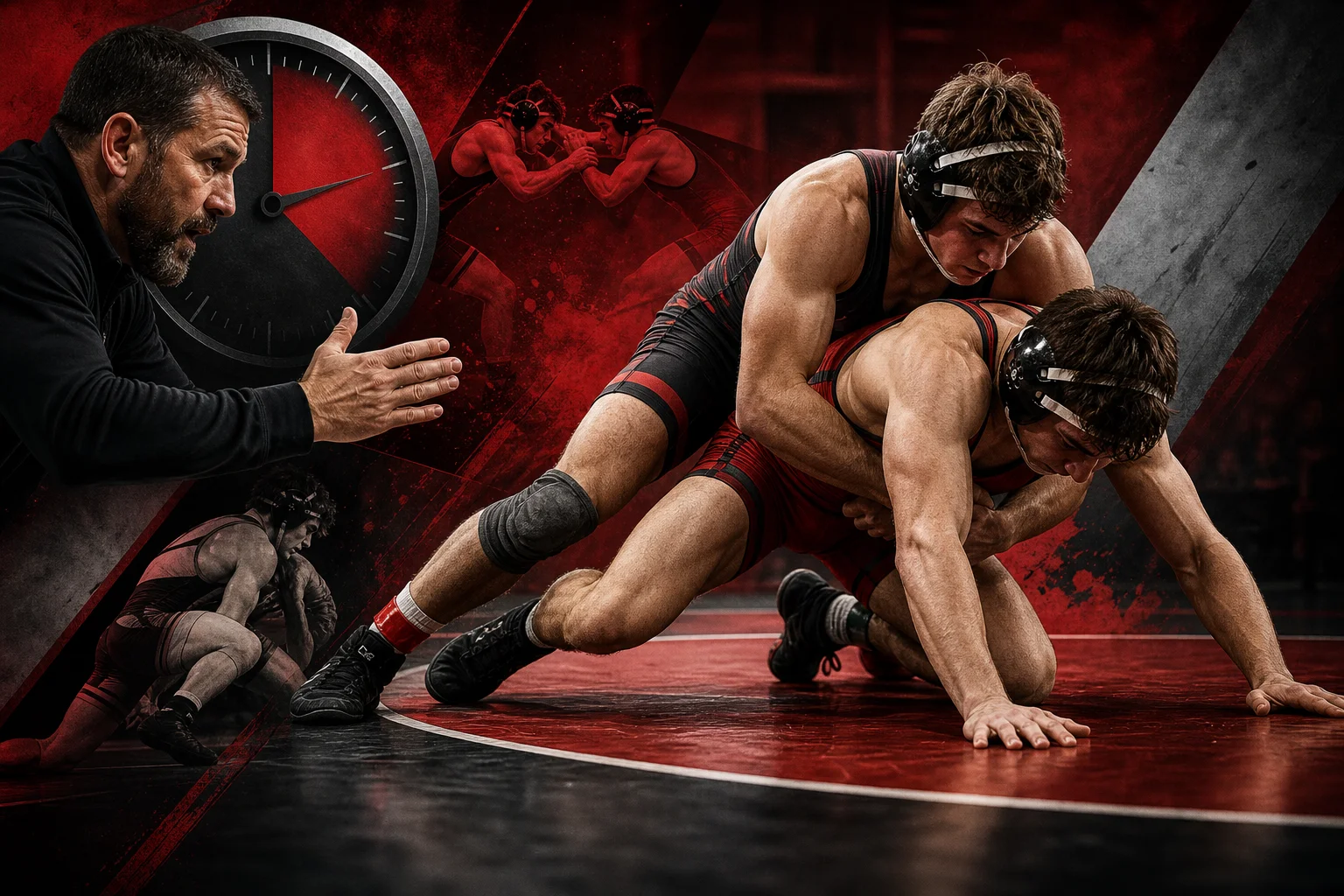
2025 Mat Work Drilling Framework: 20 Minutes That Build Match-Ready Habits — Not Just Busy Reps
A good mat drill block does more than fill practice time. It teaches wrestlers how to win the positions that decide close matches: riding after a takedown, turning from control, escaping from bottom, recovering at the edge, and staying legal while pressure rises.
For high school wrestling under NFHS rules, mat wrestling also has a strong officiating component. The best athletes do not just know “what works.” They understand when control is established, when an escape or reversal is earned, when near-fall criteria are met, what makes a hold potentially dangerous, and how stalling is called from the top and bottom positions.
This article gives coaches, athletes, and officials a practical 20-minute mat drill block that can be dropped into a daily practice plan. The block is built around three core skill groups:
- Turn sequences that create near-fall danger.
- Top control drilling that teaches pressure, return, and mat awareness.
- Defensive standup repetitions that create clean escapes and reversals without panic.
The goal is not to collect random reps. The goal is to build habits that survive a hard third period.
Why a 20-Minute Mat Block Works
Twenty minutes is long enough to build skill, but short enough to keep pace and focus high. It also fits well inside most practice structures:
- Warmup and movement prep
- Neutral technique
- Mat drill block
- Situational live wrestling
- Conditioning or cooldown
- Team review
A 20-minute block also forces coaches to make choices. Instead of teaching five turns, three rides, and four escapes in one session, the coach selects one primary chain and drills it with clear standards.
A good mat block answers four questions:
- What position are we trying to win?
- What is the first action?
- What happens when the opponent gives a common reaction?
- How will we score or avoid giving up points under NFHS rules?
When those questions are clear, athletes can drill with purpose.
NFHS Rules Context for Mat Work: 2025-26 Essentials
This framework is designed for high school wrestling under NFHS rules for the 2025-26 season. Coaches do not need to turn every drill into a rules lecture, but rules awareness should be built into the language of practice.
Current NFHS Scoring Points That Matter on the Mat
| Situation | NFHS Scoring Value | Practice Coaching Point |
|---|---|---|
| Escape | 1 point | Bottom wrestler must get free from opponent’s control and face the situation safely. |
| Reversal | 2 points | Bottom wrestler gains control from underneath without first earning an escape. |
| Takedown | 3 points | Matters in return-to-mat drills when action begins from the feet or after a restart. |
| Near-fall | 2, 3, or 4 points | Awarded based on the referee’s count when near-fall criteria are met. |
| Technical fall | 15-point margin | Mat turns can end a match quickly when repeated near-fall points are earned. |
Near-fall criteria are especially important during turn drilling. A wrestler is in near-fall danger when the defensive wrestler’s back is exposed in a way that meets NFHS criteria, such as both shoulders or scapulae being held within 4 inches of the mat, one shoulder or scapula on the mat with the other at a 45-degree angle or less, or the defensive wrestler being held in a high bridge or on both elbows.
Coaches should teach athletes to recognize the difference between “almost turned” and “scoring exposure.” Officials should also see this distinction during drilling. A turn is not just a roll. It must create controlled danger.
Legal Pressure and Potentially Dangerous Action
Mat wrestling is physical, but it must stay legal. Coaches should stop and correct:
- Pressure that twists the neck beyond a safe range.
- Figure-four around the head without an arm included.
- Full nelsons or other illegal pressure holds.
- Chicken wings driven recklessly above safe shoulder range.
- Return-to-mat finishes that lift and drive an opponent dangerously.
- Any hold where the defensive wrestler cannot protect themselves.
Under NFHS rules, officials may stop potentially dangerous action before an injury occurs. Coaches should use the same standard in practice. If the drill requires the partner to “tough it out” through a dangerous joint or neck position, the drill is being taught incorrectly.
Stalling Standards From Top and Bottom
Mat drills should train action, not delay.
From the top position, the offensive wrestler must work to improve, break the opponent down, turn, return, or otherwise create scoring pressure. Riding parallel without a meaningful attempt to improve can draw stalling.
From the bottom position, the defensive wrestler must work to escape or reverse. Staying flat, clamping down, crawling out of bounds, or refusing to build a base can draw stalling.
This matters in practice because athletes often drill the wrong habit: the top wrestler holds; the bottom wrestler waits. That is not mat wrestling. That is a slow path to stall calls.
Locked Hands and Technical Violations
Coaches should reinforce legal hand use during top drills. Under NFHS rules, the offensive wrestler in control may not lock or overlap hands, fingers, or arms around the opponent’s body or both legs while the defensive wrestler is supported on the mat, except in allowed situations such as a pinning combination, near-fall situation, or when the defensive wrestler is on their feet.
The practical coaching cue is simple:
“Control with pressure and position, not illegal locked hands.”
When athletes learn legal control early, they avoid giving away technical violation points in close dual meets.
The 20-Minute Mat Drill Block
The block below is designed for a standard high school room with partners paired by size and skill level. It can be used during preseason, in-season, or tournament week with small adjustments to intensity.
Base Structure
| Time | Segment | Purpose | Intensity |
|---|---|---|---|
| 0:00-2:00 | Position primer | Prepare hips, hands, base, and pressure | Low to moderate |
| 2:00-7:00 | Turn sequence drilling | Build a scoring chain from top | Moderate |
| 7:00-12:00 | Top control and return drilling | Maintain control and prevent escapes | Moderate to high |
| 12:00-17:00 | Defensive standup reps | Build bottom motion and escape habits | Moderate to high |
| 17:00-20:00 | Situational score go | Connect technique to match scoring | High, controlled |
This format gives each major mat skill enough attention without turning the block into a lecture.
Segment 1: Position Primer, 0:00-2:00
The first two minutes set the standard for the entire block. This is not stretching. It is wrestling movement with rules and position awareness.
Partner Base and Pressure Series
Use 20-second bursts with quick partner switches:
- Bottom wrestler builds base from belly.
- Top wrestler applies hip pressure without locking hands.
- Bottom wrestler moves from base to tripod.
- Top wrestler follows hip pressure and returns opponent to base.
- Bottom wrestler performs one clean standup motion.
- Top wrestler mat-returns with control, not a slam.
The coach should walk the room and correct body position immediately.
Coaching Cues
For the top wrestler:
- Chest pressure follows the opponent’s hips.
- Stay off both knees when pressure is needed.
- Keep hands legal.
- Move the opponent before trying to turn.
- Do not reach across without hip control.
For the bottom wrestler:
- Elbows in.
- Knees under hips.
- Hands clear before standing.
- Head up on the standup.
- Move immediately on the whistle.
Official’s Lens
Officials watching this primer should see realistic mat action. Athletes should begin in legal starting positions or clearly defined drill positions. Coaches should avoid starts where one wrestler is placed in a hold that would be illegal or potentially dangerous in a match.
Segment 2: Turn Sequence Drilling, 2:00-7:00
The turn segment should focus on one primary turn and one reaction. Five minutes is not enough time to teach an entire top system. It is enough to sharpen one scoring chain.
A strong turn sequence has three parts:
- Breakdown
- Turn entry
- Finish to near-fall control
Example Chain: Chop Breakdown to Wrist Ride to Half Nelson
This is a classic high school sequence because it teaches pressure, wrist control, hip movement, and near-fall finishing.
Step 1: Chop Breakdown
Top wrestler begins from the referee’s position or a coach-designated top start.
- Chop near arm.
- Drive weight forward.
- Block or follow the near hip.
- Bring the bottom wrestler to a hip or belly.
- Cover with chest pressure.
The purpose is not to collapse the opponent by force alone. The top wrestler should remove a post and move the opponent’s weight.
Step 2: Wrist Ride
Once the bottom wrestler is broken down:
- Secure wrist control.
- Keep chest pressure forward.
- Use the wrist to keep the bottom wrestler from building back to base.
- Circle hips to create an angle.
The wrist ride must not become a stall ride. The top wrestler needs a turn threat. If the top wrestler holds a wrist and does nothing, the habit will not hold up against better opponents or officials calling action.
Step 3: Half Nelson Entry
The top wrestler uses the wrist ride to open the half:
- Thread the half legally.
- Keep pressure through the opponent’s shoulder line.
- Drive across, not straight over the head.
- Adjust hips to prevent a roll-through.
- Finish chest-to-chest or perpendicular with control.
Coaches should be strict with head and neck pressure here. A half nelson is legal when applied correctly. It becomes a problem when the top wrestler cranks the neck, drives the head outside a safe range, or loses control and tries to force the finish.
Rep Format
Use the following format:
- 30 seconds: coach demonstration with one key cue.
- 90 seconds: top wrestler drills chain at cooperative speed.
- 90 seconds: partner gives realistic base reaction.
- 90 seconds: switch partners.
- 30 seconds: coach correction and reset.
The bottom wrestler should not be a dead body. They should give realistic resistance:
- Post the chopped arm.
- Build base.
- Peel the wrist.
- Hip down against the half.
- Bridge only when safe and coached.
The top wrestler learns more from a partner who reacts correctly than from a partner who simply falls over.
Near-Fall Awareness
When the turn is finished, freeze for one second and ask athletes:
- Is the defensive wrestler in danger?
- Are the shoulders or scapulae exposed under NFHS criteria?
- Is the top wrestler in control?
- Is the hold legal?
- Could an official begin a near-fall count here?
This turns a drill rep into a scoring rep. Athletes must learn what the referee is seeing.
Segment 3: Top Control and Return Drilling, 7:00-12:00
A wrestler who can turn but cannot hold top position will struggle to score near-fall points. Top control is the bridge between takedown and turn.
This segment should train three habits:
- Stop the first move.
- Return the opponent safely.
- Improve after the return.
Drill A: First-Move Stop
Start in referee’s position. Bottom wrestler has one job: execute a hard first move. Top wrestler must stop it legally.
Bottom options:
- Standup.
- Sit-out.
- Switch.
- Granby start.
- Tripod.
Top responses:
- Follow hips.
- Block the near hip.
- Chop or spiral.
- Lift and return only with control.
- Re-cover immediately.
Run this for 60 seconds each, then switch.
The point is not for the top wrestler to guess the move. The point is to react with position: hips, hands, pressure, and angle.
Drill B: Safe Mat Return
Start with bottom wrestler standing and top wrestler behind with legal control. Bottom wrestler fights hands and tries to face. Top wrestler returns the opponent safely.
Safe return standards:
- No lifting and driving the opponent onto the head, neck, or shoulder.
- No uncontrolled back arch into the mat.
- Return the opponent to a hip, thigh, or controlled base.
- Keep the opponent within safe range.
- Maintain control after the return.
This drill is especially important for high school wrestlers because a powerful return can become illegal if control is lost or the opponent is driven dangerously.
Coaches should use clear language:
“Return, cover, improve.”
A return without a cover is just motion. A return followed by a turn threat is mat wrestling.
Drill C: Ride to Turn Threat
After each return, the top wrestler must immediately create one scoring threat:
- Wrist ride.
- Half nelson.
- Bar arm.
- Claw tilt.
- Cross-wrist tilt.
- Spiral to ankle control.
The coach can limit the room to one or two options. Too many options create slow thinking. A small menu creates fast reactions.
Top Control Scoring Goal
In a match, top control can lead to:
- Riding time in some rule sets, but not NFHS folkstyle scoring.
- Near-fall points under NFHS.
- Stalling pressure against the bottom wrestler if the bottom refuses action.
- Match control late in a period.
Because NFHS high school wrestling does not award riding time, top work must be tied to turns, returns, and breakdowns. Holding top position without improvement is not enough.
Segment 4: Defensive Standup Repetitions, 12:00-17:00
Bottom wrestling should not be taught as survival. It should be taught as scoring.
A clean standup is still one of the most reliable ways to earn an escape, but it only works when the wrestler combines motion, hand control, hip separation, and mat awareness.
The Standup Chain
Teach the standup as a chain:
- First movement on the whistle.
- Back pressure into the opponent.
- Inside foot up or outside foot up, depending on team system.
- Hands fight immediately.
- Hips separate.
- Turn and face.
- Clear control for the escape.
The escape is not earned just because the bottom wrestler stands. Under NFHS rules, the bottom wrestler must get away from the opponent’s control. Coaches should not yell “one” in practice until control is actually broken.
Drill A: Standup to Hand Control
Start in referee’s position.
- Bottom wrestler stands.
- Top wrestler follows and locks onto legal control.
- Bottom wrestler fights hands for three seconds.
- Freeze and check position.
Questions:
- Is the bottom wrestler’s head up?
- Are hips separated?
- Are hands being attacked in the correct order?
- Is the top wrestler staying legal?
- Is anyone moving toward the boundary to avoid wrestling?
This drill teaches athletes to stay calm while standing. Many wrestlers lose position because they stand up and immediately panic.
Drill B: Standup to Escape
Now complete the motion.
- Bottom wrestler stands.
- Fights hands.
- Cuts hips away.
- Turns and faces.
- Clears control.
Top wrestler gives realistic resistance but does not mat-return at full force during the first round. The purpose is technical escape, not collision.
Run 20-second rounds:
- Bottom gets as many clean escapes as possible.
- Reset quickly.
- Top gives honest pressure.
- Switch roles.
Do not count sloppy escapes. A clean rep requires actual separation and a turn to face.
Drill C: Standup to Reversal Reaction
Once the top wrestler overcommits, the bottom wrestler should be ready to reverse.
Common reactions:
- Top wrestler reaches too high.
- Top wrestler drives forward without hip control.
- Top wrestler steps around carelessly.
- Top wrestler locks around the waist illegally while both wrestlers are on the mat.
Bottom counters:
- Switch.
- Sit to hip and cut corner.
- Granby when trained and safe.
- Peterson-style roll only with proper instruction and partner awareness.
- Hip heist to go-behind.
This part builds match intelligence. The bottom wrestler learns that not every bottom score is an escape. If the top wrestler makes a mistake, the bottom wrestler can earn two for a reversal instead of one for an escape.
Segment 5: Situational Score Go, 17:00-20:00
The final three minutes connect drilling to competition. This should be short, intense, and scored.
Option 1: Top Needs a Turn
Start in referee’s position.
- Top wrestler trails by 3 points.
- There are 30 seconds left.
- Top must turn or create near-fall danger.
- Bottom must escape, reverse, or avoid stalling by working up.
Score the situation under NFHS rules. Coaches should call out potential points, but the best version is to have an assistant or experienced athlete act as the official.
Option 2: Bottom Needs One
Start in referee’s position.
- Bottom wrestler trails by 1.
- There are 20 seconds left.
- Bottom needs an escape or reversal.
- Top needs a legal ride and return.
This forces urgency without making the drill reckless.
Option 3: Edge Mat Standup
Start near the boundary line, still safely in the practice area.
- Bottom wrestler attempts a standup.
- Top wrestler returns or follows.
- Both athletes must wrestle until the coach stops the action.
This teaches boundary awareness. Wrestlers should not assume the whistle will save them at the edge. Under NFHS rules, action may continue while wrestlers remain inbounds by rule. Coaches should teach athletes to keep wrestling until the whistle, while also respecting safety and space.
Scoring the Go
Use match language:
- “Escape, one.”
- “Reversal, two.”
- “Near-fall count started.”
- “Potentially dangerous, stop.”
- “Locked hands, technical violation.”
- “Stalling warning.”
- “Out of bounds, reset.”
This helps athletes connect technique, rules, and official signals.
Building the Block Around Your Team’s System
The framework is fixed, but the techniques can change. A coach should plug in the team’s preferred mat system.
Sample Technique Menus
| Skill Area | Beginner Option | Intermediate Option | Advanced Option |
|---|---|---|---|
| Breakdown | Chop | Spiral ride | Spiral to cross-wrist |
| Turn | Half nelson | Bar arm | Tilt series |
| Top control | Hip pressure | Claw ride | Cross-wrist ride |
| Return | Knee block return | Mat return to hip | Return to immediate turn |
| Bottom escape | Standup | Standup to switch | Standup to re-attack |
| Bottom reversal | Switch | Sit-out turn-in | Granby or Peterson series |
The key is consistency. If Monday is chop-half, Tuesday can be spiral-wrist, but the structure of the 20 minutes should remain familiar. Athletes learn faster when the practice format is predictable and the technical focus is specific.
Coaching Standards for Quality Reps
A mat drill block can look busy while producing poor habits. Coaches should define what counts as a good rep before the whistle blows.
A Good Top Rep Includes
- Legal starting position.
- Immediate pressure.
- Control of hips or hands.
- A breakdown or return.
- A turn threat.
- No illegal locked hands.
- No unsafe neck or shoulder pressure.
- Finish in a position an official would recognize as control or near-fall danger.
A Good Bottom Rep Includes
- First move on the whistle.
- Base before explosion.
- Hand control before separation.
- Hips away from pressure.
- Turn and face on escape.
- Re-attack if the top wrestler loses position.
- No crawling out of bounds to avoid wrestling.
- No lying flat without action.
A Good Partner Rep Includes
- Realistic resistance.
- Safe reactions.
- No cheap counters during technical rounds.
- Communication when a joint or neck position feels unsafe.
- Respect for the purpose of the drill.
Partners matter. A wrestler who gives lazy resistance teaches bad top control. A wrestler who goes full live during a technical phase slows learning and increases injury risk.
Common Problems and Fast Fixes
Problem: The Top Wrestler Rides Parallel
A parallel ride can control for a moment, but it rarely creates scoring pressure by itself.
Fix: Require an angle before every turn attempt. The top wrestler must move to a hip, wrist, bar, claw, or cross-body angle before the rep counts.
Problem: The Bottom Wrestler Stands but Cannot Escape
Standing up is not the score. Separation is the score.
Fix: Add a hand-fighting checkpoint. The rep only counts when the bottom wrestler clears the hands, separates hips, and turns to face.
Problem: Turns Are Too Loose
Athletes roll through positions without control.
Fix: Freeze at the near-fall position. Ask whether the referee would count. If not, adjust chest pressure, hip angle, and control.
Problem: Mat Returns Are Too Rough
The top wrestler throws instead of returns.
Fix: Slow the drill down. Require return to a hip or controlled base. Remove full resistance until the athlete can return safely.
Problem: Bottom Wrestlers Accept Being Flat
Some athletes treat belly-down as a resting position.
Fix: Use a three-second rule. If the bottom wrestler is flat, they have three seconds to build to base or execute a coached movement. If not, reset and correct.
Problem: Coaches Try to Cover Too Much
The room gets five techniques and masters none.
Fix: Use one primary chain and one reaction per day. Repeat the framework across the week with small changes.
Weekly Planning: Rotating the 20-Minute Block
A coach can use the same 20-minute framework every day without making practice stale. Rotate the technical focus.
| Day | Turn Focus | Top Control Focus | Bottom Focus | Situational Finish |
|---|---|---|---|---|
| Monday | Half nelson | Chop and wrist | Standup | Bottom needs one |
| Tuesday | Bar arm | Spiral ride | Sit-out | Top needs turn |
| Wednesday | Tilt | Cross-wrist | Standup to switch | Edge mat go |
| Thursday | Claw series | Return and cover | Hand control | 30-second rideout |
| Friday | Athlete’s best turn | Best ride chain | Best escape | Tournament-style score go |
This structure gives athletes repeated exposure to the same match problems. It also helps coaches evaluate progress. If an athlete cannot escape on Monday, Wednesday, and Friday, the issue is clear.
Athlete Health and Safety in Mat Drilling
Mat work can place stress on the neck, shoulders, ribs, knees, and lower back. Good coaching protects athletes while still preparing them for hard competition.
Safety Rules for the Room
- Stop immediately when a partner says “stop.”
- Do not crank the neck to finish a turn.
- Do not force a shoulder beyond a safe range.
- Do not bridge wildly during technical drilling.
- Keep mat returns controlled.
- Pair athletes by size, skill, and maturity when possible.
- Give extra supervision to new wrestlers during turns and returns.
- Keep the mat area clear around boundary drills.
Fatigue also affects safety. A tired wrestler may post awkwardly, fail to protect their neck, or land poorly on a return. Coaches should watch body language during the final situational go and shorten rounds if technique breaks down.
Hydration, nutrition, and recovery should support practice quality. Mat drill blocks should never be used as punishment for weight cutting, dehydration, or unsafe body-weight goals. Athletes need enough fuel and fluid to learn, react, and protect themselves.
How Officials Can Use This Framework
Officials who attend practices, camps, or preseason rules sessions can use this block as a teaching tool.
During the turn segment, officials can explain:
- When near-fall criteria begin.
- Why a count starts or does not start.
- When pressure becomes potentially dangerous.
- What control looks like during a scramble.
During the top control segment, officials can reinforce:
- Locked hands.
- Stalling from top.
- Legal and illegal mat returns.
- Boundary action.
During the bottom segment, officials can explain:
- Escape versus reversal.
- Stalling from bottom.
- Fleeing the mat.
- Why turning to face matters for a clean escape.
This kind of rules education is more useful when athletes are in the position, feeling the pressure, and seeing the official’s angle.
Coaching Language That Builds Better Mat Wrestlers
Short cues work best during a 20-minute block. Long speeches break rhythm.
Top Cues
- “Hips first.”
- “Pressure before turn.”
- “Return, cover, improve.”
- “Legal hands.”
- “Create danger.”
- “Angle, then finish.”
- “Do not ride flat.”
Bottom Cues
- “Move on the whistle.”
- “Build base.”
- “Hands first.”
- “Hips away.”
- “Turn and face.”
- “Score, don’t survive.”
- “Keep wrestling at the edge.”
Rules Cues
- “Would that be one?”
- “Would that be two?”
- “Is the count started?”
- “Is that legal?”
- “Keep action inbounds.”
- “Do not wait for the whistle.”
The best coaching language makes athletes think like wrestlers and competitors, not just drill partners.
A Complete 20-Minute Script Coaches Can Use Today
Here is a ready-to-run version.
0:00-2:00 — Primer
- 20 seconds: bottom builds base, top follows hips.
- 20 seconds: bottom tripods, top follows and returns to base.
- 20 seconds: bottom stands, top controls legally.
- Switch roles and repeat.
- Coach cue: “First move, legal pressure, safe return.”
2:00-7:00 — Turn Sequence
Technique: chop to wrist ride to half nelson.
- 30 seconds: coach demo.
- 90 seconds: partner A drills cooperative reps.
- 90 seconds: partner A drills against base reaction.
- 90 seconds: partner B drills.
- 30 seconds: freeze near-fall position and correct.
Coach cue: “Break down, control wrist, create danger.”
7:00-12:00 — Top Control
- 60 seconds: first-move stop, partner A on top.
- 60 seconds: first-move stop, partner B on top.
- 90 seconds: safe mat return, partner A on top.
- 90 seconds: safe mat return, partner B on top.
- 60 seconds: return to immediate turn threat.
Coach cue: “Return, cover, improve.”
12:00-17:00 — Defensive Standups
- 60 seconds: standup to hand control, partner A on bottom.
- 60 seconds: standup to hand control, partner B on bottom.
- 90 seconds: standup to escape, partner A on bottom.
- 90 seconds: standup to escape, partner B on bottom.
- 60 seconds: standup to reversal reaction.
Coach cue: “Hands, hips, face.”
17:00-20:00 — Situational Score Go
- 30 seconds: top needs a turn.
- 30 seconds: bottom needs one.
- 30 seconds: edge mat standup.
- Switch roles and repeat.
- Coach or assistant scores using NFHS language.
Coach cue: “Score it like a match.”
Measuring Progress Without Inventing Numbers
Coaches do not need complex data to know whether the block is working. Track simple, observable behaviors.
Top Progress Markers
- Athlete breaks opponent down without illegal hands.
- Athlete returns safely and covers.
- Athlete creates a real turn threat within a few seconds.
- Athlete understands when near-fall criteria are present.
- Athlete does not stall on top when the first turn fails.
Bottom Progress Markers
- Athlete moves immediately on the whistle.
- Athlete builds base instead of staying flat.
- Athlete hand-fights before trying to turn.
- Athlete earns clean separation on escapes.
- Athlete recognizes reversal opportunities.
Team Progress Markers
- More athletes can explain escape versus reversal.
- Fewer locked-hands violations appear in live wrestling.
- Mat returns look controlled.
- Bottom wrestlers stop accepting belly-down positions.
- Top wrestlers turn pressure into scoring danger.
These markers are easy to see during practice and even easier to confirm during competition film.
Final Coaching Takeaway
A 20-minute mat drill block should have pace, purpose, and scoring value. The coach picks the chain. The athletes drill with realistic resistance. The official’s viewpoint is built into the language. The room learns not only how to move, but how to score legally under NFHS rules.
Use the same framework often:
- Prime the position.
- Drill the turn.
- Control and return.
- Escape or reverse.
- Finish with scored situations.
That rhythm turns mat work into match habits.
For coaches building repeatable practice systems, WrestleFlow Teams can help organize drill blocks, coach playbooks, and weekly practice plans so your staff and athletes stay aligned from the first whistle to the postseason.