Illegal Holds in NFHS Wrestling 2025-26: New Prohibited Moves
Stay safe on the mat with the 2025-26 NFHS illegal-holds guide, including full nelsons, headlocks without the arm, slams, and the leg block/cut-back rule.
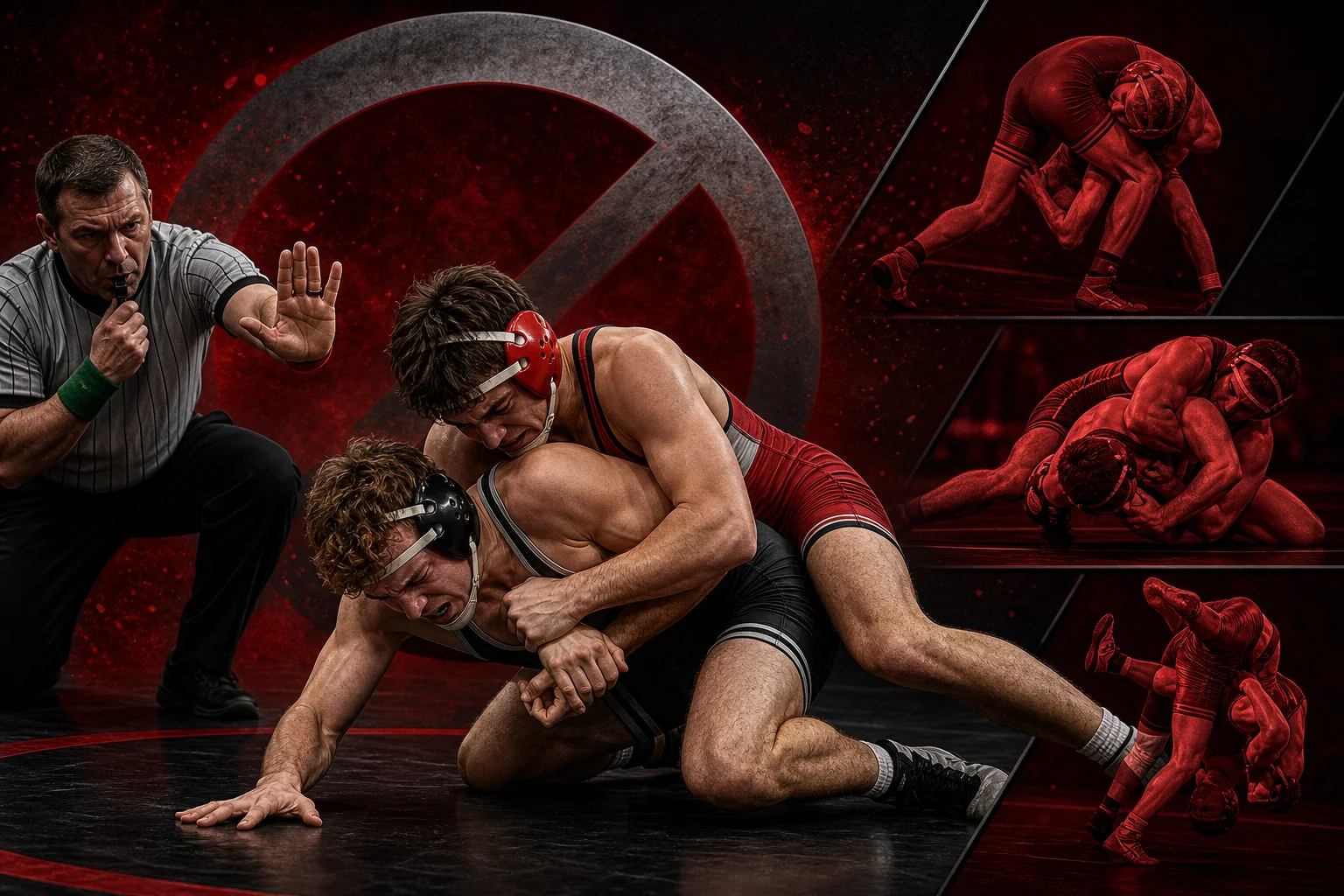
Illegal holds exist in NFHS wrestling because they create unacceptable injury risk — to the neck, shoulders, and joints. Officials are required to stop a match the moment an illegal hold is applied, regardless of whether the defensive wrestler is in distress.
Full Nelson
What it is: Both arms inserted under the opponent’s arms with fingers interlocked behind the opponent’s head or neck.
Why illegal: The full nelson creates axial compression on the cervical spine — the neck — with no way for the defensive wrestler to protect themselves. Even a brief, forceful application can cause cervical injury.
Common scenario: A top wrestler, frustrated with a standup, reaches under both arms and locks hands behind the head. This is an immediate stop and penalty.
Headlock Without the Arm
What it is: Any hold around the opponent’s head or neck where the controlling wrestler does not also capture an arm.
Why illegal: An arm-in headlock uses the captured arm as structural support, distributing force across the shoulder and torso. Without the arm, all pressure concentrates on the cervical spine and neck muscles.
The legal version: Head-and-arm control (cranks, headlocks, tilts) that capture the near arm are legal. The arm must be captured, not just in contact.
Signal context: The 2025-26 near-fall signal uses the “OK” gesture. That signal can appear during legal head-and-arm exposure, but it does not make a headlock without the arm legal.
Hammerlock Above the Armpit
What it is: A hammerlock (arm bent behind the back) that is forced above the level of the armpit.
Why illegal: Above the armpit, the shoulder joint is stretched into internal rotation at maximum range — a position where further force risks labrum tears and rotator cuff damage.
The legal zone: A hammerlock held at or below armpit level is legal. Officials watch for the arm being cranked up toward the shoulder blades, which crosses into illegal territory.
Strangle Hold
What it is: Any hold where pressure is applied to the windpipe (trachea) or the back of the neck with a choking purpose.
Why illegal: Compression of the trachea restricts airflow immediately. Even short-duration choking creates hypoxia risk. Unlike other holds that become dangerous with force or duration, any choke hold is immediately illegal.
Leg Lace Beyond 90 Degrees
What it is: A leg lace (leg scissors on the leg or ankle) twisted beyond 90 degrees of rotation.
Why illegal: The rotational force applied at 90+ degrees exceeds the knee joint’s tolerance and risks ligament damage (ACL, MCL) with minimal warning to the defensive wrestler.
Officials watch for: The approach angle — a leg lace just inside 90 is legal; officials caution wrestlers approaching that limit and stop the match if it’s exceeded.
The Double Wristlock / Chicken Wing (Doubled)
What it is: A chicken wing applied simultaneously to both arms, with upward force.
Why illegal: A single chicken wing (arm behind the back at acceptable range) is legal when applied correctly. Doubling it creates compounded shoulder stress that can dislocate both joints simultaneously.
Slam
What it is: Lifting and returning an opponent to the mat with force in a way that could cause injury.
Why illegal: Unlike normal takedowns where the offensive wrestler controls the descent, a slam uses the mat itself as an impact weapon. Even a technically executed takedown becomes a slam if the defensive wrestler is dropped rather than guided down.
Officials distinguish: Reactive falls (where the defensive wrestler’s weight and direction naturally pull them down quickly) from intentional slams. Coaches should train wrestlers to guide opponents down during takedowns to avoid slam calls.
Leg Block / Cut-Back
What it is: A wrestler leaves their feet to cut out or block an opponent’s leg.
Why illegal: Rule 7-1-5n added the leg block / cut-back prohibition for 2025-26 because the action can remove the opponent’s base with uncontrolled force and create high injury risk.
Officials watch for: The key is leaving the feet to cut out the leg. Normal, controlled attacks to the legs are still part of legal wrestling; the prohibited action is the unsafe cut-back/leg block described in the rule.
Responding to an Illegal Hold Call
When an official calls an illegal hold:
- The match stops immediately
- 1 point is awarded to the defensive wrestler
- Match restarts in an appropriate position
- Repeated illegal holds signal disqualification intent from the official
Coaches should address illegal holds immediately during time-outs or between periods — an official who sees a pattern will warn that the next infraction results in disqualification.
For related penalty mechanics, see Stalling & Technical Violations: NFHS Wrestling Rules 2025-26. For legal back-point scoring, see NFHS Near-Fall Scoring 2025-26.
Frequently Asked Questions
- Is a headlock legal in NFHS wrestling?
- A headlock is legal ONLY when the controlling wrestler also captures the opponent's arm. A headlock without the arm (called a 'guillotine' in common usage) is illegal because it places dangerous traction force on the neck without the structural protection of the trapped arm.
- What happens if an illegal hold is applied briefly before being released?
- Even brief application of an illegal hold is penalized — 1 point to the opponent. Repeated illegal holds can result in disqualification at the official's discretion.
- Is the leg block or cut-back illegal in NFHS wrestling?
- Yes. For 2025-26, Rule 7-1-5n makes the leg block or cut-back illegal when a wrestler leaves their feet to cut out an opponent's leg.
- Is a full nelson ever legal in high school wrestling?
- No. The full nelson is prohibited in NFHS wrestling because of the risk to the cervical spine.