The Referee's Position in Wrestling: Setup, Mechanics, and Common Errors
A complete breakdown of the referee's position — how it's set, what both wrestlers must do, and how officials handle incorrectly assumed positions.
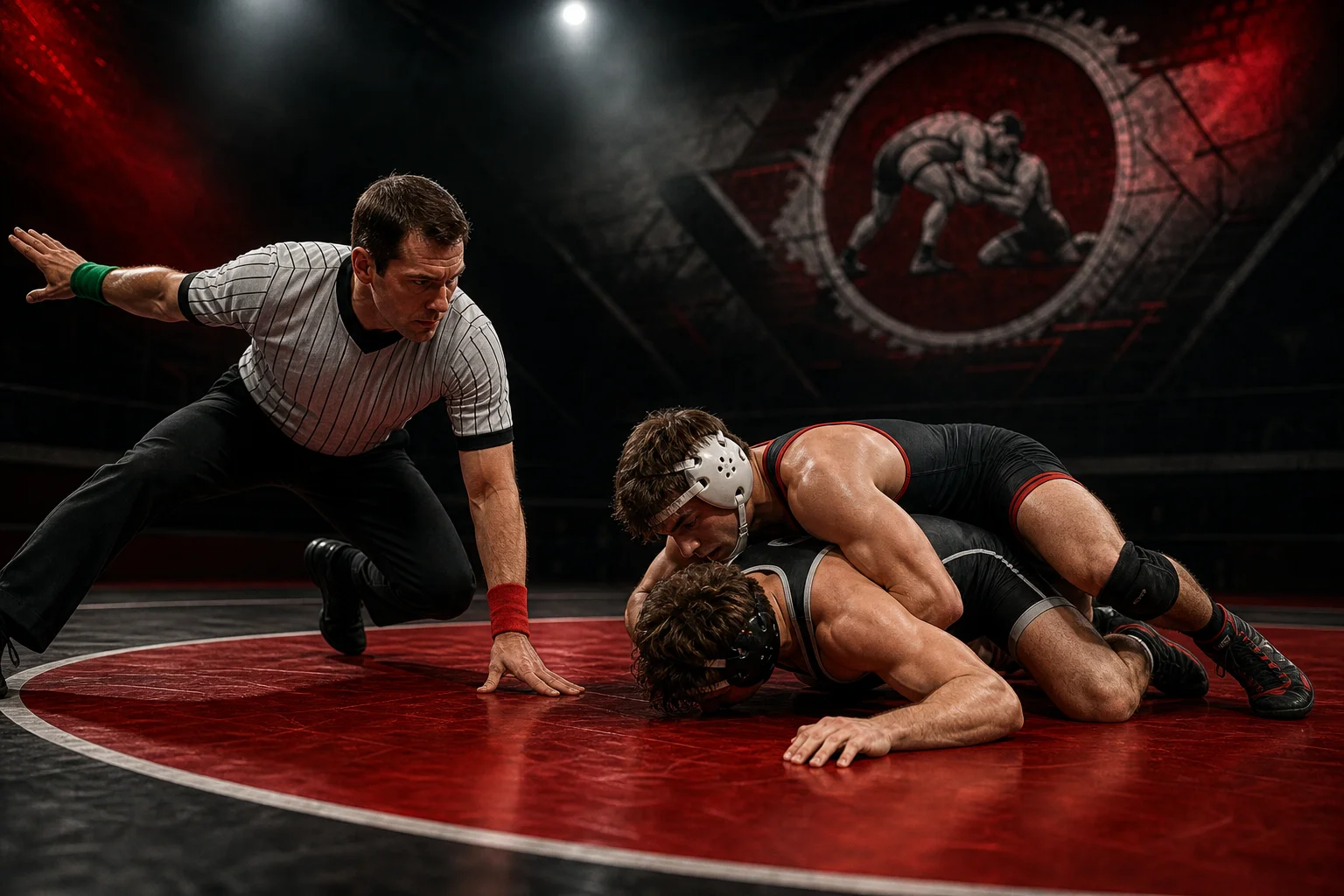
7 Mat-Tested Referee’s Position Rules for 2025-26: No-Guesswork Setup That Actually Controls the Restart
Why the Referee’s Position Matters
The referee’s position is one of the most common restart positions in scholastic wrestling, and it is also one of the most frequently mishandled. A rushed setup can give one wrestler an unfair first move. A loose interpretation of hand placement can turn into a hidden advantage. A late whistle can create confusion. A poorly managed caution sequence can affect the score in a close match.
Under NFHS rules for the 2025-26 season, the referee’s position is not a casual “top-bottom” restart. It is a defined starting position with specific requirements for the defensive wrestler, the offensive wrestler, and the official. Coaches should teach it exactly. Athletes should practice it until it becomes automatic. Officials should administer it consistently from the first period to the final tiebreaker.
This article breaks down the referee’s position from three practical viewpoints:
- For wrestlers: how to assume the position legally and win the restart without guessing the whistle.
- For coaches: how to drill the position and correct bad habits before they become match penalties.
- For officials: how to set the position, identify errors, use cautions properly, and keep the restart fair.
What the Referee’s Position Is
The referee’s position is the standard starting position used when one wrestler is in control and the match is restarted from the center. The wrestler in control is the offensive wrestler. The wrestler being controlled is the defensive wrestler.
Common situations that lead to a referee’s position restart include:
- The start of the second or third period when a wrestler chooses down and the opponent takes the offensive position.
- A restart after the wrestlers go out of bounds while one wrestler has control.
- A restart after a stalemate when one wrestler had control.
- Certain restarts after injury, blood time, recovery time, or other stoppages, depending on the choice and match situation.
- Tiebreaker situations when the rules require or permit a controlled restart.
The referee’s position is different from neutral. It is also different from an optional offensive start, though the optional start is connected to the same restart situation. In the traditional referee’s position, the bottom wrestler must set on hands and knees, and the top wrestler must cover with required hand and body placement.
The 2025-26 NFHS Legal Setup at a Glance
The key to administering this position is simple: the defensive wrestler sets first, the offensive wrestler covers legally, both wrestlers become stationary, and the official starts action with the whistle.
Core Requirements Table
| Role | Legal Requirement | Practical Checkpoint | Common Error |
|---|---|---|---|
| Defensive wrestler | Both hands on the mat in front of the forward starting line | Hands are planted, not creeping or rocking | Hands too far back, fingers moving, elbows dropped |
| Defensive wrestler | Both knees on the mat behind the rear starting line | Knees are clearly behind the line | Knees crowding the line or sliding forward |
| Defensive wrestler | Stationary before the whistle | No rocking, rolling, flinching, or early hip movement | Anticipating the whistle |
| Offensive wrestler | On either side of the defensive wrestler | Top chooses a side and covers after bottom is set | Covering before bottom is legal |
| Offensive wrestler | At least one knee on the mat on the near side | One knee is clearly down in traditional referee’s position | Starting with both knees up in a traditional cover |
| Offensive wrestler | Palm of one hand loosely over the defensive wrestler’s navel | The waist hand is not high, low, clamped, or grabbing | Hand on ribs, hip, belt line, or locked grip |
| Offensive wrestler | Palm of the other hand on or over the near elbow | Elbow hand is not pulling, hooking, or starting a ride early | Hand on far elbow, triceps, armpit, or wrist |
| Both wrestlers | No movement before the whistle | The restart is still, fair, and prompt | False start or incorrect starting position |
The official should not guess from memory or habit. The position has visible checkpoints. If those checkpoints are not met, the official should correct the position before the whistle or charge the appropriate caution when the rules call for it.
The Defensive Wrestler’s Responsibilities
The defensive wrestler sets first. This matters because the offensive wrestler cannot legally cover a moving or incorrectly placed defensive wrestler. Coaches often focus on the top wrestler’s hand position, but many cautions begin with the bottom wrestler.
Hands
The defensive wrestler’s hands must be on the mat in front of the forward starting line. The hands should be clearly placed, with weight supported and no walking fingers.
Practical coaching points:
- Set the hands quickly.
- Keep the palms or hands stable.
- Do not creep forward.
- Do not roll the wrists or pulse the shoulders to time the whistle.
- Keep the elbows off the mat unless a specific disability accommodation or authorized situation applies.
The bottom wrestler does not get to build momentum before the whistle. A legal explosive first move begins after the whistle, not during the setup.
Knees
Both knees must be on the mat behind the rear starting line. The knees should be clearly placed behind the line and should stay still until the whistle.
Common knee errors include:
- Sliding the knees forward after the top wrestler covers.
- Starting too narrow and then widening before the whistle.
- Rocking backward to load the hips.
- Lifting a knee early to beat the whistle.
- Setting with the knees too close to the line and forcing the official to judge a borderline position.
A good bottom wrestler does not need to cheat the line. The advantage comes from a clean first move, hand control, hip motion, and mat awareness.
Body Position
The defensive wrestler should be on hands and knees in a stationary position. The back does not need to be perfectly flat, but the athlete cannot use body movement to gain a start before the whistle.
Examples of illegal or questionable bottom movement:
- Rocking forward and backward.
- Turning the shoulders.
- Dropping the chest and popping back up.
- Moving the head repeatedly to draw a reaction.
- Shifting the hips to knock the top wrestler’s hand or knee out of position.
- Starting to stand before the whistle.
Officials should distinguish between a wrestler getting set and a wrestler trying to time the start. Once the defensive wrestler is set, continued movement should be addressed.
The Offensive Wrestler’s Responsibilities
The offensive wrestler covers after the defensive wrestler is set. The top wrestler has real responsibilities before the whistle: legal hand placement, legal knee placement, controlled pressure, and stillness.
Choosing a Side
The offensive wrestler may set on either side. Once the top wrestler chooses a side and covers, the official should check the required points of contact and hand placement.
Coaches should teach athletes to cover the same way every time:
- Step or kneel into position without bumping the bottom wrestler.
- Place the required knee down.
- Put the waist hand loosely over the navel.
- Put the other hand on or over the near elbow.
- Become still.
- Move only on the whistle.
A top wrestler who changes sides after the bottom wrestler is set may create delay or confusion. If the athlete is not set, the official should reset the process.
Knee Placement
In the traditional referee’s position, the offensive wrestler must have at least one knee on the mat on the near side of the defensive wrestler. This is one of the easiest checkpoints for an official to see and one of the easiest details for a wrestler to neglect.
Common errors:
- Starting with both knees off the mat.
- Hovering above the opponent to create forward pressure.
- Sliding the knee into the bottom wrestler’s leg or ankle.
- Using the leg to crowd the bottom wrestler before the whistle.
- Moving the knee after being set.
A top wrestler should not use the knee or foot as a hidden hook before action begins. The restart should begin with legal upper-body contact, not a preloaded leg ride.
Waist Hand: Palm Over the Navel
The offensive wrestler’s waist hand must be placed loosely over the defensive wrestler’s navel. The word “loosely” is important. The top wrestler is not allowed to clamp, squeeze, lock, pull, or start the ride before the whistle.
Legal means:
- Palm over the navel area.
- No locked hands.
- No gripping cloth or body.
- No driving pressure that moves the bottom wrestler.
- No pulling the bottom wrestler off the line before the whistle.
Illegal or incorrect examples include:
- Hand high on the ribs.
- Hand low on the hip or waistband area.
- Hand around the far side with a tight squeeze.
- Fingers digging or grabbing.
- Thumb or fingers hooked to create a first-move advantage.
- Hand sliding before the whistle.
The top wrestler may apply pressure after the whistle. Before the whistle, the job is to be legally placed and still.
Elbow Hand: On or Over the Near Elbow
The offensive wrestler’s other hand must be on or over the defensive wrestler’s near elbow. This hand is not a spiral ride, wrist ride, triceps chop, or armpit hook before the whistle. It is a required starting contact point.
Common elbow-hand errors:
- Covering the far elbow instead of the near elbow.
- Grabbing the wrist.
- Hooking inside the elbow.
- Placing the hand too high on the triceps.
- Pulling the elbow before the whistle.
- Floating the hand above the elbow and dropping it early.
A useful coaching phrase is: “Palm to navel, hand to near elbow, still until the whistle.”
The Official’s Mechanics
A clean referee’s position restart depends heavily on the official. Athletes should know the rules, but the official controls the pace, sequence, and enforcement.
Basic Restart Sequence
A sound sequence looks like this:
- Bring the wrestlers to the center.
- Confirm the restart situation and choice.
- Direct the defensive wrestler to set.
- Check hands, knees, and stillness.
- Direct the offensive wrestler to cover.
- Check knee, navel hand, elbow hand, and stillness.
- Blow the whistle promptly when both wrestlers are legal and stationary.
The official should avoid long pauses after both wrestlers are set. A slow whistle encourages guessing and can make both wrestlers feel forced to anticipate. The best whistle is not rushed, but it is prompt.
Where the Official Should Look
The official must see the critical contact points. Depending on body size, mat position, and the side chosen by the top wrestler, the official may need to adjust the angle.
Important visual checks:
- Bottom hands in front of the forward line.
- Bottom knees behind the rear line.
- Bottom wrestler stationary.
- Top wrestler has at least one knee down on the near side.
- Top waist hand is loosely over the navel.
- Top other hand is on or over the near elbow.
- No early movement by either wrestler.
Officials should avoid standing where the top wrestler’s body blocks the waist hand. If the hand position cannot be seen, the official should move.
Verbal Preventive Officiating
Preventive officiating is appropriate when it is brief and clear. An official may use short commands such as:
- “Hands forward.”
- “Knees back.”
- “Set.”
- “Cover.”
- “Palm on the navel.”
- “On the elbow.”
- “Hold still.”
The official should not coach strategy or debate technique. The goal is to get a legal restart, not to give one wrestler extra instruction.
Whistle Timing
The whistle should come after both wrestlers are legal and stationary. The official should not whistle while:
- The bottom wrestler is still adjusting.
- The top wrestler is sliding the waist hand.
- The top wrestler is reaching for the elbow.
- Either wrestler is rocking.
- The official cannot see the required hand placement.
Once all requirements are met, the whistle should be immediate enough that neither wrestler is punished for being still.
Incorrect Starting Position vs. False Start
NFHS rules separate two closely related concepts: an incorrect starting position and a false start. Both are handled through the caution system, but they are not the same thing.
Incorrect Starting Position
An incorrect starting position occurs when a wrestler does not assume or maintain the required legal starting position.
Examples:
- Bottom wrestler’s knees are not behind the rear starting line.
- Bottom wrestler’s hands are not in front of the forward starting line.
- Top wrestler’s hand is not over the navel.
- Top wrestler’s hand is not on or over the near elbow.
- Top wrestler does not have the required knee down in the traditional referee’s position.
- Top wrestler covers with a tight grip or illegal pre-whistle contact.
- Either wrestler changes position after being set and before the whistle.
If the issue is caught before the wrestlers are fully set, the official may correct it. If the wrestler fails to comply, repeatedly assumes the wrong position, or moves out of a legal position before the whistle, a caution is proper.
False Start
A false start occurs when a wrestler begins action before the whistle after being set or otherwise simulates the start illegally.
Examples:
- Bottom wrestler stands before the whistle.
- Bottom wrestler explodes to a sit-out early.
- Top wrestler chops the elbow before the whistle.
- Top wrestler drives forward before the whistle.
- Top wrestler pulls the waist hand or bumps the bottom wrestler early.
- Either wrestler flinches in a way that causes action to begin.
A false start should be stopped immediately. The official charges the caution to the wrestler who committed the violation and restarts the wrestlers legally.
The Caution System
Cautions are important because they can become points. Coaches and athletes sometimes treat cautions as harmless warnings, but repeated starting violations can affect the score.
Under NFHS rules, cautions are charged to the offending wrestler. The first two cautions charged to that wrestler do not award a point. The third and each subsequent caution charged to that wrestler awards one point to the opponent.
Caution Progression Table
| Caution Charged to a Wrestler | Result |
|---|---|
| First caution | No point |
| Second caution | No point |
| Third caution | 1 point to opponent |
| Each additional caution | 1 point to opponent |
The caution count belongs to the individual wrestler, not to the position and not to the team corner. A wrestler can receive cautions from false starts and incorrect starting positions during the match. The table should record them accurately, and the official should communicate clearly.
How Officials Should Signal and Communicate
When a caution is charged:
- Stop the action or prevent the start.
- Identify the offending wrestler by color.
- Signal the caution.
- Verbally state the reason when helpful: “Red, caution, false start” or “Green, caution, incorrect starting position.”
- Confirm the caution count with the table when needed.
- Award a point if it is the third or later caution on that wrestler.
- Restart cleanly.
Clear communication prevents disputes. Coaches may not like the call, but they should know who was cautioned and why.
Optional Offensive Starting Position
The optional offensive starting position is often used when the top wrestler intends to release the bottom wrestler or avoid a traditional tight cover. It is not the same as the traditional referee’s position, but it is part of the same restart family.
When the offensive wrestler uses the optional start, the wrestler must indicate that choice to the official. The top wrestler then assumes the required optional position instead of the traditional navel-and-elbow cover.
In practice, officials should make sure:
- The optional start is clearly requested.
- The defensive wrestler is legally set.
- The offensive wrestler uses the required optional hand placement.
- The offensive wrestler is not secretly applying a ride before the whistle.
- Both wrestlers are stationary.
- The whistle starts the action, not the top wrestler’s early push or release.
Common optional-start errors include:
- Failing to notify the official.
- Placing hands too low or to the side in a way that creates a grip.
- Pushing the bottom wrestler before the whistle.
- Releasing early to force the bottom wrestler to move.
- Using the optional start to hide a false start.
Coaches should teach athletes that “optional” does not mean “anything goes.” It is a legal starting position with its own requirements.
Common Errors by the Defensive Wrestler
1. Creeping the Hands
The bottom wrestler sets the hands legally, then walks the fingers forward before the whistle. This is a classic attempt to gain a head start on a stand-up or switch.
Official response: correct if early in the setup; caution if the wrestler is set and then creeps or repeatedly does it.
2. Sliding the Knees
The wrestler begins with knees behind the line, then inches them forward as the top wrestler covers. This narrows the official’s view and creates a better launch angle.
Official response: stop the setup, reset the knees, and caution when appropriate.
3. Rocking Back Into the Top Wrestler
Some bottom wrestlers load their hips backward to create contact before the whistle. This can knock the top wrestler’s hands out of place and create an unfair start.
Official response: charge the bottom wrestler if the movement occurs after being set.
4. Beating the Whistle
A bottom wrestler who repeatedly tries to move on the official’s breath, arm motion, or cadence is risking cautions. Good wrestlers react to the whistle; they do not guess.
Coach correction: use whistle-reaction drills with random timing. Penalize early movement in practice.
5. Starting With Elbows Down
Dropping elbows to the mat can change the legal shape of the starting position and create an unfair defensive shell. The wrestler should be on hands and knees, not elbows and knees.
Official response: require correction before the whistle.
Common Errors by the Offensive Wrestler
1. Hand Not Over the Navel
The top wrestler places the waist hand high on the ribs, low on the hip, or around the side. This is one of the most common incorrect starting positions.
Official response: “Palm on the navel.” If the wrestler does not correct it or repeatedly misses the position, charge a caution.
2. Gripping Instead of Placing
The waist hand must be loose. A squeeze, lock, cloth grab, or body grip before the whistle gives the top wrestler a ride before action begins.
Coach correction: teach “contact, not control” before the whistle. Control begins when the whistle blows.
3. Elbow Hand Becomes a Ride
The elbow hand slides into a chop, triceps pull, wrist grab, or armpit hook. That is not a legal starting hand.
Official response: correct the hand and caution if the wrestler persists or moves after being set.
4. Knee Not Down
In a traditional referee’s position, at least one knee must be down on the near side. Starting from a hovering stance gives the top wrestler a running start.
Official response: require the knee down before the whistle.
5. Forward Pressure Before the Whistle
The top wrestler leans, bumps, pulls, or drives before the whistle. Even if the hands are in the right place, early pressure can be a false start.
Official response: caution for false start when action begins early.
Coaching the Position in Practice
The referee’s position should be taught as a skill, not treated as a formality. Teams that practice clean restarts reduce cautions and improve first-move success.
Bottom Wrestler Drill: Legal Set to First Move
Set up at the starting lines. The coach or partner checks hands and knees. The wrestler must hold still through a random whistle, then execute one first move:
- Stand-up.
- Sit-out.
- Hip-heist.
- Granby entry when appropriate.
- Hand-control escape.
- Short sit to wrist control.
Key rule: any movement before the whistle resets the rep. This teaches patience and reaction.
Top Wrestler Drill: Legal Cover to First Contact
The top wrestler practices covering legally:
- Knee down.
- Palm over navel.
- Hand on or over near elbow.
- No squeeze before the whistle.
- First move only after the whistle.
After the whistle, the top wrestler can work:
- Tight waist breakdown.
- Near-arm control.
- Mat return reaction.
- Spiral ride entry after legal start.
- Chop after the whistle.
- Controlled release from optional start.
The difference between “hand on elbow” and “chop the elbow” must be clear. One is pre-whistle position; the other is post-whistle action.
Official-in-Practice Drill
Coaches can assign an assistant, injured athlete, or team captain to act as the official during live goes. That person checks position and calls cautions in practice.
This helps wrestlers learn:
- How long they must be still.
- What legal hand placement feels like.
- How officials communicate corrections.
- Why repeated small violations become points.
Athlete Health and Safety in the Referee’s Position
A legal restart should never require unsafe pressure. The top wrestler may be strong and heavy after the whistle, but before the whistle the athlete must not crank, choke, twist, or compress the opponent to create pain or panic.
Health and safety reminders:
- Do not torque the shoulder or elbow before the whistle.
- Do not drive the head, neck, or face into the mat during setup.
- Do not use rib pressure before the whistle to force a reaction.
- Do not ignore numbness, sharp pain, or breathing difficulty.
- Coaches should correct unsafe pressure immediately, even if an official misses it.
- Athletes should report injuries honestly and follow medical guidance.
The referee’s position is a wrestling restart, not a chance to punish an opponent before action begins. Legal pressure, clean technique, and responsible coaching protect athletes and preserve fair competition.
Handling Disputes During a Match
Coaches often disagree with cautions because the movement happens quickly. The best way to manage disputes is through clear, calm communication.
For Officials
Use short explanations:
- “Red moved before the whistle.”
- “Green’s hand was not on the navel.”
- “Red changed position after being set.”
- “That is the third caution; one point green.”
Avoid long discussions during active match time. Give the necessary information, confirm the score, and restart.
For Coaches
Ask specific questions when appropriate:
- “Was that a false start or incorrect position?”
- “Who was the caution on?”
- “Is that his second or third caution?”
- “Was the hand placement the issue?”
Do not turn every caution into a debate. Teach athletes to adjust immediately. A wrestler who argues with the official instead of correcting the position is more likely to give up another caution.
For Wrestlers
If corrected, fix the position. Do not talk back, shrug, or repeat the same setup. The fastest way to regain control is to set legally and wrestle on the whistle.
Special Match Situations
Period Starts
At the start of the second and third periods, the referee’s position is used when the choice leads to one wrestler taking bottom and the other taking top. The same rules apply as on any other restart. A period start is not a relaxed setup.
Out-of-Bounds Restarts
When the wrestlers go out of bounds with control established, they commonly return to the center in the referee’s position. The offensive wrestler does not keep a special grip from the edge. The restart begins from the legal starting position.
Stalemate Restarts
If a stalemate is called while one wrestler has control, the restart generally returns to the referee’s position with the same control status. Again, the official should not rush the setup because the previous action was static or difficult.
Tiebreaker Pressure
Late-match restarts are where cautions hurt most. A third caution in a tied match can decide the result. Wrestlers must know their caution count and remain disciplined. Coaches should prepare athletes for random whistle timing and high-pressure stillness.
Practical Checklist for Officials
Before blowing the whistle, run this mental checklist:
- Is the defensive wrestler at the center and legally set?
- Are both defensive hands in front of the forward line?
- Are both defensive knees behind the rear line?
- Is the defensive wrestler stationary?
- Has the offensive wrestler covered on a side?
- Is at least one offensive knee down in the traditional position?
- Is the waist hand loosely over the navel?
- Is the other hand on or over the near elbow?
- Are both wrestlers still?
- Can I start them now without giving either athlete an unfair advantage?
If the answer is yes, whistle. If the answer is no, fix it or caution as required.
Practical Checklist for Coaches
Teach wrestlers these habits:
- Bottom sets first and stays still.
- Top covers legally and does not squeeze.
- No one moves before the whistle.
- Athletes know the difference between a correction and a caution.
- Wrestlers practice random whistle starts.
- Wrestlers understand that a third caution gives up a point.
- Optional start is practiced, not improvised.
- Safety is enforced in the room before match day.
The referee’s position is a scoring position. Escapes, reversals, breakdowns, mat returns, riding time strategy in non-NFHS formats, and late-match decisions often begin here. Treating the setup casually gives away points before technique even begins.
Final Takeaway
The referee’s position works when everyone does their job. The defensive wrestler sets hands and knees legally and stays still. The offensive wrestler covers with the required knee, navel hand, and elbow hand without grabbing or moving early. The official checks the position, corrects errors, charges cautions when required, and starts the action with a prompt whistle.
For coaches, athletes, and officials who want faster rules answers during the season, use WrestleFlow’s WrestleRef tool for Rules & Officiating support, including starting-position questions, caution situations, and NFHS restart guidance.