Wrestling Practice Design: The 90-Minute Session Template
A complete template for a 90-minute wrestling practice — warmup, drilling, live wrestling, cool-down, and how to vary intensity across the week.
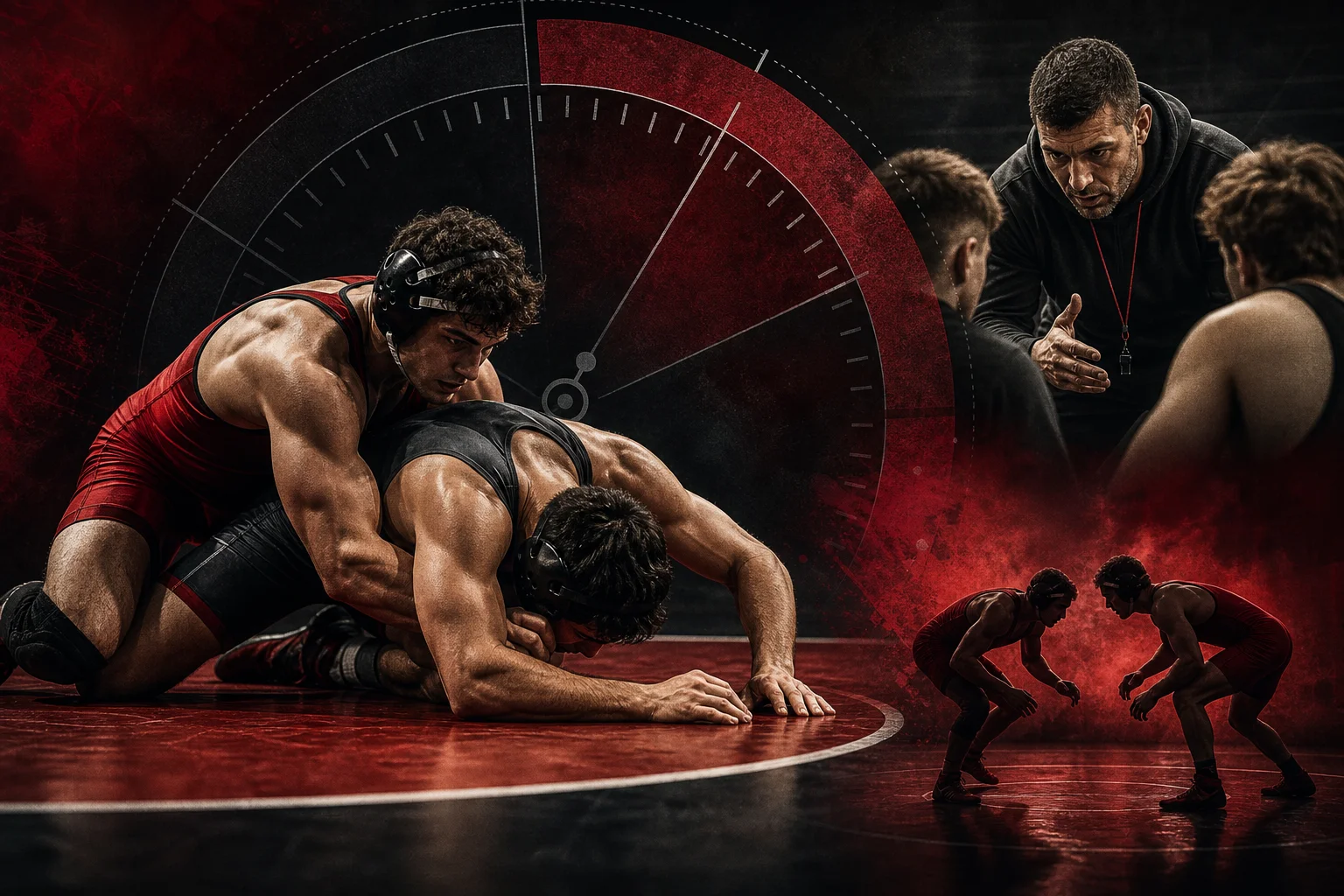
90 Minutes, Tested for 2026-27: A Wrestling Practice Template That Actually Runs on Time—Not Just Harder
A good wrestling practice is not a pile of hard activities. It is a planned 90 minutes where every block has a job: prepare the body, sharpen positions, build match skill, stress-test decision-making, and send athletes home healthy enough to improve again tomorrow.
For high school programs, 90 minutes is often the sweet spot. It is long enough to cover warmup, technical drilling, situational wrestling, live go’s, conditioning, and a short cool-down. It is also short enough to protect academic time, manage facility schedules, and reduce the “more is better” trap that leads to sloppy reps and preventable injuries.
This template is built for coaches who need a repeatable structure, athletes who want to understand why practice is organized the way it is, and officials or rules-minded staff who want practice habits to match NFHS expectations for the 2025-26 season.
The goal is simple: run a practice that is intense, safe, teachable, and on time.
Why 90 Minutes Works for Wrestling Practice
Wrestling demands technical precision under fatigue. A wrestler has to hand fight, penetrate, sprawl, finish, ride, escape, defend near-fall, recover, and reset within short bursts. A practice plan should reflect that.
A 90-minute session gives a coach enough room to train four key needs:
- Movement readiness — Athletes must be warm, mobile, and mentally alert before contact.
- Skill acquisition — New or refined technique needs low-chaos repetitions.
- Skill application — Wrestlers must apply technique against resistance.
- Competitive stress — Live wrestling and situational scoring teach decision-making under pressure.
The problem with many practices is not lack of effort. It is poor time design. Coaches talk too long, transitions are loose, water breaks become social breaks, live wrestling starts late, and the final 15 minutes turn into random conditioning that has little connection to match needs.
A 90-minute template fixes that by giving every segment a time budget.
The Core 90-Minute Practice Template
This is the base structure. It can be adjusted for age, experience, roster size, practice room space, and the point of the season.
| Time | Segment | Purpose | Coaching Focus |
|---|---|---|---|
| 0:00–0:10 | Dynamic warmup and movement prep | Raise temperature, prepare joints, activate wrestling movement | Pace, stance, footwork, clean motion |
| 0:10–0:20 | Stance, motion, hand-fighting, pummeling | Connect warmup to wrestling positions | Head position, motion, pressure, balance |
| 0:20–0:40 | Technical instruction and drilling | Teach or refine one main skill | Short instruction, high reps, correct details |
| 0:40–0:55 | Positional drilling with resistance | Turn technique into usable skill | Start positions, scoring goals, quick feedback |
| 0:55–1:15 | Situational live wrestling | Train match problems | Short go’s, specific scores, mat awareness |
| 1:15–1:25 | Live wrestling or match simulation | Competitive application | Effort, tactics, official-style starts/stops |
| 1:25–1:30 | Cool-down, reset, announcements | Downshift, reinforce lesson, reduce chaos | Breathing, mobility, next steps |
This template is not meant to make every practice feel identical. It is meant to make every practice understandable. The content changes; the structure stays dependable.
Minute 0–10: Dynamic Warmup and Movement Prep
The first 10 minutes set the tone. A warmup should not be punishment, and it should not be a slow jog followed by casual stretching. It should prepare athletes for the positions they will use in practice.
A good wrestling warmup includes:
- Forward, backward, and lateral movement
- Hip mobility
- Shoulder and neck preparation
- Stance motion
- Penetration steps
- Sprawls
- Short acceleration and deceleration
- Rolls, hip heists, and mat returns to base
A sample 10-minute warmup:
| Minute | Activity |
|---|---|
| 0:00–0:02 | Light jog, backpedal, shuffle, carioca |
| 0:02–0:04 | Dynamic mobility: lunges, hip circles, inchworms |
| 0:04–0:06 | Stance motion: circle, level change, down-block |
| 0:06–0:08 | Penetration steps, sprawls, hip heists |
| 0:08–0:10 | Partner movement: mirror drill or light hand touch |
The coach should watch the room during the warmup. Are athletes dragging? Are they favoring a knee, shoulder, or ankle? Are partners mismatched? Is anyone returning from illness, skin infection, concussion protocol, or injury?
The warmup is also a health screen. It gives the staff a chance to catch problems before contact increases.
Keep Static Stretching in Its Proper Place
Long static holds are usually better after practice or in a separate mobility block, not as the main pre-contact warmup. Before drilling, athletes need controlled movement, gradual intensity, and position-specific preparation.
That does not mean flexibility is unimportant. It means the warmup should match the demands of wrestling: stance, pressure, motion, contact, and fast reactions.
Minute 10–20: Stance, Motion, and Hand-Fighting
This is where the practice becomes unmistakably wrestling.
The biggest mistake in this block is letting athletes stand tall and drift through reps. Every movement should reinforce match position:
- Knees bent
- Hips loaded
- Head up
- Hands active
- Feet moving without crossing unnecessarily
- Elbows in
- Forehead, shoulder, or hand position used with purpose
Good options for this 10-minute block include:
Mirror Drill
Partners face each other in stance. One leads; the other mirrors. Add level changes, fake shots, down-blocks, and short angle changes.
Coaching points:
- No standing straight up
- Stay within striking distance
- Do not overreach
- Move feet before reaching with hands
Hand-Fighting Progression
Start light, then build pressure.
- Inside ties only
- Collar tie and elbow control
- Wrist control to elbow pass
- Underhook or two-on-one entry
- Short go: first clean angle or first opponent step-out pressure win
This block should not become live wrestling yet. It should teach athletes how to create the conditions for scoring.
Pummeling With Purpose
Pummeling is often done mindlessly. Fix that by adding a task:
- Win inside position and hold for three seconds
- Move opponent’s feet before attacking
- Clear an underhook without backing straight up
- Transition from pummel to snap, go-behind, or single-leg entry
A coach can raise intensity without turning the room loose. The difference is that every rep still has a job.
Minute 20–40: Technical Instruction and Drilling
This 20-minute block is the heart of skill development. It should focus on one main theme, not six unrelated moves.
A strong technical block follows this sequence:
- Show the position
- Explain the scoring purpose
- Demonstrate the key details
- Let athletes drill quickly
- Stop briefly to correct the biggest error
- Resume reps
- Add a small amount of resistance
The coach’s instruction should be short. Wrestlers learn by doing, but they need the right cues before they repeat a mistake 30 times.
Choose One Main Skill
Examples:
- High-crotch finish to the far ankle
- Single-leg crackdown defense
- Stand-up from bottom with hand control
- Tight waist chop to wrist ride
- Spiral ride to breakdown
- Half nelson setup from a legal ride position
- Front headlock go-behind
- Mat return from rear standing position
- Defending a leg ride
- Short offense after opponent’s failed shot
One practice theme might be: “Score from a front headlock without reaching over the back.”
Another might be: “Bottom wrestler gets to feet and clears hands before turning in.”
The key is to connect the technique to scoring. Wrestlers should know whether they are trying to earn a takedown, escape, reversal, near-fall, or simply prevent the opponent from scoring.
Keep NFHS Scoring in the Room
For the 2025-26 NFHS season, high school wrestlers should practice with current scoring expectations. Coaches should make sure athletes understand that:
- A takedown is worth 3 points when control is established from neutral.
- An escape is worth 1 point.
- A reversal is worth 2 points.
- Near-fall is awarded as 2, 3, or 4 points depending on the count and criteria.
- Illegal holds, unnecessary roughness, technical violations, unsportsmanlike conduct, and stalling can affect a match just as much as a scoring move.
Practices should reflect that reality. If takedowns are worth 3, neutral control and finishing cleanly matter even more. If near-fall can create major separation, top wrestling must include legal turns, pressure, and control. If escapes remain 1, bottom wrestlers must learn that getting away is valuable but may not be enough if they give up repeated takedowns.
Drill in Short Rounds
Instead of saying, “Drill this for 10 minutes,” use short rounds:
- 60 seconds right side
- 60 seconds left side
- 30 seconds coach correction
- 60 seconds with motion before the attack
- 60 seconds with partner giving light resistance
- 60 seconds with partner reacting realistically
Short rounds keep the room sharp. They also help coaches see who is actually getting reps.
The “Three-Cue” Rule
Most athletes cannot process a long speech during practice. Give three cues.
For a single-leg finish:
- Head up
- Hands locked or controlled above the knee
- Cut the corner before finishing
For a stand-up:
- Hand control first
- Hips up
- Turn and face after clearing pressure
For a half nelson:
- Legal arm position
- Chest pressure
- Run feet, do not crank the neck
This is also a safety point. Athletes must understand the difference between legal pressure and dangerous force. Coaches should correct any action that resembles a full nelson, twisting of joints, unnecessary force to the head or neck, or lifting and returning an opponent without control.
Minute 40–55: Positional Drilling With Resistance
This is where technique starts to become wrestling.
Positional drilling is not full live. It is controlled resistance from a specific start. The coach chooses the position, the goal, and the restart rule.
Examples:
Neutral Position: Finish or Defend
Start with one wrestler in on a single leg. The offensive wrestler has 10 seconds to finish. The defensive wrestler tries to square up, sprawl, whizzer, or force a stalemate-style reset.
Scoring:
- Offense scores: 1 rep point
- Defense clears: 1 rep point
- Unsafe scramble: stop and restart
Bottom Position: First Move Wins
Start in referee’s position. Bottom wrestler’s goal is to get to feet, clear hands, and escape. Top wrestler’s goal is to break down or return with control.
Use official-style starts. Require top and bottom wrestlers to set properly before the whistle. This helps athletes avoid false starts and sloppy habits.
Top Position: Turn or Ride
Top wrestler has 20 seconds to secure a legal turn or maintain control while working. Bottom wrestler has 20 seconds to build base, clear ties, and escape.
Coaching points:
- Top pressure must be legal.
- Bottom should not sit flat and wait.
- Coaches should stop potentially dangerous positions early.
Edge Position: Wrestle Until the Whistle
Edge wrestling should teach mat awareness, not reckless action. Wrestlers need to know where they are, keep wrestling through legal positions, and respond to the official’s whistle.
NFHS rules define inbounds, out of bounds, control, and scoring situations with specific criteria. Coaches do not need to turn every athlete into a rules expert, but they should teach this habit: do not stop just because a foot touches near the boundary. Continue legally until the official stops the action or awards points.
This is a good place to involve an assistant coach or experienced athlete as a practice official. Use a whistle. Signal points. Restart correctly. If athletes learn the rhythm of officiated wrestling in practice, they are less likely to complain or freeze in competition.
Minute 55–75: Situational Live Wrestling
Situational live wrestling is one of the highest-value parts of practice. It creates match stress without using full matches every day.
Use short rounds, clear scoring goals, and quick partner rotation.
Recommended Situational Rounds
| Situation | Time | Goal |
|---|---|---|
| Neutral, tied score | 45 seconds | Score first takedown |
| Down by 1, bottom | 30 seconds | Escape or reversal |
| Up by 1, top | 30 seconds | Ride legally, avoid stall habits |
| Down by 3, neutral | 45 seconds | Attack to score, not panic |
| Short time, edge of mat | 20 seconds | Finish or defend legally |
| Near-fall defense | 20 seconds | Fight off back safely and legally |
| Overtime-style neutral | 60 seconds | Best attack under pressure |
The scoreboard changes behavior. A wrestler who attacks freely in neutral may freeze when down by one with 25 seconds left. A top wrestler who can ride for a full minute in practice may make poor choices when warned for stalling. Situational live exposes those gaps.
Coach the Score, Not Just the Move
During situational live, talk in match language:
- “You are down by two. What score do you need?”
- “You are up by one. Do not force a risky turn.”
- “Twenty seconds left. Get to your best attack.”
- “Bottom wrestler: first movement must be hand control.”
- “Top wrestler: return safely and improve.”
Wrestlers need to learn that tactics change with time and score. A desperate headlock attempt with five seconds left may be smart in one situation and a poor choice in another.
Use Officials’ Signals in Practice
When a coach or assistant acts as the official, use the correct signals and language whenever possible:
- Takedown
- Escape
- Reversal
- Near-fall count
- Potentially dangerous
- Illegal hold
- Stalling warning or penalty
- Out of bounds
- Restart
Athletes who recognize official mechanics are better prepared for matches. Coaches also reduce sideline confusion when everyone in the room has practiced under the same signals.
Minute 75–85: Live Wrestling or Match Simulation
This is the most intense part of the session, but it does not need to be the longest. Ten minutes of focused live wrestling can be more valuable than 30 minutes of exhausted, low-quality wrestling.
Choose the live format based on the day’s training goal.
Option 1: Short Live Go’s
Use 30- to 60-second rounds with quick rotation.
Best for:
- High pace
- Takedown focus
- Conditioning through wrestling
- Large rooms with many partners
Example:
- 5 rounds x 60 seconds
- 15 seconds to switch partners
- Start neutral each time
- Score must be called out after every round
Option 2: Full Period Simulation
Use 2-minute periods to match high school varsity structure. NFHS high school matches commonly use three 2-minute periods at the varsity level, though states and events may set modifications for sub-varsity, middle school, or special formats.
Best for:
- Tournament preparation
- Period strategy
- Riding time feel, even though NFHS folkstyle does not use college riding time scoring
- Conditioning for real match pacing
Example:
- One 2-minute neutral period
- One 2-minute top/bottom period
- One 2-minute choice period
- Partners keep score
Option 3: One Match, Coached Hard
Pick one live match in the room while others watch briefly, then rotate.
Best for:
- Teaching mat awareness
- Showing official signals
- Correcting tactical errors
- Building team standards
Keep this tight. Athletes do not need to stand around for 20 minutes. Use one match for two or three key teaching points, then get everyone moving again.
Option 4: Shark Bait
One wrestler stays in for several short goes against fresh partners.
Best for:
- Preparing a starter for a tough opponent
- Testing conditioning
- Training bottom escape under fatigue
- Building mental toughness
Use this carefully. Shark bait can become unsafe if the athlete is overwhelmed, injured, or exhausted beyond control. Coaches should stop the drill when technique disappears or safety drops.
Minute 85–90: Cool-Down, Reset, and Close
The final five minutes should not be ignored. A short cool-down helps bring the room down physically and mentally.
A good close includes:
- Slow breathing
- Light jogging or walking
- Hip and shoulder mobility
- Brief static stretching
- Hydration reminder
- Injury check
- One key lesson from practice
- Tomorrow’s focus
Example close:
“Today was about finishing clean after contact. Takedowns are 3 points, so finishing matters. If your head drops, you lose position. Tomorrow we build from that into mat returns and first ride. Check skin, hydrate, and report injuries before you leave.”
This is also the time to reinforce team standards. Clean the mats if that is the team routine. Remind athletes to shower, wash gear, and report skin concerns. Do not let wrestlers leave with open questions about injuries, weight, or return-to-play issues.
How to Vary Intensity Across the Week
A 90-minute template works best when the weekly load is planned. Every practice should not be a war. Hard practices are necessary, but repeated max-intensity days can lead to poor learning, low energy, and injury risk.
A simple weekly structure:
| Day | Intensity | Main Goal | Live Volume |
|---|---|---|---|
| Monday | Medium-high | Correct weekend issues, build one technical theme | Moderate |
| Tuesday | High | Hard situational wrestling and conditioning | High |
| Wednesday | Medium | Skill volume, position repair, controlled resistance | Low to moderate |
| Thursday | Medium-low if competing soon; high if no event | Match prep, sharpness, weight-class planning | Low |
| Friday | Low to medium, depending on competition | Weigh-in readiness, drilling, starts, strategy | Very low |
| Saturday | Competition or controlled team session | Perform or simulate matches | Event-based |
| Sunday | Off or active recovery | Recovery, mobility, treatment | None |
This is not a fixed rule. A team that competes on Wednesday and Saturday needs a different rhythm than a team that wrestles only on weekends. Younger athletes need more teaching and less grind. Experienced varsity wrestlers may handle more live wrestling, but only if their technique and recovery support it.
Hard Days
A hard day should have a reason. It might be used to:
- Prepare for a dual meet
- Build third-period pace
- Test bottom wrestling
- Create pressure situations
- Separate lineups through wrestle-offs
- Prepare for tournament fatigue
Hard does not mean careless. A hard day still needs proper warmup, legal technique, safe returns, and coaching control.
Medium Days
Medium days are often the best teaching days. Athletes are working, sweating, and competing, but they are not so exhausted that they cannot learn.
Use medium days for:
- New technique
- Chain wrestling
- Top and bottom improvements
- Scramble control
- Rule situations
- Edge wrestling
- Short live rounds
Low Days
Low days matter. They keep athletes sharp without adding unnecessary stress.
Use low days for:
- Stance and motion
- Short drilling
- Starts and restarts
- Strategy review
- Film connection
- Mobility
- Injury management
- Mental preparation
A low day before competition is not a wasted day. It is often the reason athletes feel fast, confident, and ready.
Building Practices Around the Season
The same 90-minute structure can serve different parts of the year.
Preseason
The preseason should build movement quality, general conditioning, and basic wrestling positions. Avoid throwing athletes into heavy live wrestling before they are ready for contact.
Priorities:
- Stance and motion
- Mat movement
- Safe falling and returning
- Basic shots and sprawls
- Bottom base and stand-up
- Top pressure and breakdowns
- Conditioning through controlled wrestling
Early Season
Early season practices should establish team identity and scoring habits.
Priorities:
- Clean takedown finishes
- Legal top pressure
- Escapes from bottom
- Match scoring awareness
- Official-style starts
- Conditioning that matches wrestling pace
- Safe intensity progression
Midseason
Midseason is where practice design becomes more individualized. Wrestlers now have match data. Coaches can see patterns.
Priorities:
- Fix repeated errors
- Prepare for known opponents
- Increase situational live
- Manage fatigue
- Protect injured athletes
- Reinforce rules and mat awareness
- Plan weight responsibly
Postseason
Postseason practices should be sharp, focused, and confidence-building. This is not the time to rebuild a wrestler from scratch.
Priorities:
- Best attacks
- Best finishes
- First escape
- Favorite ride or turn
- Short-time situations
- Overtime situations
- Recovery and readiness
Designing the Technical Theme
A practice should have a clear theme. If the coach cannot state the theme in one sentence, the practice may be too scattered.
Good themes:
- “Finish single legs when the opponent sprawls heavy.”
- “Escape in the first 10 seconds from bottom.”
- “Use legal wrist control to create turns.”
- “Score from front headlock without forcing dangerous pressure.”
- “Win the last 30 seconds of each period.”
Weak themes:
- “Work hard.”
- “Get better.”
- “Do some neutral.”
- “Condition.”
- “Review everything.”
Effort matters, but effort needs direction.
Connect the Theme Across Blocks
If the theme is finishing from neutral, the practice might look like this:
- Warmup: penetration steps and angle changes
- Hand-fighting: create angle from collar tie
- Technique: single-leg finish from crackdown
- Positional: start in on single leg
- Situational: tied score, 30 seconds left, need takedown
- Live: neutral-only short go’s
- Close: key finish cues
That is how a 90-minute session becomes one connected lesson instead of a list of activities.
Managing Roster Size and Mat Space
Not every team has ideal room conditions. Some teams have 12 athletes and two full mats. Others have 60 athletes in a tight room.
Large Teams
For large teams:
- Use stations
- Split varsity and developmental groups when possible
- Assign captains to lead warmup lines
- Use short rotation rounds
- Keep instruction brief
- Mark mat areas for specific positions
- Pair by size, skill, and safety
A station setup might include:
- Neutral finishes
- Bottom stand-ups
- Top breakdowns
- Conditioning movement
- Rules and restart station
Rotate every six minutes. Coaches float and correct.
Small Teams
For small teams:
- Rotate partners often
- Use assistant coaches or alumni carefully if allowed by school policy
- Film reps for feedback
- Build individualized plans
- Avoid overusing the same partner matchup every day
Small rooms can produce fast improvement because coaching feedback is immediate. The risk is repetition against the same style. Coaches should vary start positions and scoring goals to keep learning broad.
Safety and NFHS Rules Habits in Practice
Practice should teach legal wrestling. Athletes tend to compete the way they train.
Coaches should stop and correct:
- Full nelsons
- Headlocks without proper arm control
- Illegal pressure on the neck or spine
- Twisting knees, ankles, or fingers
- Slams or uncontrolled mat returns
- Scissors around the head
- Potentially dangerous scrambles
- Unnecessary roughness after the whistle
- Hands to the face or eyes
- Grabbing uniform in ways that create a technical violation or unsafe action
A practice room does not need constant lectures, but it does need a clear standard: legal, hard wrestling is expected; dangerous wrestling is stopped immediately.
Teach Potentially Dangerous Positions
Wrestlers should know that an official may stop action before an illegal hold occurs if a position becomes potentially dangerous. That is not “saving” one athlete unfairly. It is part of the official’s job to protect competitors while applying the rules.
Coaches can help athletes by teaching safe reactions:
- Roll hips instead of twisting the knee
- Release and improve instead of cranking
- Return opponents under control
- Keep pressure across the body, not through the neck
- Stop when the whistle blows
Practice Restarts Correctly
Many points and penalties come from starts and restarts. Use official-style starts in practice:
- Bottom wrestler set in proper position
- Top wrestler set legally
- Neutral starts with both athletes ready
- Whistle starts action
- Wrestlers stop on the whistle
False starts, caution patterns, and sloppy positioning are preventable. Make restarts part of training, not an afterthought.
Athlete Health: Weight, Hydration, Skin, and Recovery
A responsible practice plan includes athlete health. Wrestling has weight classes, but that does not justify unsafe weight loss.
Coaches should not promote crash cutting, dehydration, sauna suits, spitting, food restriction, or last-minute weight drops. Athletes should follow their state association’s weight-management rules, school policies, and medical guidance. NFHS-aligned programs commonly include hydration and body composition assessment, minimum weight standards, and descent limits set by the state association.
Hydration
Hydration should be a daily habit, not a weigh-in trick. Dehydrated athletes are less able to regulate temperature, concentrate, recover, and perform. Build short water breaks into practice and keep them controlled.
A water break should be:
- Scheduled
- Brief
- Available to all athletes
- Not used as a reward or punishment
- Adjusted for heat, room conditions, and practice intensity
Skin Health
Skin checks are part of wrestling safety. Coaches should encourage athletes to report rashes, lesions, or infections early. Athletes should not hide skin issues to stay in the lineup.
Team standards:
- Shower soon after practice
- Wash practice gear daily
- Do not share towels
- Clean headgear and knee pads
- Disinfect mats according to school procedures
- Report skin concerns before contact
Concussion and Injury Response
If an athlete shows signs of concussion or significant injury, remove the athlete from practice and follow school, state, and medical return-to-play procedures. Coaches should not diagnose from the corner or allow an athlete to “tough it out” through a possible head injury.
Pain that changes movement is information. If a wrestler is limping, protecting a shoulder, or avoiding contact, the practice plan should adjust.
Conditioning Inside a 90-Minute Practice
Wrestling conditioning should not always mean sprints after practice. Much of the best conditioning comes from high-quality wrestling intervals.
Conditioning can be built through:
- Short neutral go’s
- Bottom escape rounds
- Mat return chains
- Hand-fighting intervals
- Stance motion under pressure
- Situational live with score demands
- Partner carries only when safe and appropriate
- Short finish flurries
The question is not, “Are they tired?” The question is, “Are they getting better while tired?”
A good conditioning block maintains wrestling posture and decision-making. Once athletes stand tall, reach lazily, stop moving their feet, or become unsafe, the coach should change the task or end the round.
Common Practice Design Mistakes
Mistake 1: Teaching Too Many Moves
Athletes do not need five new attacks in one day. They need one skill they can actually use.
Fix: Pick one main theme and connect every block to it.
Mistake 2: Live Wrestling Too Early
If live starts before athletes are warm or technically prepared, practice becomes chaotic.
Fix: Build from movement to technique to resistance to live.
Mistake 3: Conditioning as Punishment
Conditioning tied to anger often creates resentment and poor movement.
Fix: Use conditioning to train match needs: pace, recovery, stance, and scoring under fatigue.
Mistake 4: Ignoring Bottom Wrestling
Neutral is exciting, but bottom wrestling wins and loses high school matches.
Fix: Include bottom work daily, even if only for 10 minutes.
Mistake 5: No Time Awareness
If the coach spends 18 minutes explaining a move, the room loses reps.
Fix: Use a timer. Plan transitions. Keep instruction short.
Mistake 6: No Rules Integration
Athletes who never practice with whistles, restarts, points, and boundary situations are less prepared for real matches.
Fix: Add official-style language and scoring to live blocks.
Sample 90-Minute Practice: Neutral Finish Day
Here is a complete session using the template.
| Time | Block | Content |
|---|---|---|
| 0:00–0:10 | Warmup | Dynamic movement, stance motion, penetration steps, sprawls |
| 0:10–0:20 | Hand-fighting | Collar tie to angle, wrist control to attack, motion before shot |
| 0:20–0:30 | Technique 1 | Single-leg finish: head up, corner cut, cover hips |
| 0:30–0:40 | Technique 2 | Finish when opponent sprawls: shelf leg, climb, turn corner |
| 0:40–0:55 | Positional | Start in on single; 10 seconds to finish or defend |
| 0:55–1:05 | Situational | Tied match, 45 seconds left, neutral start |
| 1:05–1:15 | Situational | Down by 3, need takedown and turn attempt |
| 1:15–1:25 | Live | Five 60-second neutral go’s, rotate partners |
| 1:25–1:30 | Cool-down | Breathing, stretch, key cues, hydration and skin reminder |
Key coaching phrase:
“A 3-point takedown changes matches. Finish clean, cover control, and keep wrestling until the whistle.”
Sample 90-Minute Practice: Bottom Escape Day
| Time | Block | Content |
|---|---|---|
| 0:00–0:10 | Warmup | Hip heists, stand-ups, back pressure movement |
| 0:10–0:20 | Position prep | Referee’s position starts, first move reaction |
| 0:20–0:32 | Technique 1 | Stand-up with hand control |
| 0:32–0:40 | Technique 2 | Cut, turn, and face after clearing hands |
| 0:40–0:55 | Positional | Bottom has 15 seconds to escape; top rides legally |
| 0:55–1:05 | Situational | Down by 1, third period, bottom choice |
| 1:05–1:15 | Situational | Top wrestler up by 1, must ride without stalling |
| 1:15–1:25 | Live | One 2-minute period from referee’s position, partner choice |
| 1:25–1:30 | Cool-down | Mobility, scoring reminder, injury check |
Key coaching phrase:
“Bottom wrestling starts before the whistle: set position, know your first move, and clear hands before turning.”
Sample 90-Minute Practice: Top Control and Turns
| Time | Block | Content |
|---|---|---|
| 0:00–0:10 | Warmup | Shoulder prep, hip pressure movement, mat returns to control |
| 0:10–0:20 | Partner prep | Spiral pressure, wrist control, safe breakdown motion |
| 0:20–0:32 | Technique 1 | Tight waist chop to wrist control |
| 0:32–0:40 | Technique 2 | Legal half nelson setup from controlled ride |
| 0:40–0:55 | Positional | Top has 20 seconds to turn; bottom builds base |
| 0:55–1:05 | Situational | Top up by 2, ride and improve without forcing |
| 1:05–1:15 | Situational | Need near-fall late in match |
| 1:15–1:25 | Live | Top-bottom go’s, 45 seconds each, switch partners |
| 1:25–1:30 | Cool-down | Neck and shoulder reset, legal pressure reminder |
Key coaching phrase:
“Top pressure must be legal and controlled. Turns come from position, not cranking.”
How Coaches Should Evaluate a Practice
After practice, a coach should be able to answer five questions:
- Did the main theme show up in every block?
- Did athletes get enough quality repetitions?
- Did live wrestling connect to match scoring?
- Were safety and NFHS rules habits reinforced?
- Did the session end with athletes ready to train again?
If the answer is no, adjust the next practice. Good coaching is not writing a perfect plan once. It is building a plan, watching the room, and improving the next session.
The 90-Minute Template Coaches Can Reuse
Here is the clean version:
| Time | Segment | What to Do |
|---|---|---|
| 0:00–0:10 | Warmup | Dynamic movement, stance, mobility |
| 0:10–0:20 | Wrestling movement | Hand-fighting, pummeling, motion |
| 0:20–0:40 | Technique | One main skill, short instruction, many reps |
| 0:40–0:55 | Positional resistance | Specific starts, clear scoring goals |
| 0:55–1:15 | Situational live | Score, time, and position-based wrestling |
| 1:15–1:25 | Live or simulation | Short go’s, periods, or match situations |
| 1:25–1:30 | Cool-down | Breathing, mobility, health check, lesson |
The best practice plan is not the one that looks impressive on paper. It is the one athletes can execute, coaches can manage, and officials would recognize as legal wrestling. Keep the room organized. Train the score. Protect athlete health. Make every minute count.
Ready to build cleaner practice plans across your staff? Use WrestleFlow Teams to organize drills, save coach playbooks, plan 90-minute sessions, and keep your wrestling program aligned from warmup to live wrestling.