Wrestling Recruiting Film: How to Cut a Highlight Reel That Gets Noticed
What college wrestling coaches want to see in recruiting film — match selection, editing structure, length, and how to distribute your tape.
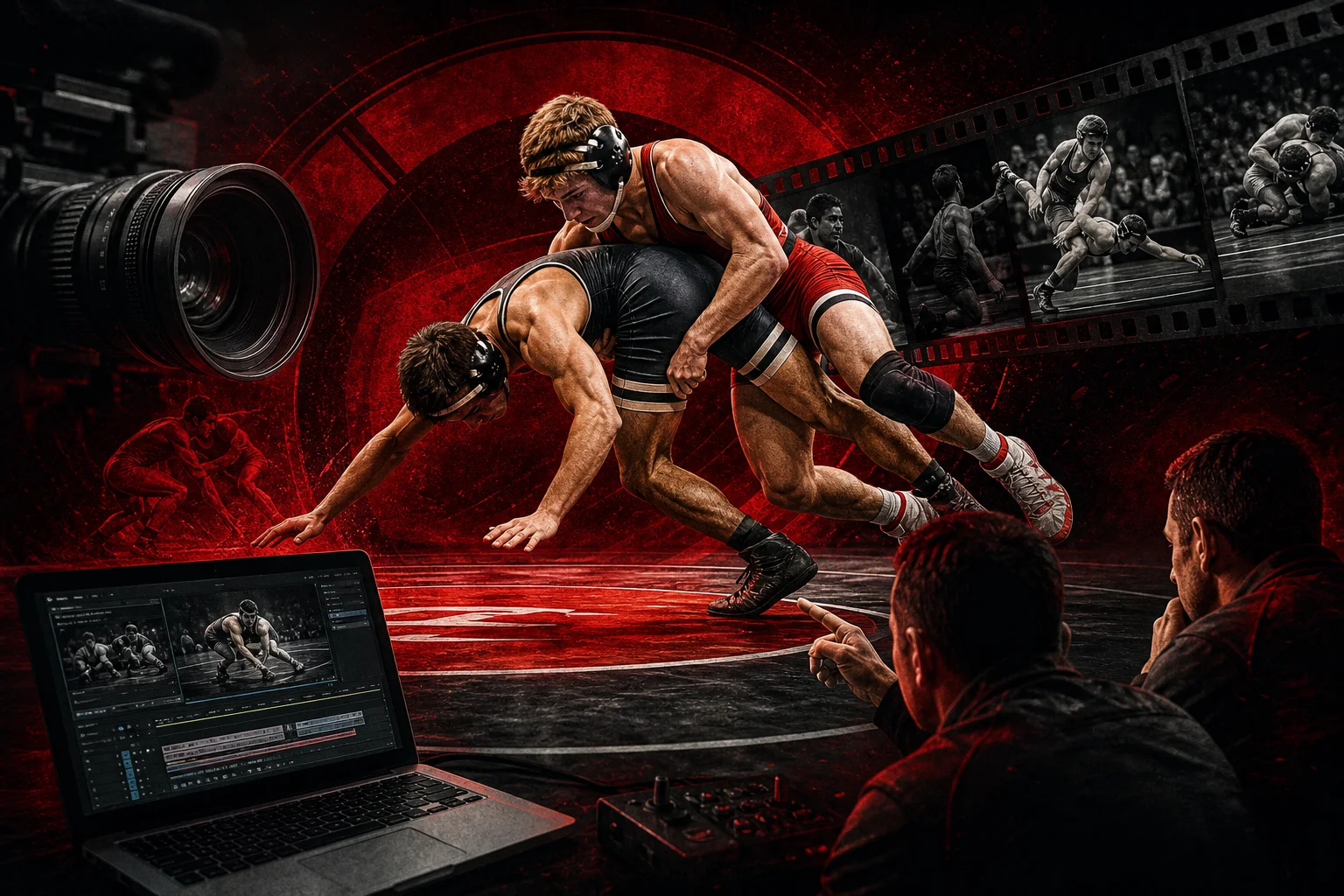
2025 Wrestling Recruiting Film: 7 Tested Edits That Actually Help Coaches Evaluate You—Not Just Your Best Moves
College wrestling coaches do not need a music video. They need clear evidence.
A good recruiting film helps a coach answer practical questions quickly: Can this wrestler score on quality opponents? Can they hand fight, defend, ride, get away, manage match situations, and compete hard when the first attack fails? Does the athlete understand mat awareness and position? Are the results repeatable against credible competition?
A highlight reel can open the door, but it should not hide the wrestler. The best recruiting film is clean, honest, organized, and easy to watch on a phone between practices, travel, and admissions meetings. Coaches may watch hundreds of clips during a recruiting cycle. Your job is to make their evaluation easier.
This guide covers what to include, what to leave out, how long the reel should be, how to handle full matches, and how to distribute your film professionally.
What Coaches Are Really Looking For
A college coach is not only asking, “Can this athlete hit big moves?” They are asking, “Can this athlete help our program?”
That means your film should show the traits that translate to college wrestling:
- Position before points
- Consistent hand fighting and pressure
- Leg attack finishes against resistance
- Defense that does not panic
- Mat returns and top pressure
- Escapes against real rides
- Pace late in periods
- Awareness near the edge
- Ability to wrestle through bad positions
- Clean, legal wrestling under NFHS rules
- Coachability and competitive behavior
A five-second throw can be exciting, but coaches will also notice what happened before it. Did you create the angle? Did your opponent step into it because of pressure? Was the score already out of reach? Was the opponent a state qualifier, a backup, or someone clearly overmatched?
Your film should help a coach see the difference.
The Recruiting Film Package: Highlight Reel Plus Full Matches
A serious recruiting package should have two parts:
- A short highlight reel
- Several full match links
The highlight reel earns attention. The full matches support the evaluation.
Coaches often start with the highlight reel because it is fast. If they are interested, they will want full matches to confirm what they saw. A reel that only shows pins and big takedowns is incomplete if there are no full matches attached.
Recommended Film Package
| Film Type | Ideal Length | Purpose | What to Include |
|---|---|---|---|
| Highlight reel | 3–5 minutes | Quick first impression | Best scoring sequences, defense, top work, escapes, pace |
| Full match 1 | Full match | Quality win | Strong opponent, competitive setting |
| Full match 2 | Full match | Tough match | Close match, late scoring, response to pressure |
| Full match 3 | Full match | Style evidence | Shows pace, mat wrestling, or positional strength |
| Optional bonus match | Full match | Context | A loss where you wrestled well against an elite opponent |
A good loss can be more useful than a bad win. If you lose 4-2 to a nationally ranked opponent and wrestle hard for six minutes, that may tell a coach more than a 30-second pin over an inexperienced wrestler.
1. Start With the Right Matches
The biggest mistake athletes make is building a reel around moves instead of match quality.
College coaches care who you wrestled, where the match happened, and how the sequence developed. A takedown in a state semifinal is not the same as a takedown in a lopsided dual. Both may belong in your film, but the stronger context should appear earlier.
Prioritize These Matches
Use footage from:
- State tournament matches
- State placement matches
- Regional or sectional finals
- National events
- High-level offseason tournaments
- Matches against state qualifiers, placers, or ranked opponents
- Competitive duals where team score pressure mattered
- Close matches where you had to make adjustments
Do not build the entire reel from matches where the opponent offered little resistance. Coaches can spot that quickly.
Include Multiple Positions
Wrestling is not only neutral offense. A complete recruit can be evaluated in all three positions:
- Neutral: stance, motion, hand fighting, setups, attacks, re-attacks, edge wrestling
- Top: breakdowns, pressure, mat returns, turns, riding control, legal pinning combinations
- Bottom: first move, hand control, hip separation, stand-ups, switches, granbys when appropriate, ability to clear legs
- Scrambles: recovery, hip position, control, patience, finishing discipline
- Match management: clock awareness, score awareness, choice selection, late-period wrestling
If your reel is only double legs and pins, it may look impressive for 45 seconds, then feel incomplete.
2. Build the Reel in the Order Coaches Prefer
A recruiting reel should not be edited like a social media clip. It should be edited like an evaluation tool.
The first 20 seconds matter. A coach should immediately know who they are watching, what weight class the athlete competes at, graduation year, school or club, and how to contact the athlete or coach.
Suggested Opening Slate
Use a simple title card for 5–7 seconds:
- Full name
- Graduation year
- High school and club
- City and state
- Current weight class and projected college weight, if appropriate
- GPA and test score if you choose to include them
- Contact email and phone
- High school coach contact
- Club coach contact
Keep it readable. Do not use tiny text, distracting colors, or animated effects that waste time.
Recommended Reel Structure
A clean structure looks like this:
- Opening slate
- Best 3–5 scoring sequences against strong opponents
- Neutral offense and re-attacks
- Defense and scrambling
- Top work and turns
- Bottom escapes and reversals
- Late-match or pressure situations
- Closing slate with full match links and contact information
This order helps the coach see your strongest evidence first, then evaluate your range.
Why You Should Not Save the Best Clip for Last
Do not make coaches wait. Put your best sequence early, especially if it came against a strong opponent in a meaningful match.
The first clip should answer: “Why should I keep watching?”
A clean takedown against a state placer, a turn in a high-stakes match, a late go-ahead score, or a strong defensive sequence can all work. Choose a clip that shows skill, not just flash.
3. Keep It Short Enough to Finish
The ideal highlight reel is usually 3 to 5 minutes. Some elite recruits can justify a longer reel, but most athletes should avoid going past 6 minutes.
A coach who wants more will click the full matches. A coach who is not interested after five minutes probably will not be won over by minute nine.
Practical Length Guide
| Athlete Situation | Highlight Reel Length | Notes |
|---|---|---|
| Freshman or sophomore with limited varsity footage | 2–3 minutes | Focus on quality and improvement |
| Junior beginning serious recruiting contact | 3–5 minutes | Add full matches and clear contact info |
| Senior with strong results | 4–6 minutes | Open with best competition and current season footage |
| National-level recruit | 5–7 minutes | Still keep editing tight; full matches matter more |
| Transfer or post-grad prospect | 4–6 minutes | Include recent competition and full match links |
Short does not mean shallow. It means every clip has a reason to be there.
4. Show the Setup, Not Just the Finish
One of the most common film errors is cutting too late.
If the clip begins when you already have your opponent’s leg in the air, the coach cannot evaluate how you got there. They need to see the setup, the hand fight, the level change, the angle, and the reaction.
Better Clip Timing
For most scoring sequences, start the clip:
- 3–5 seconds before the attack
- Earlier if the setup is important
- At the whistle if the clip is about first move or short offense
- At the restart if the clip is about top or bottom
End the clip:
- After the score is clearly awarded
- After control is established
- After the mat return is completed
- After the near-fall count or pinning sequence is clear
- Before dead time begins
Do not cut so fast that the sequence becomes hard to judge.
Example: Neutral Attack
Weak edit: clip starts with the opponent already on one leg.
Strong edit: clip starts with your collar tie, opponent reacts to pressure, you clear the tie, create an angle, attack, finish through a whizzer, and cover for the takedown.
The second version shows college-level information.
5. Make the Wrestler Easy to Identify
If the coach has to guess which wrestler is you, the edit has failed.
Use simple visual markers:
- Add an arrow or circle for the first second of each clip
- Identify singlet color in the opening slate
- Use a short lower-third label if needed
- Avoid covering the action with text
- Do not use bright graphics that block hand control, hips, or feet
A small arrow at the beginning of each clip is enough. You do not need flashing effects.
Keep Camera Angles Usable
Good film does not need to be cinematic. It needs to be clear.
The best camera position is usually elevated and centered, far enough back to show both wrestlers’ full bodies, the boundary, and the official. Avoid filming from floor level behind a crowd if possible.
For tournaments, ask a parent, teammate, or manager to record from the stands at a slight angle. For duals, use a tripod if allowed. If your program uses a video system, export clean clips without scoreboard clutter covering the action.
Film Quality Checklist
Before sending a reel, check:
- Can both wrestlers be seen from head to toe?
- Is the mat edge visible?
- Is the score or situation understandable?
- Is the camera stable?
- Is the clip bright enough?
- Is the athlete identified quickly?
- Is the audio acceptable or muted?
- Are there any blocked views during key action?
A shaky clip from a big match can still be useful, but do not make the whole reel hard to watch.
6. Use NFHS Rules Context Correctly
Most high school recruiting film comes from NFHS-governed competition or state associations using NFHS rules with state procedures. Your film should reflect clean, legal wrestling and accurate scoring context.
For the 2025-26 high school season, key NFHS scoring basics include:
- Takedown: 3 points
- Escape: 1 point
- Reversal: 2 points
- Near fall: awarded according to NFHS criteria and count duration
- Penalty points: awarded under the NFHS penalty chart
- Match stoppages, injury time, blood time, recovery time, and potentially dangerous situations are administered by rule
If you add score labels, make sure they match the current rule set. Do not use old two-point takedown graphics for current high school matches. If a clip is from a tournament using different rules, label the event context or avoid adding scoring text that may confuse the evaluation.
Do Not Feature Illegal or Unsafe Action
A recruiting reel should not celebrate illegal holds, unnecessary roughness, or dangerous returns. Officials, coaches, and college staffs notice when an athlete wins with poor control.
Avoid using clips where the main action includes:
- A slam or uncontrolled return
- Illegal pressure on joints
- Potentially dangerous action that was stopped
- Unnecessary roughness
- Taunting or poor sportsmanship
- Late action after the whistle
- A pinning combination that depends on illegal pressure
- A sequence where the official clearly penalized the action
If the clip includes a legal aggressive return, show the control. If it includes a tough scramble, show that you protected yourself and your opponent while competing. College coaches want wrestlers who can train hard without becoming a liability in the room.
Officials Should Be Visible When Possible
Film that shows the official can help clarify scoring and stoppages. A coach does not need the official centered in every frame, but the referee’s signal can confirm takedowns, near-fall points, reversals, locked hands, stalling, or out-of-bounds calls.
Do not edit around a call to make a sequence look better than it was. If the official waved off a takedown or stopped potentially dangerous action, cutting away can damage trust if the full match is later reviewed.
7. Edit Honestly
Recruiting film is marketing, but it is also evidence. Be selective without being misleading.
Acceptable Editing
It is fine to:
- Use your best sequences
- Remove dead time
- Cut between matches
- Use labels for opponent quality
- Highlight your wrestler at the start of each clip
- Add event names and dates
- Add full match links
- Use a clean title card and closing card
Poor Editing Choices
Avoid:
- Cutting before the opponent reverses you
- Hiding the score when the context matters
- Showing only pins over weak opponents
- Splicing clips so they appear to come from one match
- Using slow motion for every attack
- Adding loud music that distracts from the wrestling
- Including poor sportsmanship
- Mislabeling opponents or events
- Claiming rankings or awards you cannot verify
A coach who likes your reel may check track records, tournament brackets, social accounts, full match film, and coach references. Keep everything accurate.
What Clips Should Make the Cut?
A strong reel should include clips that answer evaluation questions. Think in categories.
Neutral Offense
Show attacks that work against resistance:
- Sweep single
- High crotch
- Double leg
- Low single
- Duck-under
- Slide-by
- Underhook offense
- Front headlock offense
- Short offense from opponent shots
- Re-attacks after opponent motion
The goal is not to show every move you know. It is to show that you can create and finish reliable offense.
Finishing Skill
College coaches pay close attention to finishes. Many high school wrestlers can get to a leg; fewer can finish against strong hips and defense.
Include clips showing:
- Shelfing and covering
- Backside finishes
- Crackdowns with good hip position
- Tripod defense counters
- Finishing through a whizzer
- Switching off when the first finish stalls
- Returning an opponent safely from the feet
- Continuing action near the edge without losing position
Defense and Scrambling
Do not hide defense. Good defensive clips can separate you from other recruits.
Show:
- Down-block to go-behind
- Hip pressure on a single
- Whizzer defense to stalemate or score
- Re-attack after opponent shot
- Chest wrap or funk only when controlled and legal
- Mat awareness on the boundary
- Scoring after defending a strong attack
Avoid clips where the scramble is exciting but your position is poor for most of the exchange. Coaches want to see repeatable skill, not luck.
Top Wrestling
Top wrestling is often underrepresented in recruiting reels. That is a mistake.
Include:
- Breakdowns
- Spiral rides
- Claw rides
- Leg rides if legal and controlled
- Tilts
- Half nelson series
- Bar arms
- Cross-wrist control
- Mat returns
- Riding through opponent’s first move
- Turning a tough opponent
Even if college rules and riding time differ from high school formats, the ability to control hips and wrists matters.
Bottom Wrestling
Many athletes forget to include bottom clips because escapes are less flashy. Coaches do not forget.
Show:
- First-move explosiveness
- Hand control
- Stand-up and cut
- Switch or sit-out
- Clearing legs
- Building height under pressure
- Escaping late in a close match
- Avoiding turns while still working up
A 1-point escape in the third period can be one of the best clips in your reel if it shows toughness and mat awareness.
How to Handle Music, Graphics, and Effects
Keep production simple.
Music is optional. If you use it, keep it low or remove audio entirely. Do not choose explicit tracks. Many coaches watch film in offices, vans, airports, or training facilities. Loud music can be annoying and may cause the coach to mute the clip immediately.
Graphics should be functional:
- Name
- Graduation year
- Weight
- Event
- Opponent credential, if verified
- Score and period, if helpful
- Contact information
Avoid clutter. The wrestling should be the focus.
Slow Motion: Use Rarely
Slow motion can help show a clean finish or a difficult scramble, but overuse makes the reel drag. If you use slow motion, show the action once at full speed first.
A good rule: no more than two or three short slow-motion replays in the entire reel.
Full Matches: What to Send With the Reel
Full matches are where coaches confirm the truth.
Attach 3–5 full match links. Do not make coaches search through your channel. Label each link clearly.
Full Match Label Format
Use a consistent format:
- Athlete Name vs. Opponent Name
- Event
- Date
- Weight class
- Result
- Opponent credential, if verified
Example:
Jordan Smith vs. Alex Rivera — State Quarterfinal, Feb. 2025, 138 lbs, W 7-4, opponent: 2024 state placer
Do not exaggerate credentials. “Ranked” should mean you can point to the ranking source. “State qualifier” should be true. If you are unsure, leave it out.
Which Full Matches Work Best?
Choose full matches that show different parts of your wrestling.
A strong set might include:
- A win over a quality opponent
- A close match where you scored late
- A match with strong top or bottom wrestling
- A loss to an elite opponent where you competed hard
- A recent match from your current season
Do not include only pins. Quick pins can be useful, but they do not show enough of your wrestling.
Academic and Character Information Belongs Near the Film
College recruiting is not only athletic evaluation. Admissions, eligibility, financial fit, and program culture matter.
Your email or film page should include:
- Full name
- Graduation year
- School
- City and state
- Weight class
- Projected college weight
- GPA
- Test scores, if available and helpful
- NCAA ID, if applicable
- Major interests, if known
- Coach contacts
- Parent or guardian contact, when appropriate
- Tournament results
- Awards and honors
- Full match links
- Social media or profile page, if professional
Keep the academic information accurate. Do not round a GPA in a way that misleads. If your grades are improving, you can say so and provide an updated transcript when requested.
Distribution: How to Send Film So Coaches Watch It
A great reel can be ignored if it is hard to open.
Use a simple, accessible link. YouTube unlisted links, Hudl links, Vimeo links, Google Drive files, or recruiting profile pages can all work if permissions are correct.
Before sending, test the link on:
- A phone not logged into your account
- A school computer, if possible
- A different browser
- A parent or coach’s device
If the coach has to request access, you may lose the moment.
Email Subject Lines That Work
Use a direct subject line:
- 2026 132 lb Wrestler — State Placer — Recruiting Film
- 2027 150 lb Wrestler — Fargo Qualifier — Full Match Links
- 2026 190 lb Wrestler — Updated Junior Season Film
- 2025 125/133 Prospect — Senior Year Match Film
Do not use vague subjects like “Check me out” or “Recruit me.”
Recruiting Email Template
Here is a clear format:
Coach [Last Name],

My name is [Full Name], and I am a [graduation year] wrestler at [High School] in [City, State]. I compete at [weight class] and project at [college weight if appropriate].

I am interested in [College/University] because [specific reason: academic program, coaching staff, team culture, location, style, etc.].

Highlight reel:
[link]

Full matches:
1. [link] — [event, date, opponent/result]
2. [link] — [event, date, opponent/result]
3. [link] — [event, date, opponent/result]

Academic information:
GPA: [x.xx]
Intended major: [major or interests]
NCAA ID: [if applicable]

Wrestling highlights:
- [verified result]
- [verified result]
- [verified result]

Coach contact:
[High school or club coach name, email, phone]

Thank you for your time. I would appreciate any feedback and would be excited to learn more about your program.

[Full Name]
[Phone]
[Email]
Personalize each email. Coaches can tell when an athlete sends the same message to 80 programs.
How Often to Update Your Film
Recruiting film should stay current.
Update your reel when you have:
- New varsity results
- A strong tournament performance
- A quality win
- Improved body composition through normal training and nutrition
- A new weight class
- Major technical growth
- Better full match footage
- Updated academic information
For juniors and seniors, it is reasonable to send an updated reel after major competition blocks: preseason, midseason, postseason, and key offseason events.
Do not email a coach every week with one new clip unless they have asked for frequent updates. Send meaningful updates.
Weight Class, Body Composition, and Health: Be Responsible
Wrestling recruiting often raises questions about weight class and college projection. Handle this carefully.
Do not build a recruiting plan around unsafe weight loss. Do not promote severe dehydration, food restriction, sauna use, excessive sweats, or last-minute weight drops. Coaches are not impressed by athletes who risk their health to make an unrealistic number.
A responsible recruiting profile can list:
- Current certified or competition weight
- Normal walking weight, if useful
- Projected college weight based on growth and coach guidance
- Strength and conditioning progress
- Multi-year trend, especially for younger athletes
For high school wrestlers, weight management should follow NFHS and state association procedures, school policy, medical guidance, and the direction of qualified coaches and healthcare professionals. Hydration, recovery, sleep, and safe fueling matter. Long-term development beats short-term scale chasing.
If you were injured, do not rush back just to get film. A coach would rather see healthy, current wrestling later than watch an athlete compete compromised and risk a longer setback.
Special Advice by Graduation Year
Freshmen
You do not need a polished recruiting reel right away. Focus on development, grades, and building quality match footage. Keep clips organized by season and event so they are easy to use later.
A short skills-and-match reel can be helpful for camps or clubs, but do not overthink it.
Sophomores
Start saving your best varsity and offseason matches. Build a simple 2–3 minute reel if you are contacting camps, regional training centers, or early college interest lists where permitted.
Make sure your academics are on track.
Juniors
This is a key film year. Build a 3–5 minute reel with current footage and full match links. Contact programs that fit your academic, athletic, geographic, and financial goals.
Be realistic but ambitious. Include programs across levels if appropriate: NCAA Division I, Division II, Division III, NAIA, junior college, and club programs.
Seniors
Send current film early and update after major events. If you improved significantly from junior to senior year, make that easy to see. Coaches need recent evidence, especially if roster spots are limited.
If you are still looking late, include full matches, transcripts, application status, and clear contact information.
Common Mistakes That Cost Attention
Making the Reel Too Long
A 12-minute highlight reel usually means the athlete did not make hard choices. Cut it down.
Hiding the Score
Sometimes the score does not matter. Sometimes it matters a lot. A late third-period takedown in a tied match is more valuable when the coach knows the situation.
Using Only Offseason Clips
Offseason tournaments can be excellent, but include scholastic footage too. Coaches like seeing athletes compete for their school, manage dual pressure, and wrestle under the rules used in that setting.
Ignoring Losses
A tough loss against a strong opponent can show grit, defense, conditioning, and coachability. Do not be afraid to include one as a full match.
Poor File Names
Do not send files named final_final_reel_3.mov or wrestlingvideo.mp4.
Use clear names:
Jordan-Smith-2026-138-Recruiting-Reel.mp4
Sending Huge Attachments
Do not attach massive video files unless requested. Send links.
Using Unverified Claims
If you write “nationally ranked,” be ready to identify the ranking source. If you say “state placer,” make sure it is accurate.
Leaving Out Contact Information
A coach should never have to search for your phone number, email, graduation year, or coach contact.
A Practical Editing Workflow
You do not need expensive software. iMovie, CapCut, Adobe Premiere, Final Cut, Hudl tools, YouTube Studio, and other basic editors can all produce a clean reel.
Step-by-Step Workflow
-
Collect all footage
- Save matches by event and date.
- Back up files in cloud storage.
-
Create a clip log
- Note opponent, event, period, score, and sequence type.
- Mark the best clips.
-
Rank clips by value
- Strong opponent beats weak opponent.
- Complete sequence beats partial sequence.
- Current footage beats old footage.
-
Build the opening slate
- Keep it readable and short.
-
Add clips in evaluation order
- Best evidence first.
- Mix positions.
-
Add simple labels
- Event, date, opponent credential if verified.
-
Identify the wrestler
- Arrow or circle at clip start.
-
Cut dead time
- Keep setup and finish.
- Remove walking back, long resets, and crowd shots.
-
Check rules and scoring labels
- Make sure any point graphics match current NFHS scoring or the event rule set.
-
Export and test
- Watch on a phone.
- Check audio.
- Confirm links work.
- Send to your coach first
- Ask for honest feedback before emailing colleges.
What Coaches May Notice That Athletes Miss
College coaches often see details that athletes overlook:
- Do you reach from bad position?
- Do you stand tall in your stance late in periods?
- Do you circle in or back straight out?
- Do you finish with your head down?
- Do you lose wrist control on top?
- Do you give free escapes?
- Do you stop wrestling after a score?
- Do you complain to officials?
- Do you help opponents up?
- Do you return to the center ready to wrestle?
- Do you look to your corner and respond?
Your film is not only about moves. It shows habits.
Coach and Official Perspective: Why Clean Film Matters
For coaches, film is a recruiting screen, a teaching tool, and a character sample. For officials, it can also show whether an athlete understands legal positions and safe wrestling.
A wrestler who consistently returns opponents with control, releases dangerous pressure when appropriate, respects the whistle, and competes without extra contact after stoppages looks college-ready. A wrestler who scores but creates safety concerns may raise questions.
That does not mean your film should be soft. Physical wrestling is part of the sport. Hard hand fighting, strong mat returns, pressure rides, and tough finishes are all welcome when performed legally and under control.
The message should be: “I can wrestle hard, score on good opponents, and be trusted in a college room.”
Final Pre-Send Checklist
Before you email a coach, review this checklist:
| Item | Yes/No |
|---|---|
| Reel is 3–5 minutes or clearly justified if longer | |
| Opening slate includes name, grad year, weight, school, and contact | |
| Wrestler is identified at the start of each clip | |
| Best clips appear in the first minute | |
| Clips show neutral, top, bottom, and defense | |
| Strong opponents and meaningful events are prioritized | |
| Full match links are included | |
| Links work without special access | |
| Any scoring labels match the correct rule set | |
| No illegal, unsafe, or poor-sportsmanship clips are featured | |
| Academic information is accurate | |
| Coach contact information is included | |
| File names and labels are professional | |
| High school or club coach has reviewed it |
The Reel Should Start a Conversation
A recruiting highlight reel does not earn a roster spot by itself. It starts a conversation. The goal is to make a coach interested enough to watch full matches, contact your coach, review your academics, and learn more about your fit with the program.
Keep the film honest. Keep it current. Show complete wrestling. Respect the rules. Protect your health. Make the coach’s job easy.
For more wrestling resources, rules guidance, coaching support, and athlete development tools, visit the WrestleFlow hub and build your next recruiting step with organized, sport-specific support.