Wrestling Season Planning: A 16-Week Dual Meet Schedule Framework
How to build a high school wrestling season plan from the first day of practice through the postseason — periodization, taper, and dual meet selection strategy.
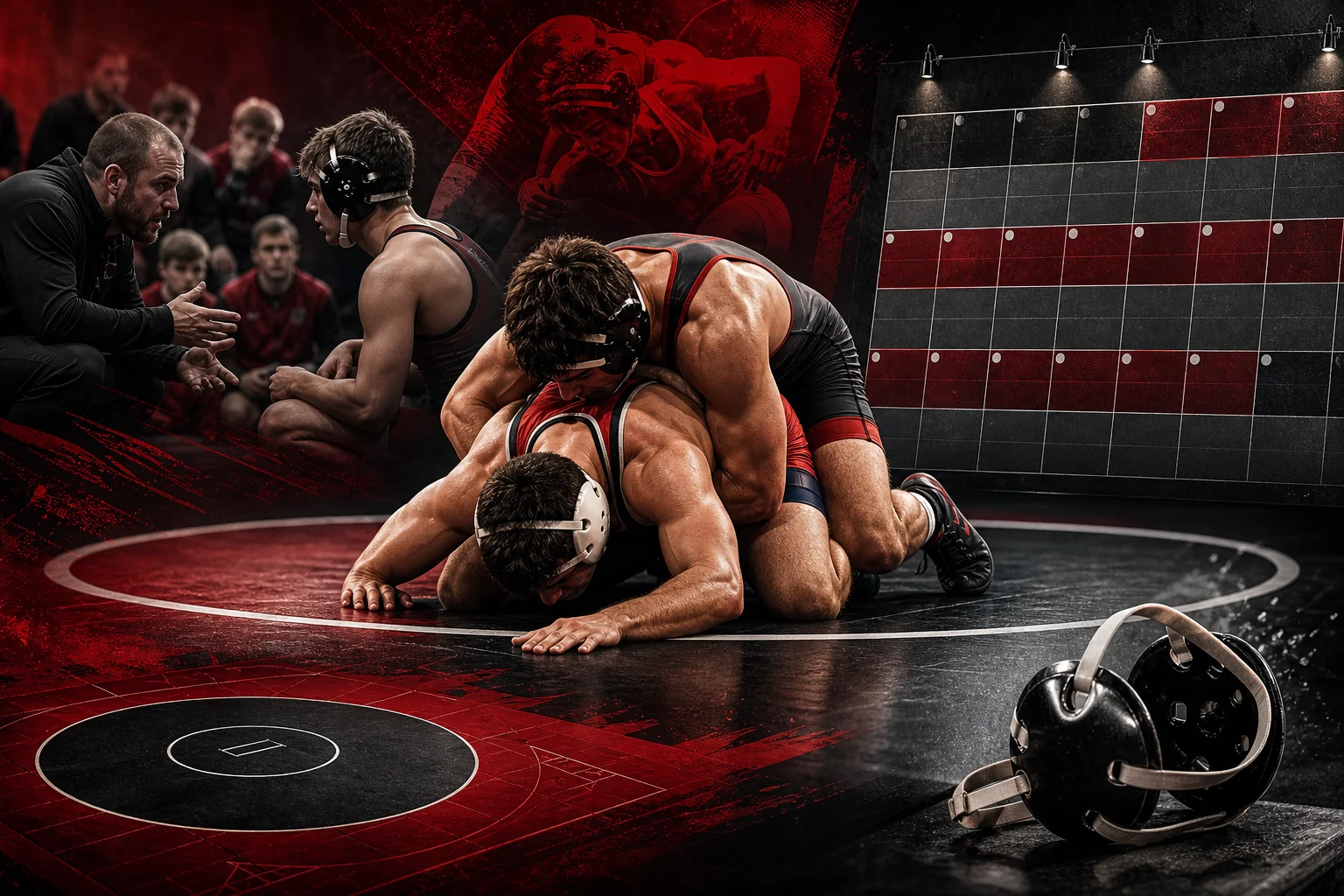
16-Week Wrestling Season Plan for 2025-26: A Tested Dual Meet Framework That Actually Builds to February
Why a 16-Week Plan Works for High School Wrestling
A high school wrestling season is short, demanding, and unforgiving. Coaches have to teach technique, build conditioning, manage weight responsibly, protect athlete health, prepare for dual meets, qualify wrestlers for the postseason, and keep the room moving through injuries, skin issues, academics, holidays, weather, and late-season fatigue.
That cannot be handled well by “practice hard every day and figure it out Friday.”
A 16-week season plan gives the staff a map from the first official practice through the postseason. It does not lock you into a rigid script. It gives you a structure for making better weekly decisions: when to install systems, when to compete, when to back off, when to sharpen, and when to peak.
For most high school programs, the season can be divided into five phases:
- Foundation phase — first practices, stance, motion, hand-fighting, mat returns, rules education, safe training habits.
- Build phase — increased intensity, early dual meets, identifying lineup needs.
- Competition phase — duals, tournaments, scouting, weight-class decisions, recovery management.
- Championship preparation phase — narrowing the focus, tactical match planning, controlled intensity.
- Postseason phase — tapering, confidence, weigh-in discipline, and clean execution.
This framework is designed for coaches, athletes, and officials working under NFHS rules for the 2025-26 season, with the reminder that state associations may adopt administrative policies, weight-management systems, contest limits, postseason formats, and girls weight classes that must be followed locally.
Core NFHS Planning Points Coaches Must Build Around
Before building a schedule, the staff should understand the rule structure that affects training, dual selection, lineup management, and athlete safety.
Weight Classes and Lineup Planning
NFHS boys weight classes currently used by many state associations are:
| Boys Weight Class | Pounds |
|---|---|
| 1 | 106 |
| 2 | 113 |
| 3 | 120 |
| 4 | 126 |
| 5 | 132 |
| 6 | 138 |
| 7 | 144 |
| 8 | 150 |
| 9 | 157 |
| 10 | 165 |
| 11 | 175 |
| 12 | 190 |
| 13 | 215 |
| 14 | 285 |
NFHS also provides girls wrestling weight classes, but state associations may vary in how they adopt girls divisions, dual formats, and postseason structures. Coaches should confirm the state-specific girls weight classes before building a dual meet lineup plan.
For dual strategy, remember that a wrestler generally may compete at the weight class for which they are eligible based on weigh-in and certification rules, or one weight class higher. A coach should never build a season plan around routinely moving athletes far outside their appropriate size range. That creates poor matchups and can increase injury risk.
Dual Meet Team Scoring
Dual meet planning must account for the scoring system:
| Result | Team Points |
|---|---|
| Fall | 6 |
| Forfeit | 6 |
| Default | 6 |
| Disqualification | 6 |
| Technical fall | 5 |
| Major decision | 4 |
| Decision | 3 |
This affects scheduling. A young team that gives up four forfeits starts many duals down 24 points before wrestling a live match. A veteran team with bonus-point threats may be better served by a stronger dual schedule, because pressure matches help prepare them for the postseason.
Match Scoring and Technical Development
NFHS folkstyle scoring includes:
- Takedown: 2 points
- Escape: 1 point
- Reversal: 2 points
- Near fall: 2, 3, or 4 points based on the count under current NFHS criteria
- Technical fall: 15-point advantage
- Penalty points: awarded as prescribed by rule
The near-fall scoring structure should shape practice. If a wrestler can turn opponents but cannot hold criteria, that wrestler is leaving team points on the mat. A 16-week plan should include pinning combinations, controlled mat returns, safe breakdowns, and finishing mechanics from November through February.
Weigh-Ins, Skin Checks, and Health Rules
Coaches should build routines around the rules rather than rushing to satisfy them on competition day.
Key principles:
- Wrestlers must pass the required weigh-in procedure for the event.
- Skin checks are part of safe competition administration.
- Communicable skin conditions require proper evaluation and documentation under NFHS and state procedures.
- Athletes may not use artificial or unsafe methods to make weight.
- State weight-management programs commonly include hydration assessment, body-composition standards, minimum weight certification, and a maximum weekly descent rate, often tied to the NFHS 1.5% per week standard.
- Minimum body fat standards commonly used in scholastic wrestling are 7% for boys and 12% for girls, unless a state-approved medical exception applies.
A responsible staff does not promote crash-cutting, dehydration, rubber suits, spitting, sauna use, or skipped meals as a competitive strategy. Those methods are dangerous and can violate rules. A sound plan teaches athletes to eat, hydrate, sleep, certify properly, and compete at a sustainable weight.
Match Limits and Recovery
NFHS rules set limits on the number of matches a wrestler may compete in during a day, and state associations may add more restrictive policies. Coaches should also account for required rest between matches and event administration procedures.
Even when an event is legal, that does not mean every athlete should wrestle the maximum possible load. A first-year 106-pounder, a returning state placer, and an athlete coming back from illness should not be treated the same.
The Big Scheduling Question: Dual Meets, Tournaments, or Both?
High school coaches often inherit a schedule. Some schools are locked into conference duals, holiday tournaments, county championships, rivalry nights, and league obligations. Still, most staffs have at least some freedom to choose duals, multi-duals, or weekend tournaments.
A strong 16-week plan uses each competition type for a clear purpose.
Dual Meets
Dual meets are ideal for:
- Building team identity
- Teaching lineup strategy
- Getting inexperienced wrestlers varsity mat time
- Creating school and community energy
- Testing bonus-point ability
- Practicing weigh-in and warm-up routines
- Preparing for team dual postseason formats, if your state has them
Duals are also easier for fans to follow than large tournaments. A well-run home dual with introductions, youth wrestlers in attendance, and a clear pace can help grow the program.
Individual Tournaments
Tournaments are ideal for:
- Getting multiple matches in one day or weekend
- Seeing different styles
- Testing recovery between rounds
- Building bracket discipline
- Preparing for individual postseason events
- Evaluating wrestlers against stronger regional opponents
The concern is fatigue. A heavy tournament schedule can wear down athletes by January, especially if weekday duals remain intense.
Multi-Duals
Multi-duals can be useful when:
- Your team needs live matches more than bracket placement
- You want predictable match counts
- You are building a young lineup
- You want to see several comparable teams in one day
- You need to prepare for dual meet scoring
The downside is that a wrestler may face uneven match quality. A state-level senior might receive two forfeits and one short match, while a first-year wrestler gets pinned three times. That is why event selection matters.
The 16-Week Season Framework
The following model assumes a typical high school season running from the first official practice through the postseason. Adjust dates based on your state calendar.
| Week | Phase | Primary Goal | Competition Target | Practice Emphasis |
|---|---|---|---|---|
| 1 | Foundation | Establish standards | None or controlled wrestle-offs only if allowed | Stance, motion, rules, safety |
| 2 | Foundation | Build baseline skills | Scrimmage if permitted | Hand-fighting, takedown finishes, escapes |
| 3 | Foundation/Build | First lineup picture | First dual or jamboree | Bottom survival, mat returns, conditioning |
| 4 | Build | Compete without overload | 1 dual or small tournament | Chain wrestling, short offense |
| 5 | Build | Identify weight and lineup needs | Dual + weekend event | Riding, turns, match strategy |
| 6 | Competition | Raise intensity | Conference duals | Finishing under pressure |
| 7 | Competition | Holiday management | Tournament or multi-dual | Recovery, position-specific drilling |
| 8 | Competition | Midseason assessment | Strong tournament or rivalry dual | Scouting adjustments |
| 9 | Competition | Restart after break | 1-2 duals | Neutral attacks, first points |
| 10 | Competition | Bonus-point growth | Dual-heavy week | Top pressure, near fall |
| 11 | Competition | Toughest controlled test | Premier dual/tournament | Situational wrestling |
| 12 | Championship Prep | Reduce volume slightly | Selective competition | Late-match execution |
| 13 | Championship Prep | Sharpen lineup | Final conference duals | Starts, edge wrestling, riding time habits if applicable to state format |
| 14 | Taper | Fresh legs, clean positions | Light dual or no event | Speed, confidence, short goes |
| 15 | Postseason | Qualify and advance | District/sectional | Tactical match plans |
| 16 | Postseason | Peak | Regional/state | Recovery, weight stability, mental readiness |
Weeks 1-2: Foundation Without Chaos
The first two weeks set the tone. The biggest mistake is trying to win December in the first ten practices. Athletes arrive at different fitness levels, and many are transitioning from football, cross country, soccer, or no fall sport.
Coaching Priorities
Start with:
- Stance and motion
- Head-hands-hips defense
- Safe mat returns
- Penetration step mechanics
- Sprawl and re-attack
- Stand-up and hand control
- Referee’s position
- Legal holds and potentially dangerous situations
- Skin hygiene and locker room expectations
- Weight-management education
Officials appreciate athletes who understand basic starting positions, out-of-bounds awareness, control, near-fall criteria, and potentially dangerous calls. Coaches should teach rules as part of wrestling, not as a separate lecture athletes ignore.
Practice Structure
Early practices should be organized but not reckless:
- Dynamic warm-up
- Stance-motion-hand fight block
- Technique instruction
- Partner drilling
- Short situational goes
- Conditioning through wrestling positions
- Cooldown and hygiene reminder
Avoid long, sloppy live goes before athletes have enough position discipline. Early injuries often come from tired athletes wrestling from poor positions.
Wrestle-Offs
If your school uses wrestle-offs, set rules early:
- Who is eligible?
- How much notice is required?
- Are wrestle-offs officiated?
- Can a coach override based on attendance, certification, injury, discipline, or matchup?
- How often can a spot be challenged?
Do not let wrestle-offs divide the room. A strong backup still has value in duals, tournaments, injury coverage, and practice quality.
Weeks 3-5: Build the First Lineup, Not the Final Lineup
By Week 3, most teams begin competing. This is not the time to panic over the first dual result. The goal is to learn.
What Coaches Should Track
Create a simple staff chart:
| Category | Questions to Answer |
|---|---|
| Weight class stability | Is the athlete certified and competing at a sustainable weight? |
| First-period performance | Does the wrestler start fast or give up early points? |
| Bottom position | Can the wrestler escape against varsity pressure? |
| Top position | Can the wrestler hold, turn, or at least return opponents safely? |
| Bonus points | Is the wrestler scoring falls, tech falls, or majors when available? |
| Penalties | Are stalling, locked hands, illegal holds, or unsportsmanlike issues recurring? |
| Conditioning | Is fatigue technical, physical, or weight-management related? |
Dual Meet Selection Strategy
Early duals should match your team’s developmental needs.
If you are rebuilding, schedule at least one dual where your athletes can compete in winnable matches. A team that only wrestles powerhouse opponents in December may become timid by January.
If you are experienced, schedule a stronger opponent early enough to expose weaknesses, but not so early that athletes are unprepared for the pace.
A balanced early schedule might include:
- One conference dual
- One local rival or comparable opponent
- One small individual tournament
- One weekend off or light event before a heavier stretch
Technical Themes
Weeks 3-5 should emphasize “first layer” scoring:
- Get to a leg
- Finish cleanly
- Get off bottom
- Return opponents safely
- Control wrists
- Build a pinning combination from a breakdown
- Wrestle through the edge without assuming a call
Athletes do not need ten takedowns. They need two attacks they can finish under pressure.
Weeks 6-8: Midseason Competition and Honest Evaluation
This is where the season can get messy. School breaks, holiday events, travel, family schedules, illness, skin checks, and weight changes all arrive at once.
A good staff stays calm and uses data.
Midseason Lineup Review
At the end of Week 8, hold a staff meeting and review:
- Which weights are stable?
- Where are we forfeiting?
- Which wrestlers are close to turning decisions into majors?
- Which wrestlers are giving up bonus points too easily?
- Who needs junior varsity matches?
- Who needs a rest week?
- Are any athletes showing signs of unsafe weight-management behavior?
- Are practice partners grouped correctly?
- Are captains helping or just being the best wrestlers?
Responsible Weight Management During Holidays
Holiday breaks can create two bad patterns: overeating followed by panic cutting, or constant under-fueling to “stay close.”
Neither is acceptable.
Coaches should teach athletes to:
- Eat regular meals
- Hydrate daily
- Monitor weight without obsessing
- Avoid large late-night meals before weigh-ins
- Pack appropriate food for tournaments
- Sleep enough during travel
- Communicate early if weight is trending in the wrong direction
A wrestler who is strong, hydrated, and alert is more prepared to compete than one who barely makes weight and fades after the first period.
Tournament Placement
Holiday tournaments should have a clear purpose. Ask:
- Are we chasing medals, matches, or experience?
- Is this event too difficult for our young lineup?
- Will our elite wrestlers see state-level opponents?
- Does the event create a recovery problem before conference duals?
- Are girls wrestlers getting appropriate bracket opportunities?
- Are junior varsity athletes getting enough matches elsewhere?
Not every athlete must attend every event. If state and school policies allow split scheduling, a varsity group can attend a premier event while newer wrestlers attend a developmental tournament.
Weeks 9-11: The Hardest Training Block
Weeks 9-11 are often the most important block of the regular season. Athletes are no longer new, but the postseason is still far enough away to improve conditioning and fix weaknesses.
Practice Intensity
This is the time for high-quality live wrestling, but it must be planned.
A sample Week 10 schedule:
| Day | Focus | Intensity |
|---|---|---|
| Monday | Correction from weekend, bottom escapes, short live | Medium |
| Tuesday | Hard neutral and top/bottom goes | High |
| Wednesday | Dual meet | Competition |
| Thursday | Recovery drill, film, position work | Low-medium |
| Friday | Tournament prep, short explosive goes | Medium |
| Saturday | Tournament or multi-dual | Competition |
| Sunday | Off | Recovery |
The mistake is making Monday, Tuesday, Thursday, and Friday all “hard days” around a Wednesday dual and Saturday tournament. That is not toughness; it is poor load management.
Dual Meet Strategy: Winning the Swing Matches
By midseason, the staff should identify swing matches. In dual scoring, a single result can shift the entire meet:
- Losing by decision instead of major saves 1 team point.
- Winning by major instead of decision adds 1 team point.
- Turning a tech fall into a fall adds 1 team point.
- Avoiding a fall saves 3 team points compared with a decision loss.
- Moving a wrestler up one class may create a better matchup, but only if legal, safe, and strategically sound.
Coaches should prepare athletes for score awareness without making them wrestle scared. A wrestler down 10-2 late must understand that fighting off the major matters. A wrestler up 12-5 must know that one more takedown and near-fall sequence may change the dual.
Officials and Match Management
Officials are part of the competition environment, not an obstacle to coach around. Teach athletes to wrestle through positions and respond respectfully.
Areas that often affect duals:
- Stalling calls
- Edge wrestling
- Locked hands
- Illegal holds
- Potentially dangerous situations
- Control on takedowns
- Near-fall counts
- Blood time, injury time, and recovery time procedures
- Coach misconduct and unsportsmanlike conduct
Coaches should model rule knowledge. If the staff constantly argues calls they misunderstand, athletes learn the wrong lesson.
Week 12: Begin the Shift Toward Championship Preparation
Week 12 is where smart teams begin reducing unnecessary volume. This does not mean soft practices. It means more purpose and fewer wasted reps.
What Changes
Reduce:
- Long conditioning after hard live wrestling
- Random extra matches
- Punishment sprints for technical errors
- Overly broad technique installation
- Heavy lifting that creates soreness near competition
Increase:
- Situational starts
- First 30 seconds of each period
- Short-time scoring
- Mat returns near the edge
- Bottom escapes against tough rides
- Specific opponent preparation
- Recovery monitoring
Technical Narrowing
Each wrestler should have a postseason identity:
- Best takedown
- Best secondary attack
- Go-to escape
- Best ride
- Best turn
- Favorite restart plan
- Short-time plan when leading
- Short-time plan when trailing
This is not the time to rebuild a wrestler from scratch. It is the time to make their best positions sharper and their worst positions survivable.
Week 13: Final Regular-Season Tests
Week 13 is often the last heavy competition week before postseason qualifying. The staff should choose events carefully.
When to Wrestle a Tough Final Dual
A tough final dual is useful if:
- Your lineup needs pressure
- Conference standings matter
- Rivalry energy helps the team
- The opponent exposes postseason-style matchups
- Athletes are healthy enough to benefit
When to Avoid an Extra Event
Skip or soften an event if:
- Multiple starters are injured or ill
- Skin issues are circulating
- Athletes are struggling academically
- Weight management is becoming unsafe
- The team has already had several high-match weekends in a row
- The event does not serve postseason goals
Coaches sometimes fear that rest will make wrestlers flat. In reality, many high school wrestlers underperform late because they are tired, sore, and mentally drained.
Week 14: Taper Without Going Flat
A taper is not a vacation. It is a planned reduction in volume while maintaining speed, timing, and confidence.
Taper Principles
Use shorter practices with high attention:
- Fast drilling
- Clean finishes
- Short live bursts
- Starts and restarts
- Shot defense
- Bottom escape chains
- Controlled top turns
- Short-time situations
- Warm-up rehearsal
- Mental preparation
Avoid:
- Marathon live sessions
- Conditioning tests
- New technique overload
- Public weigh-in pressure
- Last-minute lineup drama
- Emotional speeches every day
Sample Taper Practice
A 75-minute taper practice might look like this:
- 10 minutes: dynamic warm-up and stance motion
- 10 minutes: hand fight to first attack
- 12 minutes: takedown finishes from best attacks
- 10 minutes: bottom escape chain
- 10 minutes: top ride to turn sequence
- 12 minutes: situational live, 20-40 second goes
- 6 minutes: short-time scenarios
- 5 minutes: cooldown, announcements, hydration reminder
The room should feel sharp when athletes leave, not exhausted.
Weeks 15-16: Postseason Execution
The postseason is about advancing. Style points matter only when they support winning and bonus points for team scoring formats.
District or Sectional Week
The first postseason event often creates the most pressure because the season can end quickly. Coaches should keep routines familiar.
Checklist:
- Confirm weigh-in time and location
- Confirm grooming, uniform, and equipment compliance
- Confirm skin documentation if needed
- Review bracket procedures
- Pack food and fluids
- Assign coaches to mats
- Prepare for blood/injury situations
- Review opponent tendencies
- Keep warm-ups consistent
- Communicate calmly with athletes and parents
State Qualifying Strategy
In qualifying tournaments, the bracket changes decision-making.
A wrestler may need to:
- Protect a lead more carefully
- Chase bonus if team points matter
- Avoid a dangerous throw when ahead
- Choose neutral if bottom has been a problem
- Ride out a period instead of forcing a turn
- Manage emotions after a controversial sequence
Coaches should discuss these situations before the tournament. During the match, instruction must be short and clear.
State Tournament Week
For state qualifiers, the plan becomes individualized.
Each athlete should know:
- Weight plan
- Sleep plan
- Warm-up routine
- First opponent profile
- Best scoring positions
- Risk positions to avoid
- Recovery routine between matches
- How to reset after a win
- How to reset after a loss
The biggest enemy at the state tournament is often emotional overload. Keep the athlete’s world small: next meal, next warm-up, next match, next position.
Building the Dual Meet Schedule
A 16-week framework only works if the competition schedule matches the team’s stage of development.
Step 1: Define the Team Profile
Before scheduling, classify your team:
| Team Type | Scheduling Priority |
|---|---|
| Young/rebuilding | More comparable duals, JV matches, controlled tournaments |
| Balanced varsity | Mix of conference duals, competitive tournaments, rivalry events |
| State-contending dual team | Strong dual schedule, bonus-point focus, lineup flexibility |
| Individual-title focused | High-level tournaments, targeted duals, recovery protection |
| Small roster | Avoid excessive duals with many forfeits; seek bracketed match opportunities |
| Growing girls program | Find quality girls brackets, dual opportunities, and state-aligned weights |
Step 2: Count High-Stress Events
A high-stress event is not only a difficult tournament. It can be:
- A rivalry dual
- A conference championship
- A two-day tournament
- A long travel event
- A multi-dual with many matches
- A senior night dual
- A state-ranked opponent
Try not to stack too many high-stress events without recovery. Teenagers are not professional athletes. They have school, family obligations, and developing bodies.
Step 3: Protect Recovery Weeks
Every schedule should include lighter weeks. These are not wasted.
A lighter week can be used for:
- Technique repair
- Injury care
- Academic catch-up
- Junior varsity development
- Strength maintenance
- Film review
- Weight stabilization
- Team culture
If the schedule is already fixed, create lighter practices around heavy events.
Step 4: Use Home Duals Strategically
Home duals can grow the program if planned well:
- Start on time
- Use a clear announcer
- Recognize youth wrestlers
- Keep introductions efficient
- Educate fans on scoring
- Run the table professionally
- Respect officials
- Promote girls matches if your program includes them
- Keep the event moving
A chaotic home dual hurts the sport. A sharp home dual makes wrestling easier to understand and more exciting.
Periodization for Wrestling: What to Train and When
Wrestling periodization should not be copied from track, football, or weightlifting. Wrestling requires repeated explosive efforts, grip endurance, position strength, mat awareness, and tactical decision-making under fatigue.
Early Season
Focus on:
- General conditioning
- Movement quality
- Stance endurance
- Safe falling and scrambling limits
- Basic strength maintenance
- Technical volume
Midseason
Focus on:
- Match conditioning
- Hard situational wrestling
- Chain attacks
- Top-bottom pressure
- Recovery habits
- Competition scouting
Late Season
Focus on:
- Speed
- Precision
- Confidence
- Short live bursts
- Tactical clarity
- Freshness
Strength Training
Strength work should support wrestling, not compete with it.
Early season:
- Moderate loads
- Movement quality
- Pulling strength
- Squat and hinge patterns
- Core stability
- Neck and shoulder care
Midseason:
- Lower volume
- Power maintenance
- Grip work in small doses
- Injury prevention
Late season:
- Short sessions
- Low soreness
- Explosive intent
- Mobility and activation
Avoid adding a new heavy lifting program in January. That is a common way to make athletes sore at the wrong time.
Athlete Health: The Non-Negotiables
A season plan is only successful if athletes stay healthy enough to train and compete.
Skin Health
Daily habits matter:
- Shower after practice
- Wash workout gear
- Clean mats properly
- Do not share towels
- Report skin concerns early
- Follow medical clearance rules
- Do not hide suspicious lesions
Coaches should create a culture where reporting skin issues is responsible, not shameful.
Concussions and Injuries
NFHS rules and state laws require proper removal and return-to-play procedures for suspected concussions. Coaches are not medical providers. If an athlete shows signs of concussion, the athlete must be handled according to state policy and medical guidance.
For other injuries, avoid the “tough it out” trap. Wrestling requires contact, torque, and rapid reactions. A minor issue can become a major issue if ignored for three weeks.
Nutrition and Hydration
A responsible nutrition message is simple:
- Eat enough to train
- Hydrate consistently
- Fuel before and after practice
- Avoid unsafe cutting
- Communicate with coaches and parents
- Use qualified medical or nutrition professionals when needed
The goal is not to see who can suffer the most. The goal is to compete well at a certified, sustainable weight.
Practical Weekly Planning Template
Each Sunday or Monday, the staff should answer these questions:
- What are the competitions this week?
- Which athletes need hard live wrestling?
- Which athletes need recovery?
- What rule or situation hurt us last week?
- What two technical areas matter most this week?
- Who is at risk academically, physically, or mentally?
- What lineup decisions must be made?
- What parent or administrative communication is needed?
- What is the weigh-in plan?
- What does success look like this week?
Then write the week in simple terms.
Example:
| Day | Plan |
|---|---|
| Monday | Film, correction, medium live bottom |
| Tuesday | Hard neutral, dual lineup prep |
| Wednesday | Conference dual |
| Thursday | Recovery drill, top turns, short lift |
| Friday | Tournament prep, short goes |
| Saturday | Individual tournament |
| Sunday | Off |
A written plan keeps the staff aligned and helps athletes trust the process.
Common Season Planning Mistakes
Mistake 1: Too Many Hard Days
Wrestlers need hard wrestling. They do not need every practice to become a survival test. Quality drops when fatigue becomes the main coach.
Mistake 2: No JV Development Plan
If junior varsity wrestlers only get used as practice bodies, the program will shrink. Build JV events into the schedule. Celebrate improvement.
Mistake 3: Treating Every Weight Class the Same
Some weights are deep. Some are thin. Some athletes are growing. Some are managing descent plans. Some are better suited up one weight. Manage people, not just slots.
Mistake 4: Installing Too Much Technique Late
Late January is not the time for a new system every day. Sharpen what works.
Mistake 5: Ignoring Officials Until There Is a Problem
Invite officials to preseason rules sessions when possible. Teach athletes legal positions. Review common calls. A rule-smart team gives away fewer points.
Mistake 6: Making Weight the Center of the Program
Weight matters in wrestling, but it should not dominate the culture. Programs built on fear of the scale usually break down. Programs built on preparation, accountability, and health last longer.
Final Coaching Checklist for a 16-Week Season
Use this checklist before the season starts:
- Confirm state association calendar
- Confirm NFHS/state rule changes for 2025-26
- Confirm boys and girls weight classes used by your state
- Confirm weight-management certification procedures
- Confirm match limits and event limits
- Confirm postseason qualification format
- Build a 16-week practice and competition map
- Identify high-stress events
- Schedule recovery weeks
- Plan JV and girls competition opportunities
- Create wrestle-off policy
- Create skin health routine
- Create parent communication plan
- Create dual meet lineup board
- Teach team scoring
- Teach basic officiating signals and match procedures
- Plan taper before postseason
The best season plans are clear enough to guide decisions and flexible enough to survive reality. Injuries happen. Snow cancels events. A freshman improves faster than expected. A senior needs rest. A lineup hole appears. The 16-week framework helps coaches adjust without losing the season’s direction.
Build the plan, teach the rules, protect athlete health, and make every dual meet serve a purpose.
For more practice planning, lineup organization, and coach playbook support, use WrestleFlow Teams to organize drills, build weekly plans, and keep your staff aligned from the first practice through the postseason.